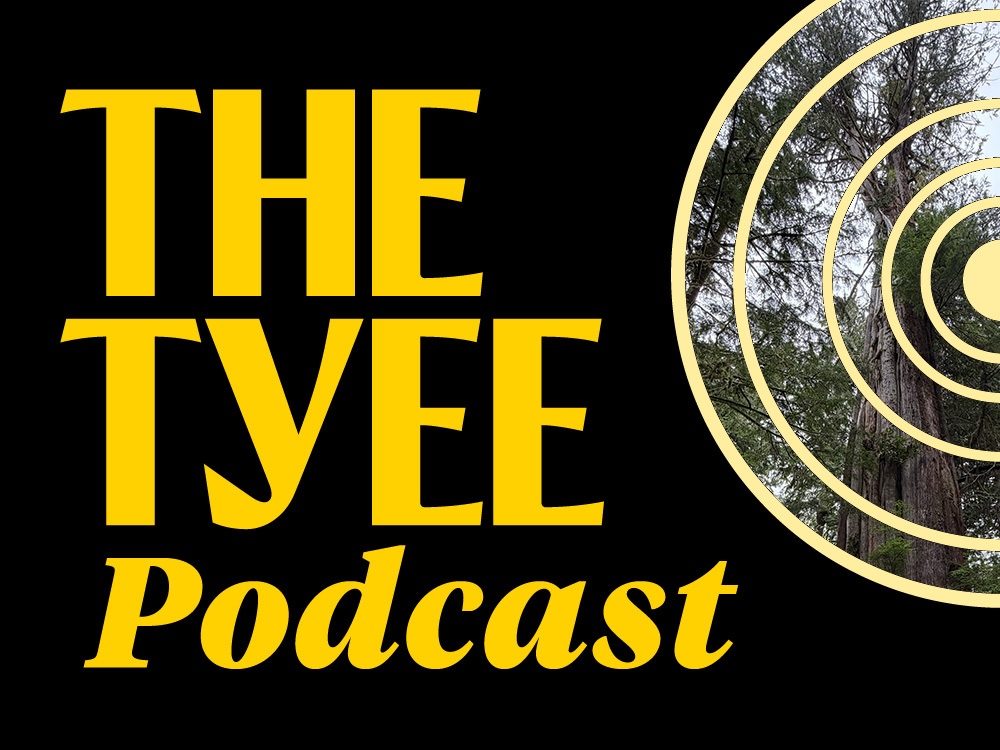
Who’s protecting your favourite tree? Possibly nobody, says author and journalist J.B. MacKinnon.
Vancouverites have a special relationship with trees, and for good reason. The city is lush with old, beloved trees. They line our streets, root in our parks and crowd the mountains to the north. And while climate change and densification strain the urban forest, there isn’t a concerted effort to protect our leafy neighbours.
“My favourite tree is in the Broadway corridor,” MacKinnon said. “I’m in the Broadway corridor too, clinging to life there, like so many tenants. And the tree tenants are at least as endangered as we are.”
MacKinnon has reported for The Tyee for two decades and in these pages co-authored a series called The 100-Mile Diet.
This week, he explains how beloved trees end up on the chopping block — and what you can do about it.
Note: Episode transcripts may contain errors. Always check the corresponding audio before quoting any part of the transcript.
Harrison Mooney:
I want you to take a moment and picture your favourite tree.
Imagine yourself standing there underneath its branches. What do you see? What do you hear? Smell? Are there birds in the tree? Ants at your feet? How long has the tree been there, and how long does it have left?
This is the Tyee Podcast. I’m your host, Harrison Mooney. Every episode, we dive deeper into the stories shaping the West Coast, because Canada needs more BC. This week: a Tyee stalwart.
J.B. MacKinnon is an author and journalist based in Vancouver. He’s been contributing to the Tyee for more than two decades. And within our web pages, McKinnon co-authored a series called The 100 Mile Diet, an experiment in eating from local food systems. Maybe you’ve heard of it. Today, he joins us for a tour of Vancouver’s oldest trees. We’ll explore why we need them, why we love them, and why we keep cutting them down. Stay with us.
Harrison Mooney:
Do you feel pressure to eat local now that you’re the 100 Mile Diet guy, or can you still get Froot Loops from Safeway?
J.B. MacKinnon:
These days, it was so long ago that that book came out that it’s not as big a deal. But at the time the book came out, and especially when they did the TV show out in Mission, we would get caught out if we went to a sushi restaurant, and we’d inevitably have people going, like, “gotcha!”
Harrison Mooney:
Yeah, I’d be stressed about that. Just being discovered eating something somewhere else.
J.B. MacKinnon:
It gives me an appreciation for how David Suzuki must feel about everything. He can’t drive, he should basically be walking around with no clothes on.
Harrison Mooney:
If he ever steps on like a bug, someone’s gonna be like, “How dare you, David Suzuki.”
J.B. MacKinnon:
I heard people talking about he flies in a float plane, and he, you know, drives, and blah blah blah, and it’s just, you know, yeah, he could never win.
Harrison Mooney:
You still need to get around. We’re actually here today to talk about trees. J.B., are you familiar with the infamous seawall tree poisonings of 2004?
J.B. MacKinnon:
I’m not.
Harrison Mooney:
Okay, can I tell? Can I tell you a story?
J.B. MacKinnon:
Yea, fill me in.
Harrison Mooney:
Okay. So, it was this very wealthy local interior designer who lived in the West End, and she actually just passe. I’m not even going to tell you how I know that. And there were these big trees that were impeding the view from her condo, and she couldn’t cut them down. So, she and a friend went to Washington, and they got this special herbicide, and then they like drilled holes in the trees, and then like injected them with the herbicide. And somehow her friend turned on her and told the police that they had done this. So she got like a court summons, and she goes to court to like pay her fine or answer for her crimes, and there are all these people outside like shouting at her and throwing stuff at her. It was a true angry mob. So she winds up having to pay like $50,000 in restitution, but also she has to move because people start throwing like dog crap on her balcony and trash, and just coming by her place, and like shouting stuff at her. It was really bad, and I think I heard that story and implicitly understood that Vancouverites have a very special relationship to trees.
J.B. MacKinnon:
Yeah. I think that’s true. I think people, human beings have a very special relationship with trees, and it’s maybe more alive in Vancouver than it is in other places. Because we have trees and because so many of us spend time in the natural world. This is a city that’s deeply connected to its mountains and its forests and its ocean, and people come back from those adventures connected in a way that they can’t be in some other cities. So people here are in touch with their trees. I mean, one of the things I noticed reporting this story was I just started asking people, hey, you got a favourite tree? I don’t think I talked to anybody who didn’t have a favourite tree, or at least a few trees that they knew of and thought about and cared about.
Harrison Mooney:
And do you have a favourite tree?
J.B. MacKinnon:
I do have a favourite tree. Would you like to hear about it?
Harrison Mooney:
I’d like to hear about it. And I since you’re a very successful writer, I want you to really just take me there with your words.
J.B. MacKinnon:
Alright. Well, this tree, this tree is in an alley, that’s kind of the key aspect of it. I can give you that, the exact coordinates, it’s right off of Laurel Street in an alley between Eighth and Seventh. I actually first saw this tree from Granville Island. I was sitting down on Granville Island, looking up at Fairview Slopes, and I saw a tree that wasn’t in line with all the other trees. It just seemed to be in the middle of the buildings,
Harrison Mooney:
Just a special tree.
J.B. MacKinnon:
A special tree
Harrison Mooney:
Calling to you.
J.B. MacKinnon:
So I went looking for it, and here it was in this alley. You know how in Fairview slopes, the developments are all kind of stepped down the slope? So on the one side of it, it has sort of two stories of one building and four stories of the building above it, and it rises above both of those. it’s a Douglas fir, and probably because of where it is, it’s almost like it’s living on the edge of a cliff, so it has that kind of look that Douglas firs get when they grow on a, on a seashore crag, where the limbs are kind of spare, there’s it has a, it has like it looks like a giant bonsai. It’s right in the middle of the alley. The asphalt comes right up to it, and there’s always, for some reason, an orange traffic cone, just to alert people to the fact that there’s a huge Douglas fir. Watch out, right in the middle of the alley.
Harrison Mooney:
I bet that cone is doing some real heavy lifting.
J.B. MacKinnon:
Yeah, I mean, I’m sure the thing’s been dinged a dozen times, many times. I’ve always wondered about it. Like, I just… I just wonder, how… how did this happen? How did you end up with this big Douglas fir in the middle of an alley that’s never been cut down, despite the fact that all this development occurred around it? So, it’s my favourite tree. It’s a survivor.
Harrison Mooney:
Yeah. You did a lot of research for, for Grandpapa, the tree in your most recent story, and we’ll get to that. But I’m wondering if you used your, your research skills at all to find out about your special Douglas fir.
J.B. MacKinnon:
I haven’t. I put it on my tree tour. There’s a tree tour that was published by The Tyee of some of not only my favourite trees, but trees that were pointed out to me by other people. I put it on the tree tour, and I put a call out on my write-up for that tree. I’m hoping somebody knows the story of it. I’ve always thought it, you know, even if I just fictionalize it, it would be a great children’s book, you know. How, this, how this tree came to be standing with asphalt right up to the trunk, you know, surviving through all of the development that must have occurred around it.
Harrison Mooney:
I’m kind of imagining the tree just saying no when, you know, the people came to cut it down, and you’re like, well, I can’t, because the tree said I can’t.
J.B. MacKinnon:
Yeah, when the people came, and then the people came again, and then the people came again. Yeah, because I mean, it has obviously been there a long time.
Harrison Mooney:
J.B., what matters to you the most about any tree? I understand that I’m sounding like I’m trying to set you up with a tree here, but what do you look for in a tree?
J.B. MacKinnon:
It can be a number of different things, I think, for me, but I think age is a big part of it. In trees, for their appeal, as trees get older, they start to-
Harrison Mooney:
You’re looking for a mature tree.
J.B. MacKinnon:
I’m looking for a mature tree, yeah, an age-appropriate tree for me.
Harrison Mooney:
That’s good.
J.B. MacKinnon:
They, I mean, old trees are just… they just have that beautiful wabi-sabi quality, you know. They’re, they’re… they have kind of… they start to spread out their limbs, they become kind of more welcoming looking, in a way. I think, in a way, the period in a tree’s life, when they most resemble human beings, is when trees are old, and when humans are old. Yeah, we seem to somehow start to resemble one another. And whenever you see a tree in a film that talks, it’s always an old tree. We make that connection to the way they, they look as they become crevassed and wrinkled, and a little exhausted looking, but, but wise.
Harrison Mooney:
Yeah, they do get like a character eventually, and you can start to see the faces in them. And okay, so I hate to rhetorically threaten your, your tree here, but after Grandpapa, it’s clear that no tree is safe. What would you say is the biggest threat to your favourite tree nowadays?
J.B. MacKinnon:
My favourite tree, I think there’s two, probably two main threats. One would be climate change, which is a big threat to Vancouver’s biggest, oldest trees. A lot of trees, like Western Red Cedars and Douglas Firs, have established, especially cedars, I think, have established themselves in pretty thin soils, kind of not great real estate for trees. They’ve been able to survive in those kinds of places because real. Vancouver just gets so much rain, but that rain pattern has changed. They’re getting a lot less rain than they used to, and so a lot of trees, and you know, people will have noticed that cedars are dying around the city, and that’s why, is because the they’re not getting the rain that they used to get that could support them in these difficult environments that they managed to thrive in in the past, so that that’s certainly a threat to this tree. I don’t even know how it’s getting enough water now. You know, like I said, the asphalt comes right up to the trunk, so the water must just kind of get in around that that collar of asphalt somehow. So I do worry about the tree at that level, but also one of the main reasons that trees get chopped down in Vancouver, particularly as they get older, is as hazards. There’s this desire to protect people and their property and their cars from a tree that falls down or a limb that breaks off a tree, and this one could easily be cut down for that. I mean, it’s already, it’s, you know, it’s sitting in the middle of an alley with cars driving under it all the time. It would be pretty easy to see how it could get caught under that, that hazard tree umbrella and be removed.
Harrison Mooney:
But trees aren’t just fun characters in your neighbourhood. When we come back, J.B. explains the vital role trees have in our city, and why still they could soon face the ax. Stay with us.
I do think people need to understand that Vancouverites, like our trees matter a lot, and other people will come here, and they’ll see we have a lot of trees, but the discourse here is that, does Vancouver have enough trees? You know, like, we still, we have them all, but it seems pretty clear that we should have more. So that’s my question to you: Does Vancouver have enough trees? Should there be more?
J.B. MacKinnon:
There should be more. Yeah, I mean, I think cities should be doing all they can to build their urban forests, their urban canopies. Lots of cities are setting targets to do that, and they, they’re doing it because trees serve a whole bunch of, you know, environmental services, as they say, ecological services in a city, they, they shade the streets, which is becoming more important as cities get hotter. They store carbon, they remove carbon from the atmosphere, they clean the air, and people love them. People love to have trees around. So we do want to have more of them. But more importantly, I mean, I think the really important thing is we want to keep them, you know, and I, we want to let them get old. That’s where the problems really are. We can squeeze trees in to every nook and cranny in an effort to build a larger urban forest, but what’s changing in a really negative way is just the removal of trees, I think, is by all accounts of people who pay attention to trees in Vancouver, we’re losing more and more of them, and we’re getting rid of the big old ones that are really the trees that people love the most and that play the biggest role in things like carbon storage and as homes for all the things that aren’t humans that live in the city.
Harrison Mooney:
How would you say these trees also serve the non-human residents in this city?
J.B. MacKinnon:
Well, they are the skyscrapers in which the non-human residents live, really. And I think one of the ironies about this story is realizing that the skyscrapers of the natural world are being cut down in many cases to make way for the skyscrapers of the human world, which are a lot more barren generally. So skyscrapers of the human world are built for one species and one species alone, but a big old tree could have hundreds of species living on it, and in many cases it’s the biggest, oldest trees that have not only the largest number of species associated with them, but also the greatest diversity of species, so not only the largest number of things, but the greatest diversity of things that depend on them, and they’re like little – the biggest, oldest trees are like little islands of respite for non-human life, you know. Raccoons live up in them, if there’s big cavities in them, then then an owl might be living in there. Bats are in the bark, tree frogs are in the bark, you’ve got these beautiful licorice fern gardens that you see sprouting out of the trees in Vancouver in the spring, and then just countless, countless bugs and spiders and moths, and you know they, they’re just so critically important to so many species that, in my mind, you know, we talked about rewilding cities. If you let a tree get old, you’re rewilding your city, and if you remove a big old tree, you are making it less wild. You know, it’s as simple as that.
Harrison Mooney:
Yeah, it was fun researching for this conversation, you know, as I do for all human-to-human conversations. I do deep research and just learning, you know, how beneficial trees are for your health, right? I mean, there’s this growing body of research showing time among trees improves, you know, I mean, blood pressure, and it helps with depression and anxiety. And there was one study that has linked children who live near green spaces with improved school performance and reduced symptoms of ADHD, which you know I have that, so that one matters to me. But I don’t think you need to have ADHD to notice that just being in nature, and you know, being around these old trees makes you feel better. Do you?
J.B. MacKinnon:
Yeah, I mean, I think you do. And my favourite take on this is this old biologist E.O. Wilson, who said, “to understand what humans desire, it’s helpful to start with the rich.”
Because the rich have the ability to shape their world and shape the places they live in a way that those of us with fewer resources cannot, and you know, you go, you, anyone who’s flown into Vancouver, has seen this. As you approach Vancouver, as you look down, you can pick out the wealthier and less wealthy neighbourhoods by the number of trees and the size of the trees. There, we recognize instinctively, intuitively, that having trees around us is beneficial, beneficial for our psychology, for the air we breathe, beneficial for the shade they cast, beneficial in, you know, a dozen different ways.
Harrison Mooney:
It’s clear that it’s also a matter of survival, right? I mean, after the 2021 heat dome, we got those reports that some of these deaths, you know, these over 600 deaths could have been prevented with more tree cover, you know, and a disproportionate number of deaths occurred in hotter neighbourhoods that lacked greenness. I mean, trees provide shade, but they also cool the environment due to my new favourite word, evapotranspiration. Do you know this word?
J.B. MacKinnon:
Evapotranspiration? Yeah, it’s the capacity for evaporation to create cooling, right?
Harrison Mooney:
Yeah. I mean, I kind of imagine that it works the same way as like when you freeze a jug of water and then you put it in front of a fan on a really hot day, and you know it does something. I do love your articles, recent emphasis on old trees, you know, I think that when we talk about trees in Vancouver, yeah, like it’s the canopy and it’s the tree cover, but you’re really drilling down to like the character of these trees, and you know, the trees that are our friends and the trees that we name. I do think that there’s a real value to that. Do you feel like a flake, though, when you’re talking about, you know, character trees in this way?
J.B. MacKinnon:
Yeah, I mean, I think there’s a flaky… it wouldn’t be hard to be to be pigeonholed as a flake, but at the same time, I think anybody who sat down and talked it through for a little while, would recognize that there’s all kinds of different ways that trees can be really important to individual people and to whole communities, and, and most people, as I said, like most people, when I talk to them, they do have favourite trees, it might be in their yard, it might be on their block, but there’s trees that they know in their world that they would not like to see removed, and certainly we see that every time one of those trees gets selected for removal or is suddenly removed without notice, and I think like that it could be just the shape of the tree appeals to the eye, but one of the more interesting experiments that I saw around this was in Melbourne, where they, they put up a map of all of the city’s public trees, so the trees in the parks and on the streets. Vancouver has a map just like this, but what Melbourne did was put up an email address for each tree, right, so you could, you could write in, and the idea was you’d write in and say, you know, this damn tree is dropping limbs all over my lawn, can you come and clean it up, but what happened was people started writing letters to the trees.
Harrison Mooney:
Just like letters to Santa Claus.
J.B. MacKinnon:
Just like letters to Santa Claus, yeah, writing to the trees, and they, you know, they were talking about the trees as, as presences that were comforting, some of them talked to trees, some of them found solace in trees in their hardest times. You know, people, people connect to trees, they’re great listeners.
Harrison Mooney:
They are great listeners. They’re also wonderful babysitters. I have, I have kids that are six and seven, and you know, you’ll go to a park, and they’ll find a tree that they can climb, you know, and some of these trees they can climb safely, and then you can just take your eyes off of them for like an hour. And they’ll just go up the tree, and like I always feel like I should thank the tree after, like that was free childcare that you gave me, you know, and then name the tree, and come back later, like, hey, should we go visit our friend this one tree, but you know, trees do have that kind of personality. I used to live in the West End, like, right on the edge of Stanley Park, and, like, I was on, like, the 10th floor, and I had this balcony that overlooked the water, and it was amazing. And so this one day, I’m sitting on this balcony, and I hear this, like, great groaning, you know, like a monster is waking up under the ground, and then I hear like the cracking of branches and the rumbling of pavement, and then this huge crash, and you know, one of the massive catalpa trees on Nelson Street had just come down. It smashed through a window of an apartment across the street, tore up the sidewalk, crushed a car, total disaster. So I ran down with my camera to take some pictures, and you know, just kind of like be there, and I wound up meeting all of my neighbours, and it was funny, because you know, this tree did a lot of property damage, but it was remarkable how little we cared about that, like we were just, we’d all just lost a friend, you know, this tree that was, that was there. And I hadn’t really thought much about that, like the way that people talked about this tree, and the stories, you know, they’d be like, “Oh, like one time I drank too much at the Bae Side, and I, and I fell asleep under this tree, or, you know, like just stories like that, and everybody had one, like I watched an owl make a nest in this tree.
I hadn’t really thought about that too much until I read your recent Tyee essay, They Cut Down Grandpapa, and it was that same kind of vibe, like just no, this tree was a community member, and you kind of given us like a eulogy for one incredible old tree. So, can you tell me a little bit about that? Like, why did that one go? What happened with Grandpapa?
J.B. MacKinnon:
The Grandpapa was, I mean, I think when it comes right down to it, the reason the Grandpapa was removed was because the entity that removed it, which was the Park Board, wasn’t aware that it was so highly valued by a community of people, and, and I wasn’t either. I mean, I liked the tree, and I knew that it was a popular tree. I went up and hung out under the Grandpapa, which was a cherry tree, and you know, really resplendent in the spring, just a magical tree covered with the palest pink blossoms. And it was the tree that launched the Vancouver cherry blossom festival. It turned out, you know, I didn’t know any of this. I just started looking into, hey, why did they cut down this, this tree that I liked a lot? Maybe there’s something in that we can learn about trees in Vancouver and our relationship with them. But yeah, it turns out that it was the tree that launched the Vancouver Cherry Blossom Festival. And then, as I dug deeper and deeper, learned that it was also a gift to the city from the Japanese community, just a just ahead of the period in B.C.’s history where, where the Japanese community was removed from the coast and sent to the Interior. So it had all of this, you know, all of this story behind it, all of this community connection behind it, all of these people who loved it very, very much, and, and somehow you know that was missed by the Park Board to such an extent that they cut it down without notice. And the reason they cut it down is straightforward enough. It was old, it was getting sick, and they were worried that it was that it was a hazard to life and limb, and again, that’s, you know, right now one of the biggest threats, and as you said earlier about your catalpa, there’s this question in my mind coming out of this story around, are people up for having conversations about how much risk they’re prepared to take around particular trees in their neighbourhoods? Maybe we would find that people would say, okay, well, let’s take some precautions and put up some barrier fencing or something, and let this thing live out its whole life, and let its limbs fall off, and let it tip halfway over, and we just want the tree to live, you know, all the way through, and maybe even beyond death, because trees often stand in decay for longer, a longer period of time than they were ever alive, and these are things that, you know, I think we’re just beginning to have conversations around, but I think we should, and Vancouver is a great place to have that conversation.
Harrison Mooney:
Yeah, I do love that. In addition to saying that this very treed area needs more trees, we are also saying that we need to care more about trees. You know, one of my major takeaways with that piece was that, you know, the city didn’t really do anything to honour this fallen tree that, you know, people. Knew and loved and had named, you know, and it seems like as we consider the value that trees have to communities, in terms of cooling, in terms of shade, you know, the mental health benefits, the way that it points out social inequalities, you know, the fact that these, these trees are community members, it does seem like a real oversight not to take a moment to honor Grandpapa, and you know, really kind of further foster this, this love of trees and this connection with trees. You know, I love that that idea of like having an email address, so that you can, you can send messages to these trees, because you know, we do have an app that, that has already mapped all of these trees, right? The Vancouver Trees app is awesome, but it has always struck me that it could be way more interactive.
J.B. MacKinnon:
Yeah, I agree.
Harrison Mooney:
Have you, do you use that app?
J.B. MacKinnon:
I do. I love the app. I’ve used it to find, I’ve used it to forage in the city, even, you know, I’ve drawn food from that app. But the, yeah, I mean, it’s great to have the app. It’s a wonderful resource for people who are curious about trees in their neighbourhood, but as you say, it could be so much more interactive, like it could be the point through which people express to the Park Board and the City of Vancouver, which trees are important to them, which trees are important to their neighbourhoods and communities, and that would do two things. It might make all of us more interested in those trees. I might go out to see what other, what were the favourite trees, the landmark trees in other neighbourhoods, but most importantly, it might offer them some kind of protection, and in Vancouver, you know, there’s never really been any particular organization that is focused on protecting, you know, treasured trees in the community. The Vancouver, the Heritage Vancouver, used to do some of that, but I mean they’re, they’re overwhelmed just with their, their remit as the protector of our built heritage, and the Park Board, again, I’m not one of these people who, who thinks that the Park Board is full of people who, who have a profound dislike for trees, you know. I think that people who, who, who sign up to be arborists for the Park Board tend to be people who love trees, but —
Harrison Mooney:
They didn’t sign up to kill trees.
J.B. MacKinnon:
They didn’t sign up to kill trees. Yeah, fair, but they… I mean, you’d be surprised how many people think that that is that I’m wrong about that, but-
Harrison Mooney:
Just like my father was killed by a tree, and I’ve sworn that I will seek revenge.
J.B. MacKinnon:
Exactly, it’s yeah, there’s almost a conspiracy theory type attitude towards the Park Board arborists at some level, and I have a lot of sympathy for them for that, because I do think that they love trees, but they’re under pressure to keep people safe from marauding trees, and they also have to, you know, they live in a city with a strong push towards development.
Harrison Mooney:
Yes.
J.B. MacKinnon:
And of course it’s hard to, it’s hard to densify a city without removing trees, so they, they have a tough, you know, a tough thing, but one thing I think the park could do, Park Board could do through that website is turn it into an avenue for people to mark out their treasure trees, and you know, I think that would be a real opportunity for the Park Board to wear a white hat, a 100 per cent white hat on this particular issue, and that would be that’d be a great step forward.
Harrison Mooney:
Yeah, let people bond with the trees in their community.
J.B. MacKinnon:
Yeah.
Harrison Mooney:
I did pull out some, some like tree data, but I found it was kind of conflicting because there was one report that said, you know, that that the tree canopy cover had reduced from —
J.B. MacKinnon:
That’s from Metro Vancouver. Yeah, right, Metro Vancouver, it has shrunk the canopy, the urban canopy has been shrinking in Vancouver city proper, it has at the last count been increasing somewhat through the planting of trees, so you could argue that the canopy is growing, but what the canopy, what the measurement of the canopy misses is the size and age of individual trees, right? So you can, you can increase your urban canopy by filling your city with tiny trees, you can put them on tops of buildings, you can put them in all kinds of places where they’re never going to grow to be grand old trees, and I think what we’re the more critical measure is, are we gaining like…
Are trees aging up to become great old trees? Or are we losing them? And there’s no absolute data on this, but from all of the sort of city foresters, and you know, tree-loving people of the city that I spoke to were losing the big old trees, and that’s a global, that’s a global that makes Vancouver part of a global trend towards the decline of big old trees. It’s happening everywhere.
Harrison Mooney:
Big old trees.
J.B. MacKinnon
Big old trees are in trouble around the world, from you know, from the forests to the farmlands, to, as it turns out, the cities, and there was research in Australia, one of the Australian cities, can’t remember if it was Melbourne or Canberra, but they were predicting that over the next 100 years they’d eventually lose all of the trees that were that were really and truly old. And that’s, you know, those are cities very much like Vancouver, known for their trees, full of citizens who love their trees, but just gradually, and gradually losing them.
Harrison Mooney:
I know Vancouver has this plan to increase their tree canopy cover, but you’re saying that that’s actually separate from letting your trees get old and become, you know, their best selves.
J.B. MacKinnon:
Yeah, and I’m also wondering, I mean, the last tree count, I think, was the last canopy measure was in, I think, 2022 and I’m really curious to know whether, whether it would even still be expanding due to tree planting or not, because there has been a great push under the current city government towards greater and greater density, right, that’s been the trend for some time in Vancouver, and it’s just very difficult to create a highly dense city without removing the big trees, and when you look at the map of where trees were lost at levels of sort of 70 to 90 per cent loss, or 100 per cent loss. In the last count, it was all in the areas that you’d expect, you know, it was in the downtown, it was in the Broadway corridor, it was in all the areas, it was up in Oak Ridge, everywhere where there’s really concentrated development, we were losing, you know, huge numbers of trees. And you can only imagine that that pattern must be continuing right now. Oh, and it just reminded me that my favourite tree is in the Broadway corridor. Oh, so I’m in the Broadway corridor too, and you know, clinging to life there, like, like so many tenants, but, but the tree tenants are at least as endangered as we are.
Harrison Mooney:
It seems like the deck is stacked against Vancouver’s old trees, and that may be true, but J.B. says there are still people who care deeply about the trees in their neighbourhoods that can make a difference, that’s after the break.
So, you’re out here stumping for trees. Oh, pardon the pun, that wasn’t intentional. Is there anyone else doing the work of protecting trees in Vancouver? And if not, what can we and listeners do to protect the trees that we care about?
J.B. MacKinnon:
I’m not aware of any specific organization that is tracking treasured trees in Vancouver and taking steps to try to protect them, but there are certainly people in the community who have been raising their voices about there being too many removals of trees, and you know, and certainly any time that a really beloved tree is about to be cut down, you do see people rallying to save particular trees, but I think what people could do is, is really just start by asking themselves what their favourite trees are and starting to communicate that to the Park Board and maybe asking the Park Board to make it possible through the public trees website, the public trees app, make it possible to let it be known, you know, which trees people appreciate most in the city. The Park Board is aware of some, you know, as one of the Park Board folks said to me, you know, they’re not just going to go cut down the oak tree in front of City Hall, you know, they understand that that’s a tree that that would be controversial to remove, but they didn’t know about the Grandpapa tree, and, and there must be, you know, dozens, if not hundreds, more trees like that, that are deeply important to at least some people in Vancouver. And I think it’d be great for people to know about it, and to start to appreciate those trees.
Harrison Mooney:
You never asked me about my favourite tree in Vancouver.
J.B. MacKinnon:
I would love to know what your favourite tree is in Vancouver.
Harrison Mooney:
All right, so it’s a group of trees. When I’m biking to work, I take the Lakewood bike path, and as you’re coming down Lakewood, heading towards Trout Lake, there are maybe four cherry blossom trees on either side of the street. Right, just coming down that hill, and they get so big and so beautiful in the spring, and for about a week every year, you just have to watch out for people standing in the middle of the road taking their pictures, you know, and it’s, it’s, it’s cute, and obviously it’s also a little obnoxious, because I don’t want to hit people with my bike, but it’s just so special, you know, to have this, this little corridor right near my house that just explodes with beauty every year, enough that people wander into the road to capture it. So that’s my favourite. And before we go, are there any other trees in Vancouver you want to give a special shout out to?
J.B. MacKinnon:
You know, one that is really sticking with me is a red oak down in, I think it’s called Alexandra Park, and actually you can, you can get kind of a one two punch here too, because there’s a giant red oak that looks very Middle Earth at the corner of Alexandra Park, and just across the street from it is a grove of, I believe, elms, which is where the famous Joe Fortes had his cabin, I guess his home, his cottage, I think, and so you’ve got, you know, some trees with great history, and then you’ve got this classic, beautiful red oak. The reason I want to mention the red oak is because of something that’s really stuck with me, stuck with me from what I read in my research for this piece, which is that big old oaks, as they age, their limbs start to droop towards the ground.
At some point the limbs will actually touch the ground in some cases, and then as the trunk of the tree starts to rot away with age, the limbs keep it propped up. Sometimes for a couple more centuries, the tree will stay standing, propped up by the limbs that it has lowered to the ground in its old age. It just says so much to me about the resilience of old trees and all of the kind of mystery and magic that we’re missing out on because we’re cutting these things down because we’re worried about our cars.
Harrison Mooney:
Save old trees.
J.B. MacKinnon is an author and journalist based in Vancouver. You can read his list of special Vancouver trees on our website at TheTyee.ca.
The Tyee is a nonprofit reader and listener funded journalism organization, all of which is made possible thanks to the support of our Tyee builders. That could be you, listener. Head over to support.thetyee.ca to sign up, so we can keep publishing journalism in the public interest, that’s support.thetyee.ca.
Today’s episode was hosted by me, Harrison Mooney. It was produced by Isaac Phan Nay and engineered by Jacob Boon. Our music is by Brian Binnema. Join us again in two weeks.
About the Author