Listen to this article
Estimated 5 minutes
The audio version of this article is generated by AI-based technology. Mispronunciations can occur. We are working with our partners to continually review and improve the results.
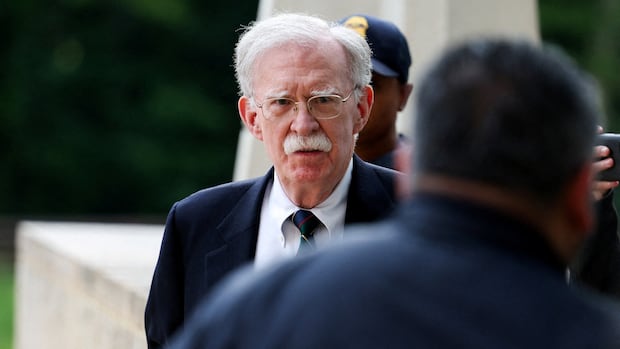
John Bolton, national security adviser during Donald Trump’s first presidential administration, pleaded guilty on Friday to illegally retaining classified information, sealing a deal with federal prosecutors.
Bolton pleaded guilty to a single count of illegally retaining classified information. His plea agreement with the Justice Department may enable him to avoid time behind bars, but the judge ultimately will decide his punishment. He will be sentenced on Oct. 28 by U.S. District Judge Theodore Chuang in Greenbelt, Md.
The plea agreement recommends capping any prison sentence at five years but the judge isn’t bound by that part of the deal. Bolton can withdraw his guilty plea if the judge issues a longer prison sentence or a fine greater than $2.25 million US.
Bolton was charged last October with 18 counts of either retaining or disseminating classified information, including diary-like notes that he shared with relatives as he wrote a memoir about his career in government.

After leaving Trump’s first government, Bolton has often been critical of the president’s foreign policy decisions. He is a frequent presence as an analyst on broadcast news channels, including on CBC News Network.
The president has slammed Bolton since their professional parting, calling him at various times a “washed-up guy” and a warmonger who would have led the country into “World War Six.”
Bolton’s indictment was sometimes cast as a case of another Trump adversary facing consequences on criminal charges. While some of those cases have collapsed under judicial scrutiny and amid claims of political retribution, Bolton didn’t mount a vigorous defence against his charges before cutting a deal, and the federal probe appears to have continued across the last two presidential administrations.
Stormy yearlong tenure under Trump
Bolton must pay half of the fine within five days of his plea and the balance within 90 days. He agreed to forfeit his retirement pay for his federal service. The plea deal also requires him to submit to a debriefing with federal intelligence officials and perform up to 100 hours of community service.
After a prosecutor read aloud a summary of his offenses, Bolton agreed that it was accurate and told the judge, “I’m sorry for it.”
Defence attorney Abbe Lowell said Bolton “did what real leaders do” by pleading guilty.
“He took responsibility for a mistake he made, thereby saving the government resources to pursue a case that could expose additional sensitive information,” Lowell said in a statement after the hearing.
Two Blocks from the White House32:48How far will the U.S. Supreme Court allow Trump to go?
America’s top court is set to deliver decisions on more than a dozen major cases in the coming days. And with rulings on birthright citizenship, transgender athletes and the Federal Reserve on the docket, there’s a lot at stake as the U.S. president’s agenda is tested by the justice system. This week, Washington correspondents Katie Simpson, Willy Lowry and Paul Hunter ask: How far will the Supreme Court allow Donald Trump to go?
Bolton faced a lawsuit and a Justice Department investigation after leaving office related to information in a 2020 book he published, The Room Where It Happened, that portrayed Trump as grossly uninformed about foreign policy.
The Trump administration asserted that Bolton’s manuscript included classified information that could harm national security if exposed.
The current investigation burst into public view in August 2025, when the FBI searched his home in Maryland and office in Washington, D.C.
Bolton served in three previous Republican presidential administration dating back to Ronald Reagan’s presidency when he was tapped by Trump in 2018 to serve as third national security adviser. But his brief tenure was characterized by disputes with the president over North Korea, Iran and Ukraine.
Several battles over classified docs
The handling of classified material has been a dominant issue in U.S. politics the past decade, beginning with a probe into former secretary of state Hillary Clinton’s handling of emails at her New York state residence, which did not result in charges but were seen to have negatively impacted her 2016 presidential campaign.
Former president Joe Biden faced scrutiny of his own after documents with classified markings were found at a former office in Washington and his home in Wilmington, Del. A special counsel investigation did not lead to penalties, but the prosecutor’s depiction of Biden’s interview over the matter added to the impression the Democrat was struggling with cognitive issues.

Former U.S. president Donald Trump says there’s no difference between his possession of classified documents and that of current President Joe Biden. Andrew Chang breaks down what Trump is right about — and what he isn’t.
In 2023, the FBI carried out a search warrant at Trump’s Mar-a-Lago estate in Florida, which led to a multi-count indictment that included charges under the Espionage Act. Documents were found in various locations across the property, officials said, including some labelled with the highest level of classification, top secret.
Trump’s remarkable political comeback in 2024, which culminated in another presidential election victory, stopped the prosecution in its tracks based on the legal tradition in the U.S. that a sitting president cannot be indicted. A special counsel report into the investigation has been muzzled in a decision by a federal judge.
Democrats have reacted with alarm in recent weeks to an opinion issued this spring by the Office of Legal Counsel within the Justice Department, which argued that a federal law that requires a president to turn over certain documents to the National Archives is unconstitutional. Democrats say the edict could provide the conditions for Trump after his current presidency to retain highly sensitive information and not face any consequence.
As a general matter, some analysts and former government officials have argued that the government’s process of information is dysfunctional and confusing, with many documents earning a classified rating more out of an abundance of caution rather than for the actual content of its information.
About the Author