When another Indigenous professor sent waaseyaa’sin Christine Sy an email about a talk being given by a Māori academic who says Israel is an example of an Indigenous people “decolonializing” their homeland, she decided to attend to try to understand the argument.
“I was very curious about her logic,” Sy, who is Ojibwa and a professor of gender studies at the University of Victoria, told The Tyee.
“I wanted to understand, because I very much see Zionism and settler colonialism as… under the same umbrella.”
Sheree Trotter has been giving public talks and podcast interviews to argue that Jewish people should be considered indigenous to Israel, and the foundation of the nation of Israel should be seen as an example of successful decolonization. She’s also founded an organization called the Indigenous Embassy Israel, which she says is not funded by the Israeli government.
On June 14, Trotter was invited to speak at the University of Victoria by the Jewish Federation of Victoria and Vancouver Island.
The concept of settler colonialism is usually used to describe the history and ongoing effects of European colonization on Indigenous people in countries such as Canada and New Zealand. Some pro-Palestinian activists have argued that Israel’s displacement of Palestinians, occupation of contested lands and militarized society that maintains divisions between Jewish and non-Jewish people are also a form of settler colonialism.
Trotter argues it’s incorrect to describe Israel’s treatment of Palestinians as “settler colonialism.” She critiques how the concept of settler colonialism has been used, she says, to “divide all of humanity into a binary of oppressor and oppressed…. This simply does not fit history.”
Trotter also denies that Israel is committing genocide against Palestinians: “Those who make such claims seem uninterested in evidence, but rather in perpetuating libels and fuelling a hate movement,” she told The Tyee via email.
The United Nations, Amnesty International and two Israeli human rights organizations have all determined that Israel is committing genocide against Palestinians in Gaza. The United Nations Human Rights Council recently found that Israel has been deliberately targeting Palestinian children and has had “genocidal intent” during its war against Gaza, which was sparked by the Oct. 7 Hamas attack against Israel.
Barry Zalmanowitz, the president of the Jewish Federation of Victoria and Vancouver Island, said his organization invited Trotter to speak to counter the idea that Zionism is settler colonialism.
“A popular claim of antisemites is that the belief that the right of Jewish people to self-determination in their ancestral homeland, i.e., Zionism, is settler colonialism,” he told The Tyee in an email.
“Dr. Trotter is a respected Māori Indigenous historian who points out the historical fallacy of the ideological claim by some academics that Zionism is settler colonialism.”
Zalmanowitz said the talk was “broadly publicized including [to] many First Nations.”
‘We’re not the only people with a relationship to this land’
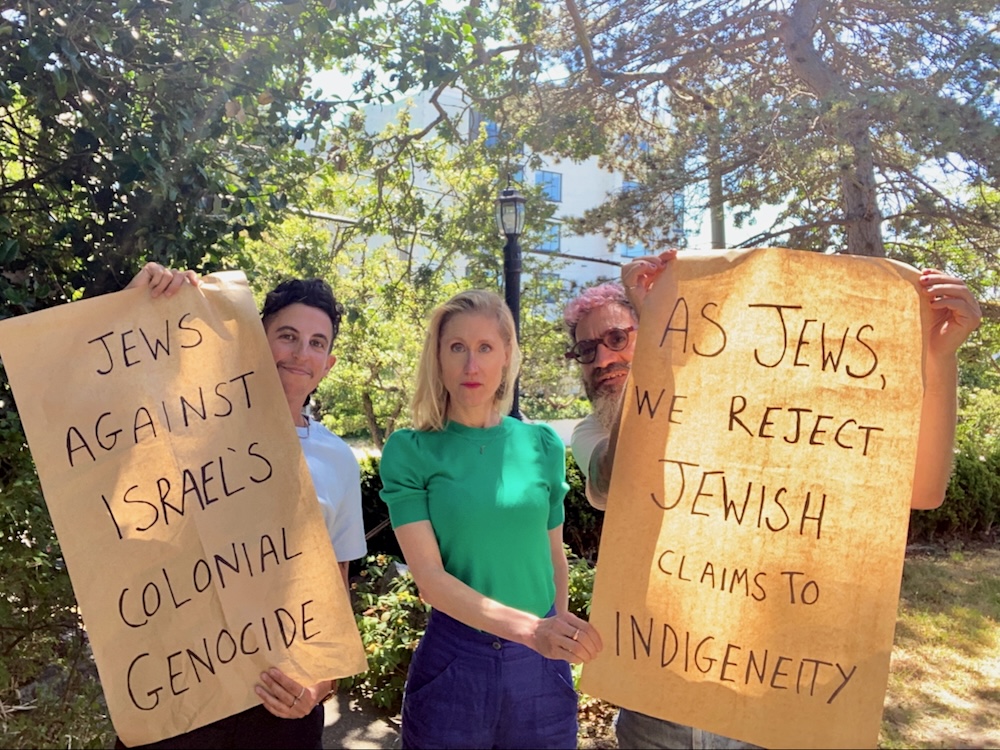
LJ Slovin and several other members of the Jewish Faculty Network’s Vancouver Island chapter decided to also attend Trotter’s talk in solidarity with Sy and Chaw-win-is, a PhD candidate at the University of Victoria.
Slovin managed to smuggle in several posters with messages of protest against Trotter’s argument. When they stood and silently unfurled the posters, security for the event promptly asked them to leave. Slovin said that about 50 to 60 people attended the event.
“This argument is that the Jewish people are indigenous to the land of Israel, and thus the genocide, the displacement, the occupation, that all of that is actually an example of land back and decolonization efforts,” said Slovin of Trotter’s message. “And that Israelis need to be supported in their efforts to ‘reclaim this land.’”
Willow-Samara Allen, another member of the Jewish Faculty Network, said there’s no question that Jewish people have a “rich relationship” with the region that became the country of Israel, and a history there that goes back thousands of years. But, she said, claims to Jewish indigeneity work to erase Palestinian self-determination and relationship to the land.
“That’s never what the issue is,” she said. “It’s the idea that these claims to indigeneity somehow ignore that there’s a settler-colonial occupation.”
“We’re not the only people with a relationship to this land,” Slovin said. “So our relationship can’t become dominant or more important than other people’s.”
Zalmanowitz said that if Slovin and their group had not unfurled the banners, they would have been allowed to stay and could have asked Trotter questions at the end of the talk.
Allen and Slovin said they had grown up in Jewish communities in Canada and the United States where support for Zionism was common. But both professors said they have come to reject Zionism over the years. Slovin and Allen said they now consider themselves to be “anti-Zionist.”
A 2024 poll found that 49 per cent of Canadian Jews do not identify as Zionists, but 94 per cent of the 588 survey respondents “said they support the existence of a Jewish state in Israel.” The poll found that one per cent of respondents identified as anti-Zionists.
University of Toronto emeritus sociology professor Robert Brym, who helped design the poll questions, suggested in an article for Canadian Jewish Studies that Jewish Canadians have become more reluctant to identify as Zionists ever since the Six-Day War in 1967. He said that in the decade after that conflict, “as Israel’s occupation of formerly Arab-controlled territory persisted and intensified,” Zionism had become increasingly associated with racism, and in the wake of the Oct. 7 Hamas attack, “self-identification as a Zionist has for many Jews become uncertain and unstable.” Brym also said “many Canadian Jews confront much hostility toward Israel in certain social settings,” which he said may be leading to “semantic drift” of the term and unwillingness to use it.
Māori academic says colonialism ‘brought some benefits’
Chaw-win-is said she attended Trotter’s June 14 talk as a member of the Nuu-chah-nulth Nation on Vancouver Island. She said she had hoped to speak during the question-and-answer portion of Trotter’s talk but left along with Sy when Slovin and the other protesters were asked to leave.
“I want to know, as a person who shares this territory with Salish and Kwakwaka’wakw folks, that I’m keeping an eye on what is being said, particularly when there isn’t local involvement or a larger indigenous involvement,” Chaw-win-is told The Tyee.
In her speeches, Trotter sometimes speaks about the benefits of colonialism and characterizes Indigenous people as engaging in “tribal warfare” and “cannibalism.” Chaw-win-is said Trotter made similar comments during her talk in Victoria.
Chaw-win-is said there is a history of racist comments accusing some First Nations people on Vancouver Island of practising cannibalism, and Trotter’s comments struck her as the “exact same problematic ways of portraying Indigenous people” by colonists, “and how we were dragging our knuckles along the ground.” Portraying Indigenous people as less civilized has been used as a justification to demand Indigenous people adopt the colonizers’ language, religion, culture and laws — a process that happened alongside displacement from traditional lands.
“It sounded like some old anthropologist understanding of who we are,” Chaw-win-is said. “It literally regurgitates anthropologists who only travelled during warm weather, only were men and talked to men in our communities and did research, and then applied their colonial view on observations of how we governed ourselves.”
In response to Chaw-win-is’s concerns, Trotter told The Tyee that while she acknowledges that “colonialism brought harm, it also brought some benefits.”
Trotter said she was speaking as a Māori person when she made comments about tribal warfare and cannibalism.
“As a Māori, I can speak about the history of my ancestors,” she told The Tyee. “The historical reality is that cannibalism was a cultural practice amongst some of my people. We don’t deal with racism by denying or rewriting history.”
Trotter is married to Perry Trotter, an evangelical Christian pastor who has written about his support of Israel and has said he is “in favour of biblical Zionism” but that that stance doesn’t mean being completely uncritical of the state of Israel. While Christian Zionism often includes the belief that the return of Jews to the region of Palestine fulfils biblical prophecies and will lead to the second coming of Jesus Christ, some religious leaders say “Christian Zionism is not based on prophecy or end-time events.”
Trotter said she “identifies broadly” as an evangelical Christian, but the Indigenous Embassy Jerusalem “is an explicitly non-sectarian endeavour with clearly delineated goals around countering false narratives emanating from academia, fighting antisemitism and affirming Jewish indigeneity to the land of Israel.”
Trotter also told The Tyee that she believes the conversion of many Māori to Christianity in the colonial period helped stop tribal warfare.
Chaw-win-is said colonialism has never ended in Canada, but academics like Trotter can provide a convenient “other side” narrative for mainstream media.
“For me this boils down to anti-Indigenous rhetoric,” Chaw-win-is said. “It’s very disturbing in this way.”
Due to the sensitive nature of the topic, we have closed comments for this story ahead of the weekend. ![[Tyee]](https://thetyee.ca/design-article.thetyee.ca/ui/img/yellowblob.png)
About the Author