Eight States Have Relatively Generous Guaranteed Issue Protections on an Either Continuous or Annual Basis
Four states – Connecticut, Massachusetts, Maine, and New York – require Medigap insurers to offer policies either continuously throughout the year or once per year to Medicare beneficiaries ages 65 and older without regard to their medical conditions (Figure 2; Appendix Table 1). Another four states — Delaware, Illinois, Minnesota, and Rhode Island — have relatively comprehensive expanded consumer protections that provide additional Medigap guaranteed issue periods for Medicare beneficiaries.
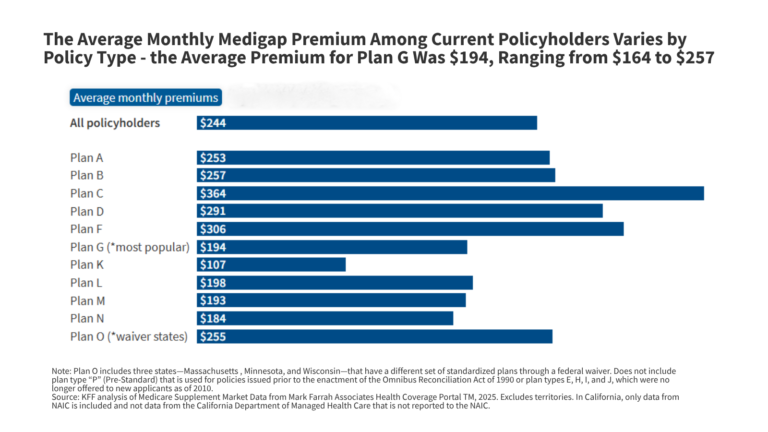
Connecticut and New York have continuous open enrollment, with guaranteed issue rights throughout the year. Massachusetts regulation requires an annual guaranteed issue open enrollment period from February 1 to March 31, but all insurers in Massachusetts offer continuous open enrollment throughout the year. Maine requires insurers to issue Medigap Plan A during an annual one-month open enrollment period of the insurer’s choosing. Plan A is less comprehensive than some Medigap plans, such as Plan G – the most popular policy in 2025.
In 2025, Rhode Island enacted legislation that provides an annual guaranteed issue period for Medicare Advantage enrollees 65 and older to purchase a Medigap plan (though this protection does not apply to people with traditional Medicare who do not have a Medigap policy). This annual guaranteed issue period is during the Medicare open enrollment period from October 15 to December 7.
In 2025, Delaware enacted legislation that provides two annual guaranteed issue periods for Medicare Advantage enrollees 65 and older to purchase a Medigap plan (though this protection does not apply to people with traditional Medicare who do not have a Medigap policy). These periods are during the Medicare open enrollment period and during the Medicare Advantage open enrollment period (January 1 to March 31). While insurers cannot deny any Medigap application, they may charge higher premiums based on medical underwriting and impose a 6-month waiting period to cover costs related to pre-existing conditions.
Minnesota enacted legislation that includes the institution of a guaranteed issue open enrollment period for individuals age 65 to 70. The opportunity to purchase a Medigap policy falls during the annual Medicare open enrollment period and can only be used one time. The law also permits insurers to charge individuals 15% more in premiums than the standard community rate beginning in 2026, with premiums increasing annually by 5%, until 2030 and subsequent years, when the premium penalty is 35%. These premiums are in effect for the duration of the policy. These new rules went into effect August 1, 2026, and represent a scaled-back version of previous legislation that would have established broader guaranteed-issue rights in the state, which passed but was not implemented.
In Illinois, one insurer – Blue Cross Blue Shield of Illinois – offers policies to anyone 65 and older who seeks to purchase a Medigap plan on a guaranteed issue basis through the year, though this is not a statutory requirement and is potentially subject to change.
States establish certain rules for Medigap insurers, including how to set premiums, and premiums may be based on factors such as a policyholder’s age, smoking status, gender, residential area, and rating system, even during open enrollment and guaranteed issue periods. Due to the variety of factors at play, KFF analysis shows that there is not a clear relationship between states with continuous or annual guaranteed issue protections and having consistently higher premiums for Medigap than in other states. However, three of the states with more robust guaranteed issue protections (New York, Connecticut, and Maine) do have the highest average premiums for Plan G. Further, Minnesota commissioned a study on the impact of instituting annual guaranteed issue protections and estimated that average annual premiums across all Minnesota Medigap plans would be 6% higher during the first year of implementation, with enrollment in Medigap expected to be 32% higher without these changes in effect.
Thirty-Seven States Require Medigap Insurers to Issue Medigap Policies to Beneficiaries Ages 65 and Older Due to Certain Qualifying Events
Thirty-seven states (including Delaware, Illinois, Maine, Minnesota, Rhode Island since they do not have continuous guaranteed issue protections) require Medigap insurers to offer policies to eligible applicants ages 65 and older based on certain qualifying events beyond the minimum federal standards (Figure 3, Appendix Table 1):
- Twenty-nine states require Medigap insurers to issue policies when an applicant has a change in their employer retiree coverage, such as a reduction in benefits or an increase in costs, depending on the state. Some states also provide guaranteed protections for individuals who choose to voluntarily leave their retiree health plan. This qualifying event is more expansive than federal law, which applies only when retiree coverage is completely eliminated by the employer.
- Thirteen states require Medigap insurers to issue policies if Medicare beneficiaries lose their Medicaid eligibility. Medicare beneficiaries who are dually-eligible individuals would no longer have premium and cost-sharing protections through Medicaid if they lose their Medicaid coverage.
- Nineteen states offer the Medicare Advantage trial period to beneficiaries older than 65. Typically, the Medicare Advantage trial period applies only when people enroll in Medicare Advantage when they are first eligible for Part A at 65. However, 12 states tie eligibility for the trial period to Part B enrollment, meaning those who delay Part B enrollment, because they are still working for example, could still be eligible for the Medicare Advantage trial period, even if they are older than 65 when they enroll in Part B. An additional state (Wisconsin) has a specific regulation that requires the trial period to be available to those who recently left employer coverage and enroll in a Medicare Advantage plan for the first time. The remaining six states still tie eligibility for the trial period to when someone first enrolls in Part A, but enrollees can be older than 65.
- Six states have guaranteed issues rules for other types of qualifying events. For example, Maine extends the federally-required Medicare Advantage trial period from one year to three years. California allows Medicare Advantage enrollees to purchase a Medigap policy from the same Medicare Advantage insurer they are enrolled in (if it sells one) if their Medicare Advantage plan reduced any of its benefits, increased cost sharing, or terminated a contract with a provider currently treating them. In Maryland, there is a new guaranteed issue period for individuals who became eligible for Medicare before January 1, 2020, and have a qualifying federal Special Enrollment Period. These individuals would typically only be able to purchase Plans F or C following a qualifying event, but this new guaranteed issue period would allow them to purchase Plans G or D.
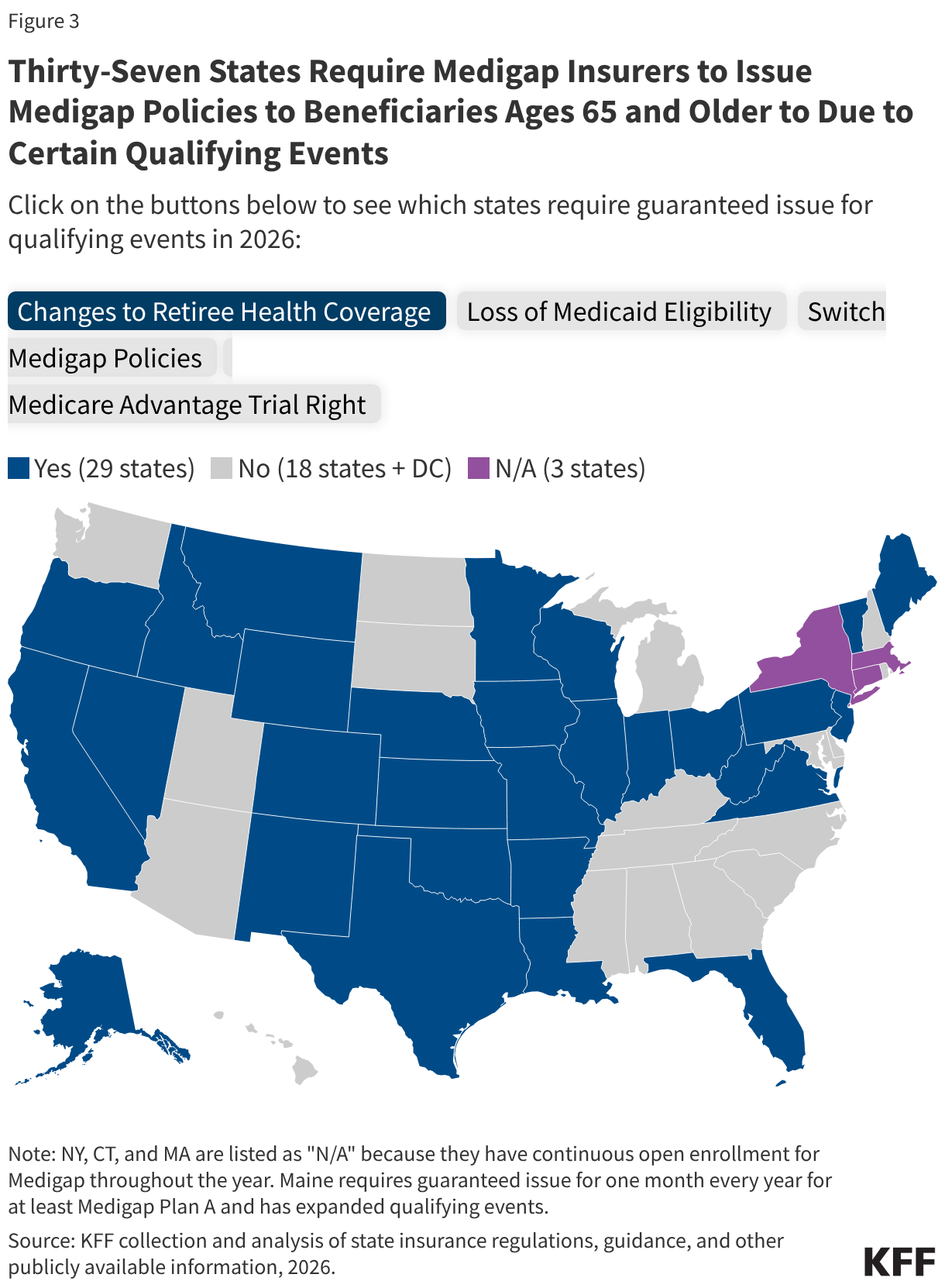
Twenty of these states provide guaranteed issue protections for current Medigap policyholders who want to switch policies (Figure 3, Appendix Table 1):
- Sixteen states have what are called “birthday rules” (CA, DE, ID, IL, IN, KY, LA, MD, NV, NM, OK, OR, UT, VA, WV, WY), which require Medigap insurers to allow current policyholders to switch each year to a different Medigap policy with equal or lesser benefits from either the same or different insurance carrier, depending on the state, around the time of their birthday. Depending on the state, these Medigap policyholders have between 30 and 63 days to switch policies. (This allowance does not enable beneficiaries who do not already have Medigap to newly purchase a Medigap policy).
- Rhode Island requires Medigap insurers to allow current Medigap policyholders to switch to any Medigap policy made available by any insurer during the Medicare open enrollment period.
- Missouri requires Medigap insurers to allow current Medigap policyholders to switch to an equivalent policy from a different insurer within 30 days before or after the annual anniversary date of their policy.
- Maine requires Medigap insurers to allow current Medigap policyholders to switch to a policy with equal or less generous benefits at any time during the year if there is less than a 90-day gap in coverage.
- Washington requires Medigap insurers to allow Medigap policyholders to switch to a policy with equal or less generous benefits at any time during the year if there is less than a 90-day gap in coverage, though policyholders with Medigap Plan A are limited to switching to another Plan A, while those with Plans B through N can switch to any other Plan B through N.
Thirty-Eight States Require Medigap Insurers to Offer an Initial Guaranteed Issue Period to Purchase Medigap to People Under Age 65 with Disabilities
Thirty-eight states require insurers to issue at least one kind of Medigap policy to beneficiaries under age 65, typically through an initial open enrollment period (Figure 4, Appendix Table 2). Of these 38 states, 27 require insurers to sell all plan types to people under age 65 during the guaranteed issue period. The remaining 12 states and DC do not require insurers to sell a Medigap policy to people under age 65 with disabilities, including people with ESRD and ALS.
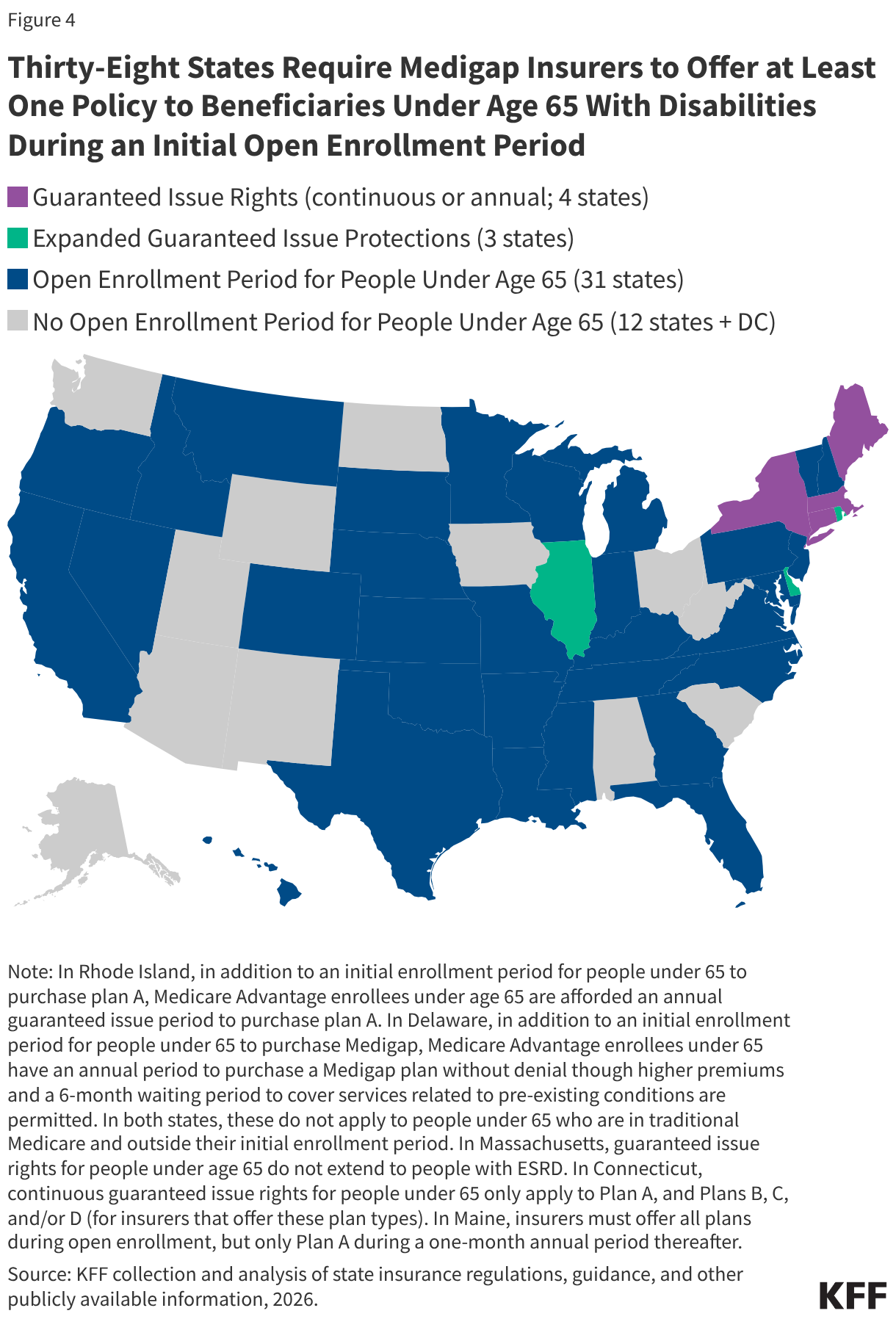
Requirements for People with ESRD and ALS:
Of the 38 states that require insurers to issue at least one kind of Medigap policy to people under age 65 with disabilities, 28 states explicitly require insurers to also sell these policies to people with ESRD and 25 states specify they must be sold to people with ALS. Four states (CA, MA, VT, and NE) explicitly state that insurers are not required to sell policies to people with ESRD, and the remaining six states are silent on whether insurers must sell at least one policy to people with ESRD. Thirteen states (including CA, MA, and VT) are silent on whether insurers must sell policies to people with ALS.
The same four states that have expanded Medigap guaranteed issue rights most broadly for beneficiaries ages 65 and older also require broader access to Medigap for people under age 65.
In addition to offering an initial guaranteed issue period to purchase Medigap, Massachusetts, Maine, New York, and Connecticut require continuous or annual guaranteed protections for people under age 65 with disabilities, though with slightly different requirements than for people ages 65 and older: in Massachusetts, insurers are not required to issue policies to people with ESRD, while in Connecticut, insurers must issue Plan A to people under age 65, as well as Plans B, C, and/or D for insurers that sell these plan types to people ages 65 and older. In Maine, all Medigap plan types must be available to beneficiaries under age 65 with disabilities during the open enrollment period, but after this period, insurers are only required to issue Medigap Plan A to beneficiaries under age 65 during the one-month open enrollment period that happens each year (the same as for people ages 65 and older).
Another three states provide more expansive Medigap guaranteed issue protections for people under age 65.
In Rhode Island, in addition to an initial enrollment period for people under 65 to purchase plan A, Medicare Advantage enrollees under age 65 are afforded an annual guaranteed issue period to purchase plan A. In Delaware, in addition to an initial enrollment period for people under 65 to purchase Medigap, Medicare Advantage enrollees under 65 who try to enroll in Medigap outside this period cannot be denied a Medigap plan, though insurers may charge higher premiums based on medical underwriting and a 6-month waiting period to cover services related to pre-existing conditions is permitted. In both states, these protections do not apply to people under 65 who are in traditional Medicare and outside their initial enrollment period. In Illinois, in addition to an initial enrollment period for people under 65 to purchase Medigap, beneficiaries under 65 can purchase a Medigap plan from Blue Cross Blue Shield annually from October 15 to December 7.
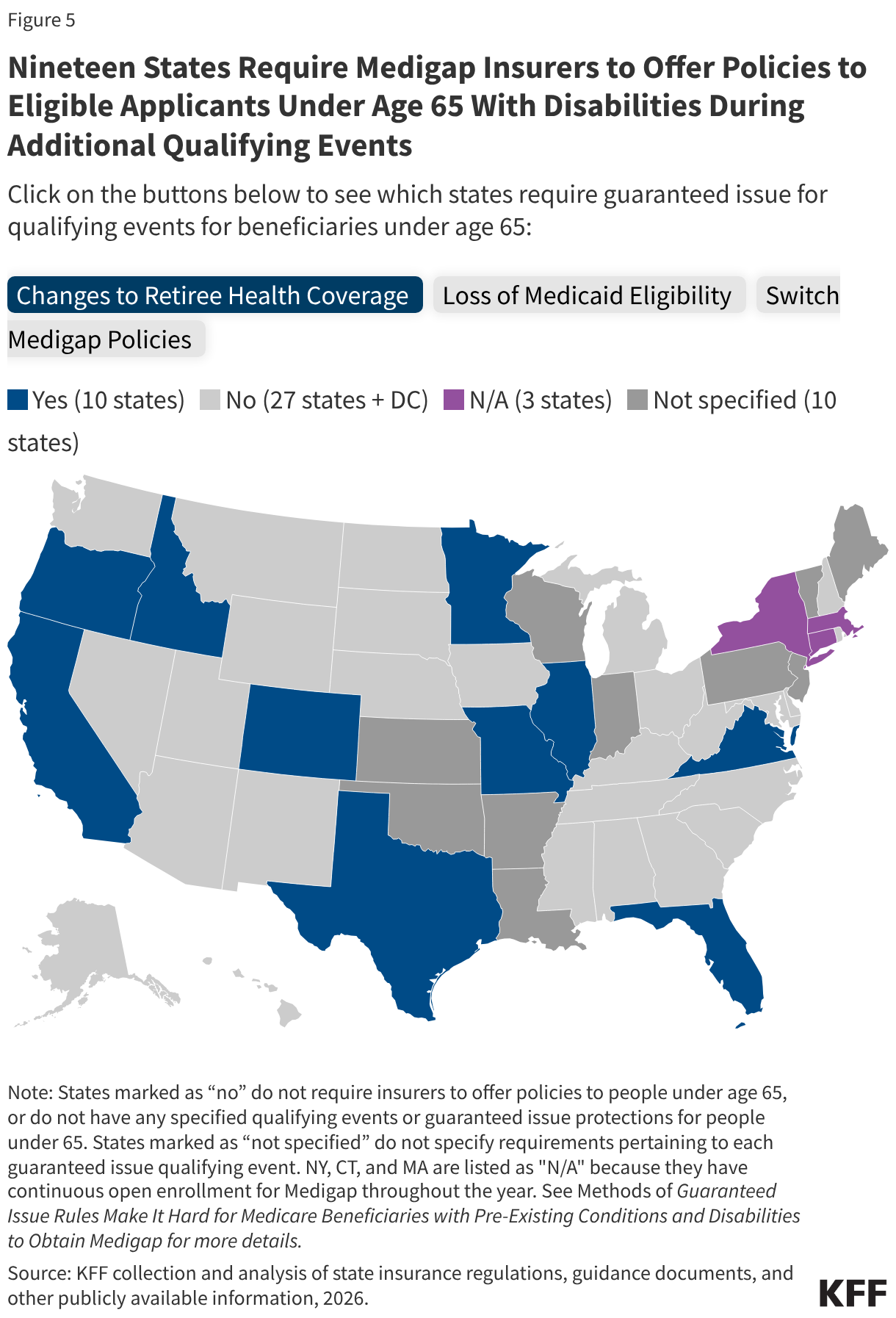
19 of the 38 States That Require Medigap Insurers to Offer Policies to Eligible Applicants Under Age 65 During an Initial Open Enrollment Period Also Do So for Certain Qualifying Events
Nineteen states require Medigap insurers to offer policies to eligible applicants under age 65 based on certain qualifying events (Figure 5, Appendix Table 3):
- Ten states require Medigap insurers to issue policies when an applicant under age 65 has a change in their employer retiree coverage – the same states that also offer guaranteed issue rights for applicants ages 65 and older who have a change in their employer (retiree) coverage. However, some states have more restrictive policies for people under age 65. For example, in Texas, this guaranteed issue right applies only for Medigap Plan A for people under age 65 with ESRD or ALS (this right does not apply to those under 65 with other disabilities).
- Eight states require insurers to issue Medigap policies to beneficiaries under age 65 who lose their Medicaid eligibility. These eight states also offer the same guaranteed issue protections for people ages 65 and older, but in the case of Texas, the guaranteed issue right for people under age 65 applies only in the case of Plan A for people under age 65 with ESRD or ALS (this right does not apply to those under 65 with other disabilities).
- Eleven states provide guaranteed issue protections for current Medigap policyholders who want to switch policies, including seven states that require Medigap insurers to allow Medigap policyholders under age 65 to switch to a policy with equal or less generous benefits (e.g., under “birthday rules”).
- Some states have other types of qualifying events for beneficiaries under age 65:
- Illinois extends the same federal Medicare Advantage guaranteed issue protections that are available to people ages 65 and older, to people under age 65 in the state. For example, Medicare Advantage enrollees under age 65 in Illinois who move out of their Medicare Advantage plan’s service area, or whose Medicare Advantage plan goes out business, have a 6-month guaranteed issue right to purchase a Medigap policy.
- Oregon requires that insurers offer a guaranteed issue period to individuals who move to Oregon from a state that does not require Medigap insurers to issue policies to people under age 65.
About the Author