Although Medicare is a federal program, Medigap policies are insurance products that are regulated at the state level, meaning states establish certain rules for Medigap insurers, including how to set premiums. Premiums may be based on factors such as a policyholder’s age, smoking status, gender, and residential area, even during open enrollment and guaranteed issue periods.
There are three different rating systems that can affect how Medigap insurers determine premiums: community rating, issue-age rating, or attained-age rating.
- Community rating: The same premium is generally charged to everyone, regardless of age or gender. Premiums may go up because of inflation and other factors, such as smoking status and residential area, but not due to age.
- Issue-age rating: The premium is based on the age of the beneficiary when they purchase the Medigap policy. Premiums are lower for people who buy at a younger age and higher for those who buy at older ages. Premiums may increase over time due to inflation and other factors, such as smoking status and residential area, but not due to age.
- Attained-age rating: The premium is based on a beneficiary’s current age, so the premium goes up as they get older. Premiums are lower for younger buyers but increase as they get older, which means that premiums may be the least expensive at first but can eventually become the most expensive. Premiums may also increase due to inflation and other factors, such as smoking status and residential area.
States can impose regulations on which of these rating systems are permitted or required for Medigap policies sold in their state. Currently, most states (37 states and D.C.) allow any rating system. Nine states (AR, CT, ID, MA, ME, MN, NY, VT, and WA) require premiums to be community rated among policyholders ages 65 and older, while another four states (AZ, FL, GA, and MO) permit issue-age rating but prohibit attained-age rating (Appendix Table 4). Depending on state rules, insurers may apply a mix of rating systems for the Medigap policies they offer and policyholders can choose which rating type applies to the policy they buy, though insurers may choose to not offer plans for all rating types. For example, those seeking to purchase Medigap may have fewer options for community rated plans in states that permit any rating type.
Premium Rules Vary Across States That Require Insurers to Offer at Least One Medigap Policy Type to People Under Age 65
There are 38 states that require insurers to make at least one kind of Medigap policy guaranteed issue during an initial open enrollment period for beneficiaries under age 65, which is not a federal requirement. In these states, rules vary as to whether the same premiums are required for people under ages 65 and people ages 65 and older.
Among these 38 states, 25 states limit how much insurers can charge in premiums for beneficiaries under age 65. (Figure 4, Appendix Table 5). The remaining 13 states have no specified rules on premium costs.
Average Medigap Premiums Vary Among Current Policyholders by State and Policy Type
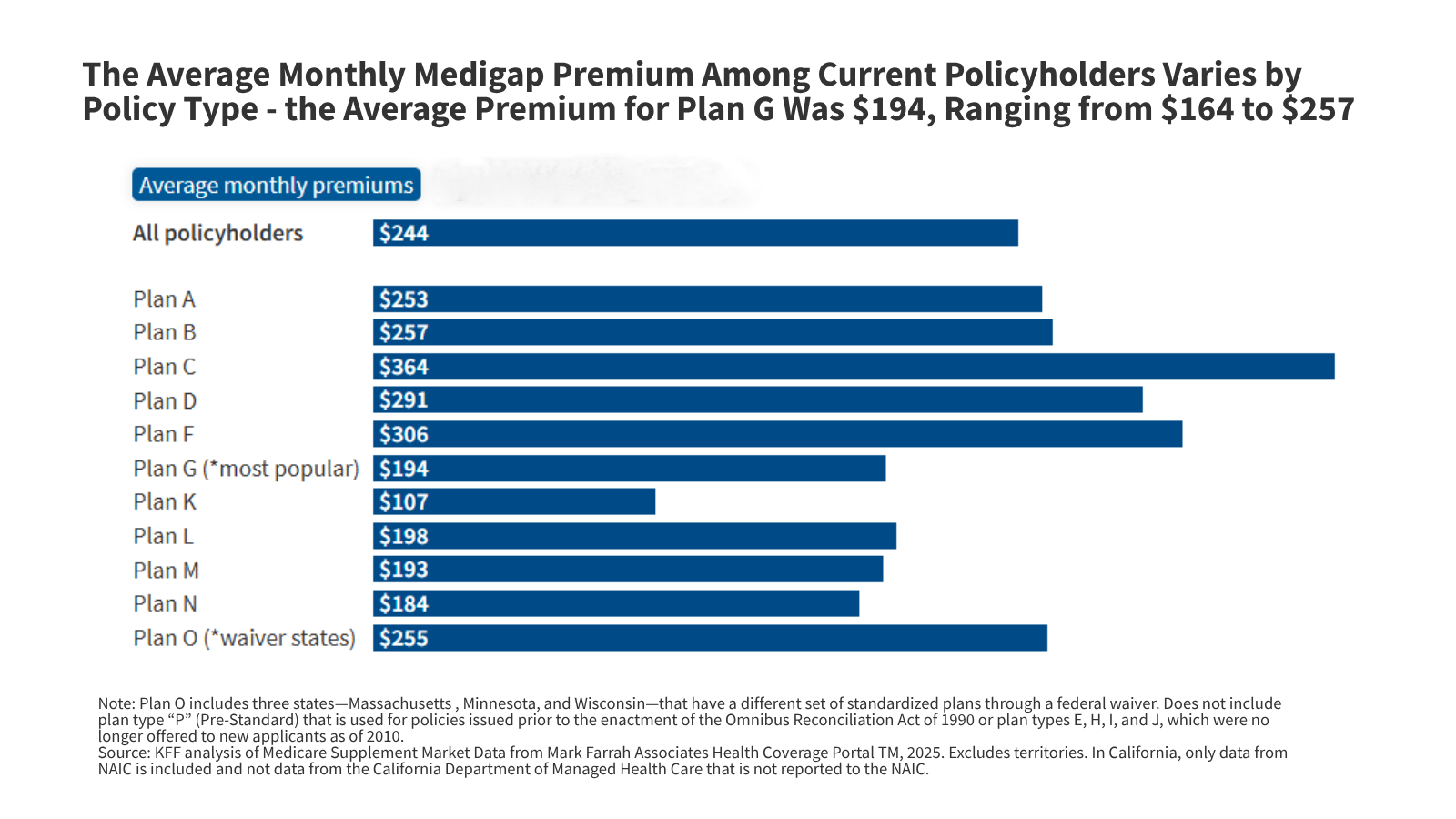
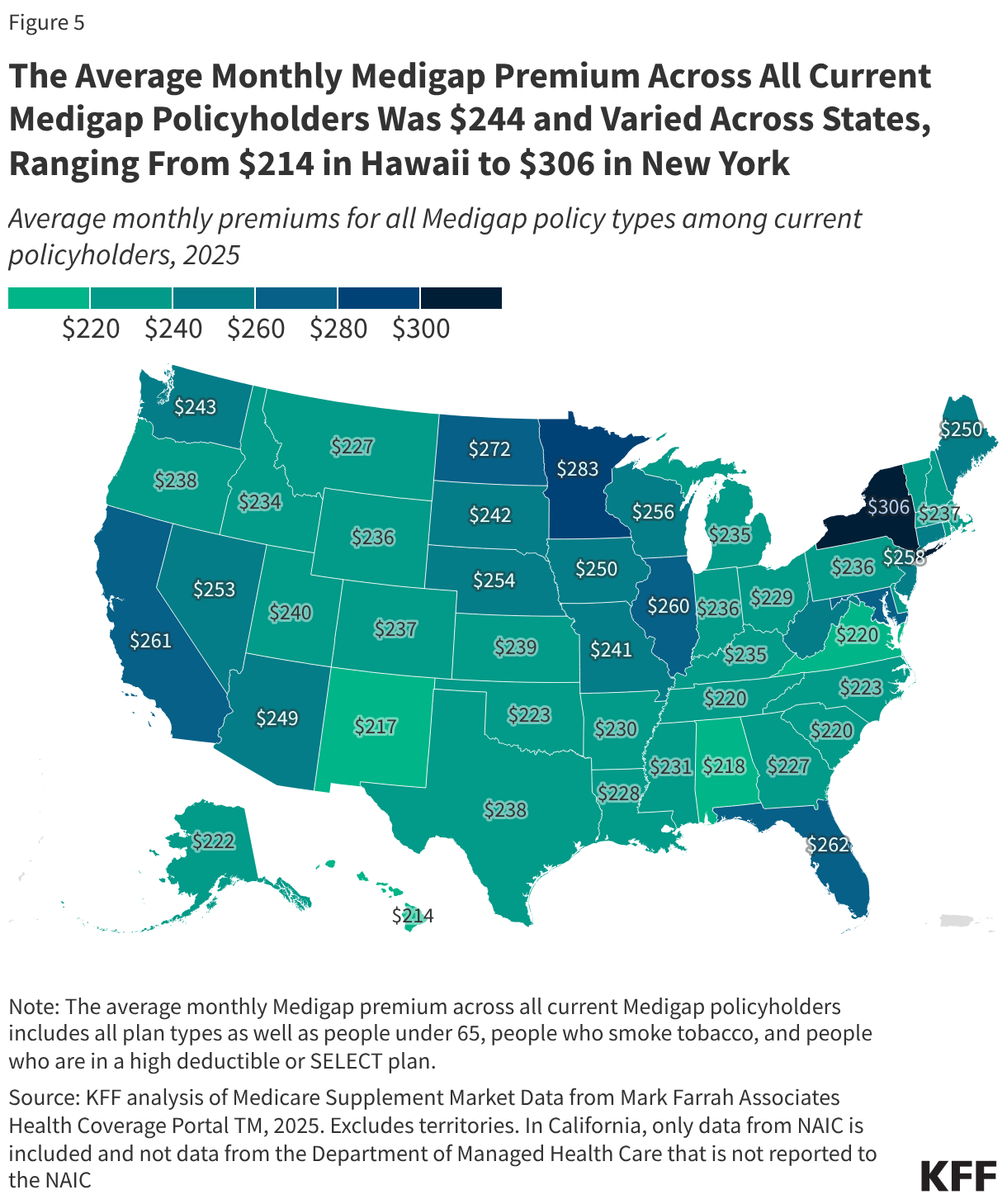
The average monthly Medigap premium across all current Medigap policyholders (including people under 65, people who smoke tobacco, and people who are in a high deductible or SELECT plan) was $244, ranging from $214 in Hawaii to $306 in New York in 2025 (Figure 5, Appendix Table 4).
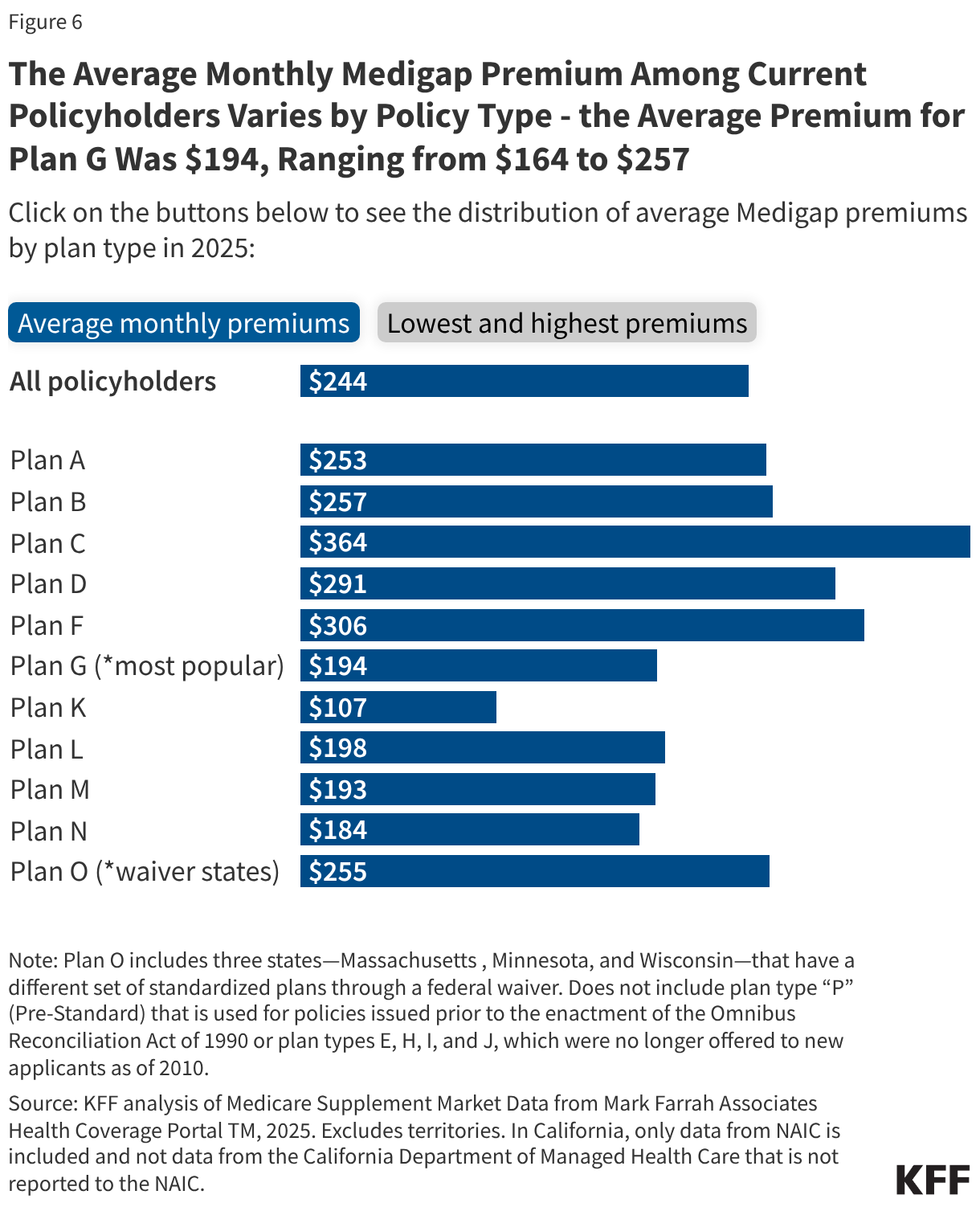
Average premiums also vary considerably depending on the policy type. For Plan G, the most popular and comprehensive plan available to newly eligible beneficiaries, the average monthly premium among current policyholders in 2025 was $194, and ranged from $164 in New Mexico to $257 in New York (Figure 6, Appendix Table 4). For Plan F, the plan with the second highest enrollment (but no longer available to Medicare beneficiaries who turned 65 after as of January 1, 2020), the average premium among current policyholders is $325, ranging from $243 in Vermont to $378 in Nebraska. The difference in premiums may be due in part to the fact that Plan F covers the Part B deductible, which Plan G does not cover, and that Plan G is enrolling new and younger beneficiaries, while Plan F covers an older group of beneficiaries since new enrollees are not eligible, creating different risk pools, though it may also be related to other factors, as described below. These data reflect what people currently pay, some of whom have had a Medigap plan for many years, rather than what a new enrollee might pay.
In the five states with the most expensive monthly premiums on average in 2025 for Plan G, four states (NY, CT, ME, WA) require community rating, while the fifth (FL) only allows issue-age rating. Further, the three states with highest premiums (NY, CT, and ME) have continuous or annual guaranteed issue protections. For Plan F, the state with the highest monthly premium is Nebraska, which is not community rated, followed closely by New York, which is community rated. The three states with the next highest premiums for Plan F (IN, IL, and ND) are not community rated and do not have guaranteed issue protections.
Overall, for average Medigap premiums across all current policyholders, there is no clear relationship between states with community rating rules or guaranteed issue protections and premium levels. For example, among guaranteed issue states, New York has the highest average monthly premium, but average monthly premiums in Connecticut and Maine are only slightly above the national average and the average in Massachusetts is slightly below the national average.
Differences in average premiums across states can be due to several factors, including Medigap rating requirements, guaranteed issue requirements, the number of Medicare beneficiaries, the characteristics of the Medicare population, Medicare Advantage penetration, urbanicity of the counties, and health care cost and usage patterns. Due to data limitations, differences in average Medigap premiums by gender, age, or smoking status cannot be evaluated.
Premium costs are one of the primary concerns for people with Medigap. KFF focus groups indicate that while most beneficiaries with Medigap are satisfied with their coverage and like many of its elements, including coverage of most or all of Medicare’s cost-sharing requirements, comprehensiveness of their coverage, control over their health care, and ability to see any provider they want (by virtue of being in traditional Medicare rather than Medicare Advantage), some participants noted their premiums were expensive or cost more than they would like.
Average Medigap Premiums Have Increased Over Time and Vary by Plan Type
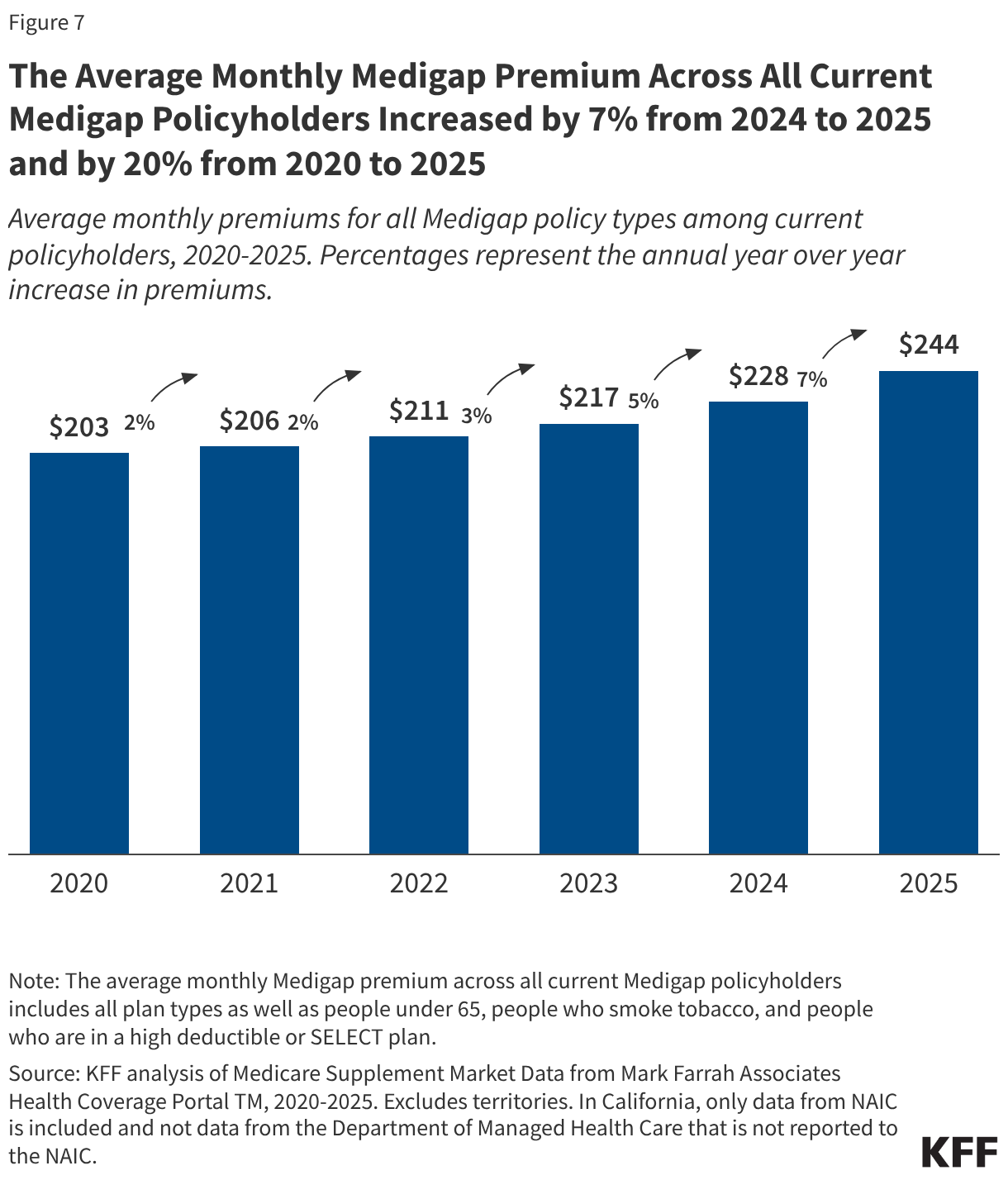
From 2024 to 2025, the average monthly Medigap premium increased by 7%, from $228 to $244, while the monthly Part B premium increased by 6% (from $174.70 to $185) – both outpacing the 2.7% increase in inflation. From 2020 to 2025, monthly Medigap premiums among current Medigap policyholders across all plan types increased 20% on average, increasing from $203 in 2020 to $244 in 2025 (Figure 7). Over the same time frame, the average monthly premium for Medicare Part B increased by 28% (from $144.60 to $185) and the consumer price index (CPI-U) increased by 24%.
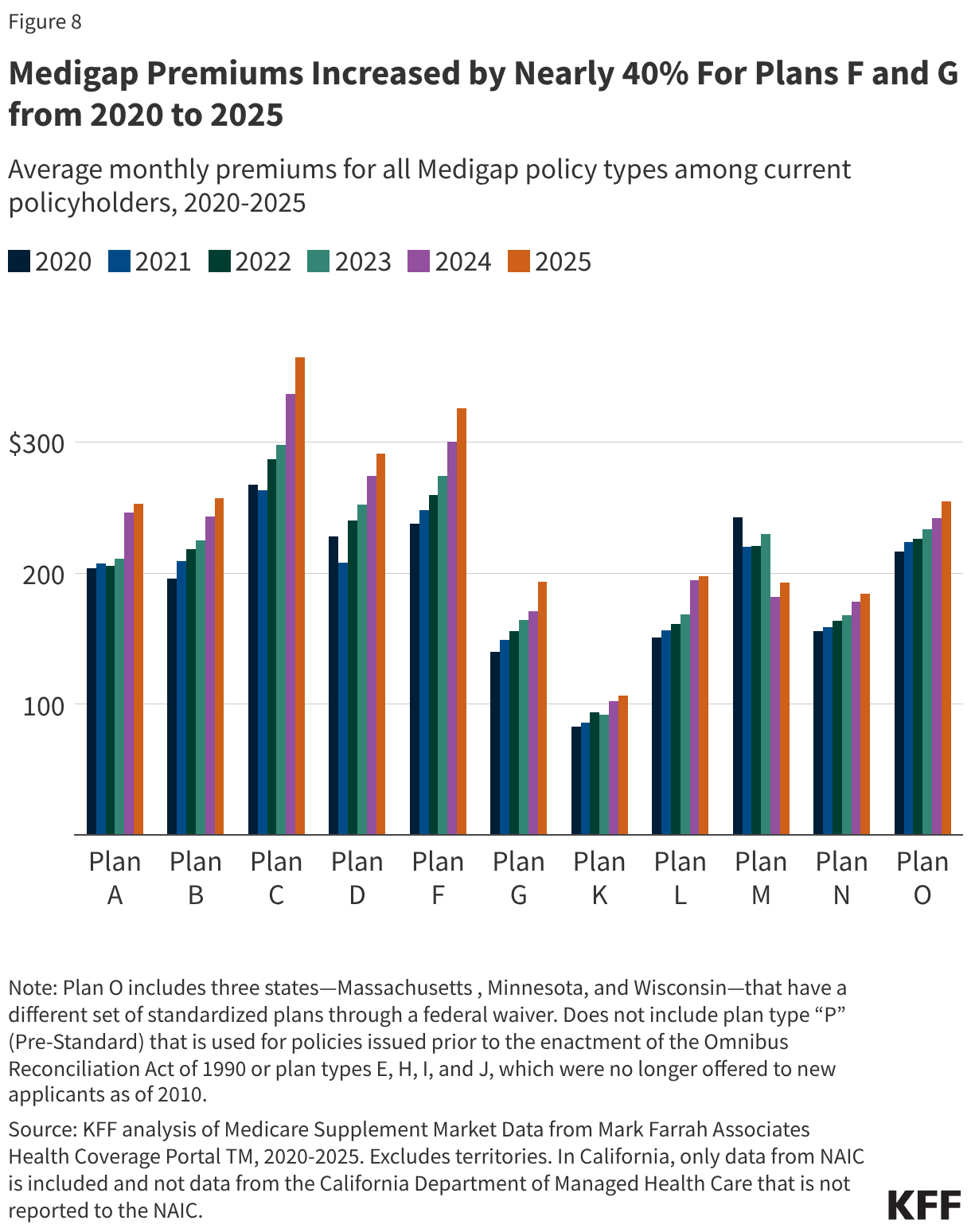
The increase in Medigap premiums also varies by plan type. For example, from 2024 to 2025, average Plan G premiums increased by 13% from $171 to $194 and average Plan F premiums increased by 8% from $300 to $325. From 2020 (when Plans D and G became first available) to 2025, overall average Medigap premiums increased by 20%, but for Plan G specifically, the average premium among current Medigap policyholders increased by 38% from $140 to $194 (Figure 8). Similarly, for Plan F, average premiums increased by 37% over that time frame from $238 to $325 (Figure 8). The only Medigap policy that experienced a decrease in the average monthly premium between 2020 and 2025 is Plan M, with less than 0.1% of Medigap enrollment, which decreased by 20% (from $242 to $193)—although consistent with all other Medigap policy types, the average premium for Plan M increased between 2024 and 2025.
Average Medigap premiums may have increased at different rates across plan types and time periods due to several factors, such as Medigap rating requirements, guaranteed issue requirements, the characteristics of the Medicare population, Medicare Advantage penetration in an area, and health care cost and usage patterns. In addition, because in many states it is difficult to switch Medigap plans (unless the state has a “birthday rule” or other opportunities to switch plans), some enrollees may face escalating Medigap premiums but are unable to purchase a cheaper policy. This may be particularly true for policyholders of Plans C or F, which are not open to newly eligible Medicare beneficiaries and cover the Part B deductible, which made these policies more expensive relative to Plans D and G, respectively.
About the Author