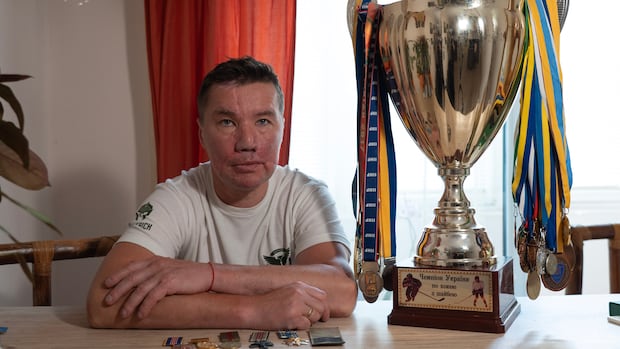
As Oleksandr Matviychuk sifts through a stack of hockey medals hanging in his Kyiv apartment, the 51-year-old proudly shows off one earned during his decade playing for Ukraine’s national team starting in 1999.
His eyes are then drawn to a medal he earned during the five seasons he played in Russia’s Kontinental Hockey League between 1998 and 2003.
Back then, Russians were his teammates and some of his fiercest competitors on the ice. Now, he struggles to even think about facing off against them again. Anger blurs his ability to envision it.
“It’s tough to imagine going in the same ring with them,” he said, speaking to CBC News a few hours after Russian ballistic missiles killed at least 28 people in an attack on the Kyiv area in the early hours of July 6.
“They just tried to kill my people. Why should I feel anything different?”
Off the ice and onto the front
When Russia launched its full-scale invasion of Ukraine on Feb. 24, 2022, the decades Matviychuk spent playing and coaching hockey came to an abrupt end once he signed up to fight.
Then, in June 2025, his time at the front ended violently after he was shot in the face while trying to help evacuate a group of Ukrainian soldiers who had been surrounded by Russian forces.
At one point, he said, doctors weren’t sure he was going to live. But more than a year and nearly a dozen surgeries later, his face has been largely reconstructed.

Matviychuk now spends most of his time at his dacha, or rural cottage, valuing the quiet time by himself. He doesn’t like venturing outside because of the way people look at him. Even though Ukrainians are now used to seeing people scarred by the violence of war, he says, some still can’t help but stare.
“I don’t like them feeling sorry for me,” he said. “I don’t like it. I prefer to stay at home and do not enjoy going out.”
At one time, hockey took Matviychuk all over the world, including to North Bay, Ont., where he spent two seasons, between 1994 and 1996, playing in the Ontario Hockey League. He fondly remembers tournaments in Calgary and points out a novelty hockey stick in his apartment that was signed by other players after a youth tournament.

After trading in his hockey skates for a military uniform, Oleksandr Matviychuk sustained severe injuries on the battlefield. The former Ukrainian national team player is now undergoing reconstructive surgery in Kyiv and longs to return the game he loves.
Matviychuk had taken a Ukrainian youth team to a tournament in Belarus just a few days before Russian President Vladimir Putin announced the start of what he called a “special military operation.” He remembers many of the parents were concerned about the trip because of repeated warnings from the U.S. that Russia was poised to invade Ukraine.
Matviychuk assured them everything would be fine, convinced Russia wouldn’t invade. When it did, he started reaching out to the Russian players he still kept in touch with.
“Most of the Russians … they kind of act like … that bird that’s hiding its head in the sand, just saying, ‘No, no it’s not happening …. We’re not doing anything,'” he said. “Some guys were saying, ‘Please don’t go fight. You’ll get killed.'”

Around the same time, he said, some of his hockey contacts in Canada offered him a coaching role in Alberta — a pathway to get him out of the country — but he turned it down because he didn’t feel right leaving.
Instead, Matviychuk was assigned to Ukraine’s military intelligence agency, known by its acronym GUR. He had no prior military experience and didn’t know how to shoot a gun, but sports had made him strong and scrappy, and he was used to working as part of a team.
But the analogy only goes so far.
“On ice, when you get blood, you just put a little snow on it, and it stops right away.”
War, he says, is much dirtier.

‘The war is not over’
Over the past four years, Matviychuk was sent on missions across Ukraine, including over the border during incursions into Russia. While he couldn’t disclose specific details, he spoke of harrowing experiences, ruined villages and nearly impossible missions that sometimes didn’t go as planned.
In June 2025, his team was sent to help a group of Ukrainian troops leave an area surrounded by Russians. Their task was to evacuate them and take up new positions. When they arrived, they encountered Russian forces immediately.
“We just had to fight … as soon as we realized that this was not our guys who [we] were supposed to meet.”
The Russian troops started shooting, and one member of Matviychuk’s team was killed right away. Four others, including Matviychuk, were severely injured.
“We had one guy who was totally unwounded, and he took care of the rest of the Russians, so we could get out.”

Shot in the face and arm, Matviychuk applied his own tourniquet to his limb to stop the bleeding. He remembers walking himself to an evacuation vehicle while holding his gun, fully aware that his face was “hanging” off.
The next thing he remembers is waking up in a hospital in Dnipro, Ukraine. He was initially treated there before being moved to Kyiv.
“When he came to us, he didn’t have a nose — the nose was destroyed,” said Leylya Omerova, a Kyiv-based plastic surgeon.
“This kind of injury gives patients not only physical suffering but mental and psychological suffering.”
Surgeons reconstructed his nose, jaw and lips, and he has at least one more surgery planned for the fall.

Back at his apartment, he shows off some of the newest medals added to his collection. The awards were given to him for his military service, but he admits he doesn’t really know what each one represents.
They aren’t like his hockey medals, where the trophies and team pictures hanging on the wall bring back fond memories of competition and camaraderie.
“I want to go back to [hockey], but I don’t feel free to do it,” he said. “The war is not over.”

About the Author