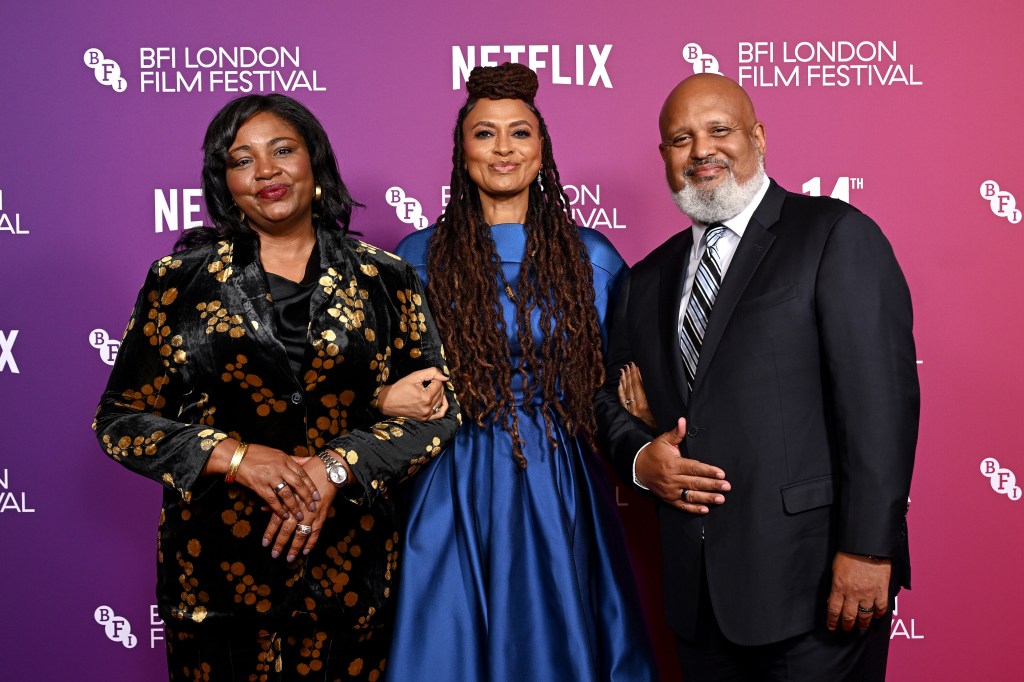
Ava DuVernay continued the rollout for the 14th, the documentary feature she has produced and directed at Netflix, this evening in London, where the film screened as the Special Documentary Presentation at the London Film Festival.
The film arrived in London following its debut bow at the New York Film Festival on October 9.
“I jumped straight on a plane and came here to see how these ideas feel in another country,” DuVernay told the packed-out London crowd as she introduced the film.
As it turns out, DuVernay’s ideas were exactly what the LFF audience had been looking for. The LA-based filmmaker and her producers, Tammy Garnes and Paul Garnes, were given a lengthy, impassioned standing ovation as they walked on stage for a post-screening Q&A session with BFI programmer Grace Barber-Plentie (Standing ovations are pretty rare at the LFF, where audiences are passionate but rarely emotive).
The film, which arrives ten years after DuVernay’s Emmy Award-winning 13th, details how the 14th Amendment and its foundational principles of birthright citizenship, due process, equal protection under the law, and the prohibition for heads of state to engage in acts of insurrection, ratified post–Civil War, are now under systematic attack.
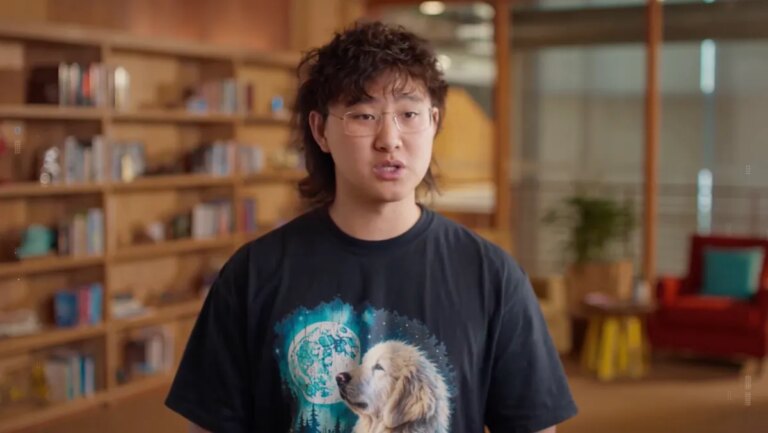
DuVernay builds the film’s narrative using a wide and often surprising range of interview subjects. Contributors include expected names like Representative Alexandria Ocasio-Cortez, former Georgia State Representative Stacey Abrams, and social justice activist Bryan Stevenson. But the Selma filmmaker also includes contemporary voices like political streamer and influencer Hasan Piker alongside MAGA republicans like Anna Paulina Luna.
“It was important for us to have a vast range of points of view. We wanted the audience to feel represented,” DuVernay told the London audience. “We reached out to more than 300 people who would be considered Republican or MAGA, and only four responded and said they would do it.”
DuVernay told the LFF crowd that she had no real intention of returning to the subject of the U.S. Constitution after the 13th, which covers the 13th Amendment, but became intrigued by the idea of interrogating the history behind the 14th Amendment during President Donald Trump’s second reelection campaign.
“It was the summer of 2024, when Donald Trump was campaigning for a second term, and I heard him talking about birthright citizenship,” she said. “One of the first things he said he would do—as a campaign promise—was challenge birthright citizenship. I thought, ‘Oh, wow. That’s the Fourteenth Amendment.’ That’s all I knew about it.”
Indeed, President Donald Trump signed an executive order challenging U.S. birthright citizenship on the first day of his second term in office, which was later ruled unconstitutional by the U.S. Supreme Court.
“But he also began systematically challenging every other part of the Amendment,” DuVernay said, explaining how the film developed.
“Part of our investigation, and our attempt to unpack all of this, was the horrible realization that no one person knew everything we needed to know. For 13th, there was a book called The New Jim Crow by Michelle Alexander that was like our bible for that film. For this film, there was no single book because there were so many pieces. A major part of the work was trying to piece everything together while the news was coming in in real time. It really evolved organically.”
The 14th runs just over 100 minutes, but covers an enormous scope of U.S. history, drawing a direct line from the Reconstruction era to President Trump’s second term.
“Every day we were making the movie, we documented something happening in the United States that shocked us or had a connection with the Fourteenth Amendment. And every single day, we could find something,” Tammy Garnes said. “The truth is there. It’s just a matter of whether or not you want to see it, hear it, and internalize it.”
The 14th will debut globally on Netflix on December 4, following a theatrical release in select U.S. and U.K. theaters beginning on November 27. DuVernay told the LFF audience that her primary takeaway from the production is that “systems are not static.”
“We often feel that we’re governed by the laws, politicians, and policies that we live within and under. But systems are motivated by people, and we need to remember that systems can be changed by people,” DuVernay said.
“This film was not made to give you hope at the end. It was made to ensure we’re all standing together in a place of truth and sobriety. That we’re clear-eyed about where we are and honest about where we need to go. I hope that’s how you feel afterward. That was the goal.”
The LFF runs until Oct 18.
About the Author