Listen to this article
Estimated 3 minutes
The audio version of this article is generated by AI-based technology. Mispronunciations can occur. We are working with our partners to continually review and improve the results.
Inside his farmhouse, nestled off a dirt road in Kent County, N.B., 80-year-old Leslie Cail sat listening to the distant chant of an auctioneer.
A crowd had gathered outside to bid on his life’s work. One by one, the tools, farm equipment, and antique furniture that had anchored his family for generations were being sold to the highest bidder.
“You got to hold back tears,” Cail said.
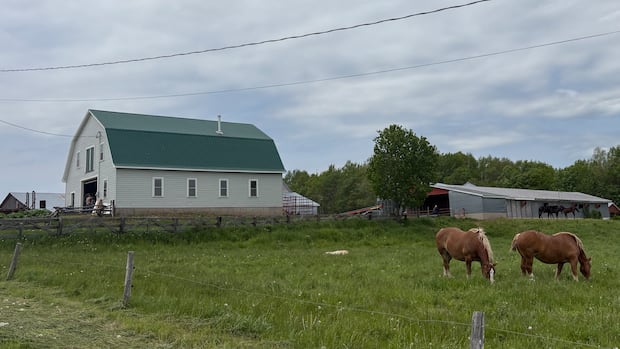
Two weeks ago, Cail sold roughly 323 of his farm’s nearly 404 hectares in the rural community of Cails Mills. Saturday’s auction marked the final step.
For Cail, the loss is deeply personal. He was born on this farm. When his father died, Cail became the owner and operator at age 17.

Over the decades, he poured his life into the farm, eventually raising 250 head of cattle, along with hogs and sheep. At its peak, the Cail farm was the fifth-largest beef operation in New Brunswick.
“You have to deal with weather and prices of a product, and of course, you’re dealing with machinery,” Cail said of the decades spent battling the elements. “To win against that was just — it was a challenge I always liked.”
History of the family farm
According to Deborah Hale, a genealogist and relative of Cail, the property was purchased by Cail’s great-grandfather between 1870 and 1880, though the family first settled in the Kent County area in 1819.
But the line of succession ends with Leslie.
“There was no one coming on in my family with the interest to take on a farm,” Cail said. “The interest isn’t here because it can’t give you that much money.”
The bitter reality, Cail said, is that skyrocketing operational costs driven by inflation have made it nearly impossible to pass a farm down to younger generations.
“It’s a hard job to get a business to go beyond three generations,” he said.
Hale, who co-wrote a book with Cail about the family’s roots in the province, views the transition as a modern reality.
“It’s becoming increasingly difficult in this day and age,” Hale said. “I don’t know how people who maintain family farms manage.”
Bittersweet comfort
The Cails’s struggle reflects a national trend. According to Statistics Canada, the number of farms across the country plummeted by 44 per cent between 1976 and 2021, driven by industry consolidation and an aging workforce.
There is a bittersweet comfort for Cail — the land was purchased by five Amish families who intend to use it for agriculture.
“People want to eat, people want good food and I think that’ll continue on from this farm,” Cail said. “That’s what makes me feel good about the whole thing.”
About the Author