Listen to this article
Estimated 3 minutes
The audio version of this article is generated by AI-based technology. Mispronunciations can occur. We are working with our partners to continually review and improve the results.
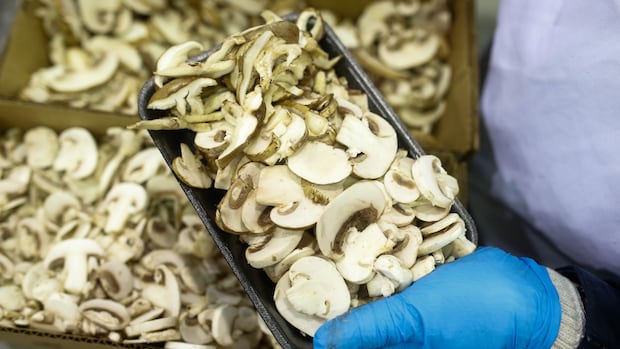
The U.S. is about to slap countervailing duties on fresh mushrooms grown in Canada, as Canadian growers warn of broader risks to the farming sector on both sides of the border.
A U.S. Commerce Department fact sheet released this week and shared with CBC by the Canadian Mushroom Growers’ Association says that following an investigation, the U.S. government will be hitting Canadian fresh mushrooms with tariffs of between 1.6 and five per cent.
Countervailing duties are slapped on imports judged to be unfairly subsidized. Similar U.S. investigations have resulted in duties on Canadian softwood lumber for decades.
The Commerce Department launched the investigation in January after being petitioned by U.S. growers who argued that several tax exemptions in Canada mean Canadian mushrooms are unfairly subsidized.
But Ryan Koeslag, executive vice-president of the Canadian Mushroom Growers’ Association, says a tax exemption is an “unprecedented” justification for countervailing duties, given that farm products on both sides of the border benefit from such exemptions.

Speaking at a political conference, Prime Minister Mark Carney stressed the need for Canada to diversify trade away from the U.S., as the deadline to review the Canada-U.S.-Mexico Agreement approaches.
“It’s a very normal practice. Countries all around the world have agricultural tax exemptions, and the United States is included in that,” Koeslag told CBC News.
Koeslag said that using general tax exemptions as a justification for countervailing duties could open up Canadian and American farm products to more tariffs.
“This not only has a broader implication to Canadian agriculture, but also to the American agriculture producer,” he said.
“They’ve really opened themselves up to having other countries identify that, ‘Hey, if the United States is going to start using tax exemptions as a countervail weapon, then we’ll do the same against the United States.’ So I think it could be a slippery slope for them in the long run.”
CBC news asked Agriculture Minister Heath MacDonald’s office for a statement regarding the mushroom duties. A spokesperson pointed CBC News to Canada-U.S. Trade Minister Dominic LeBlanc’s office for comment. LeBlanc’s office hasn’t yet responded to CBC News.
The U.S. also launched a separate investigation which could result in further anti-dumping tariffs on mushrooms later this year.
Fresh mushroom exports to the U.S. jumped 13 per cent from 2023 to 2024 before declining by nearly four per cent last year, according to data from Industry Canada.
The countervailing duties are being put in place as Canada, the U.S. and Mexico are reviewing the trilateral trade pact that came into force in 2020.
The three countries have until July 1 to decide if they want to renew the Canada-U.S.-Mexico Agreement (CUSMA) past 2036, according to the text of the agreement.
But negotiators on both sides of the Canada-U.S. border have said not all issues will be worked out by the beginning of July.
About the Author