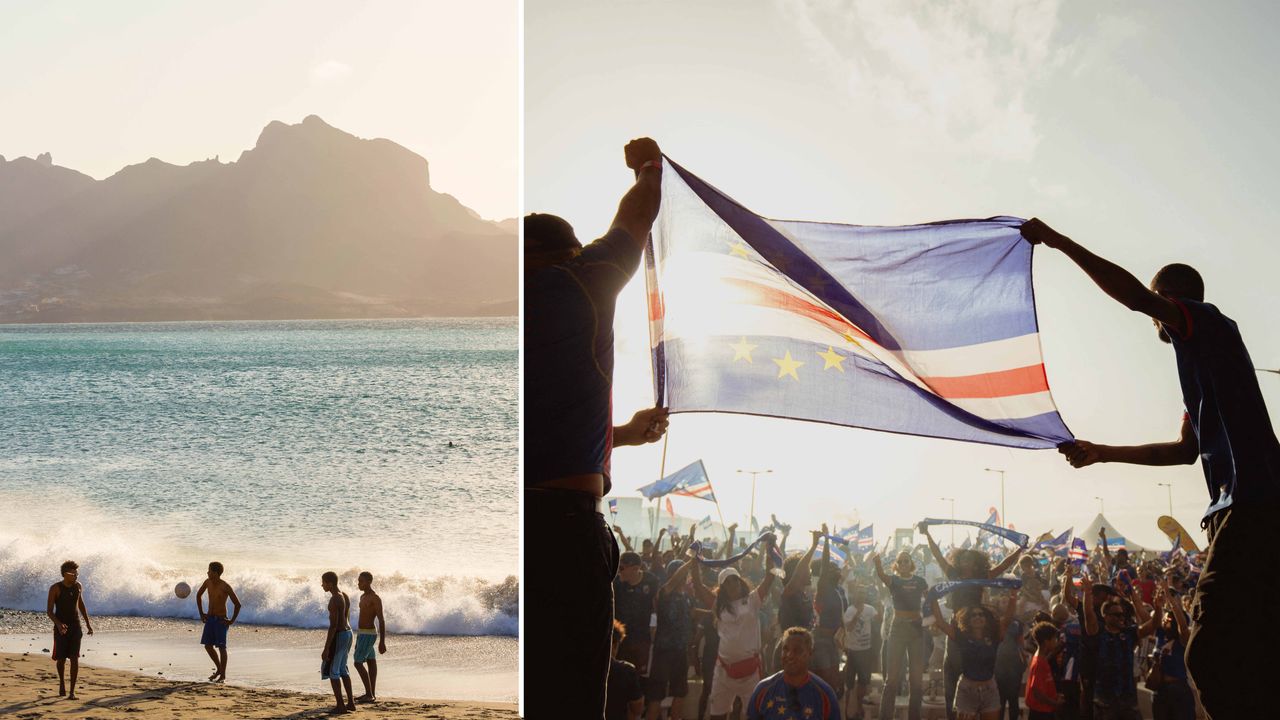
On the soft sand, with room to romp, players can test their most ambitious moves, leaping for bicycle kicks and diving into headers they wouldn’t dare on pavement or dirt, entertaining observers with back-heels and nutmegs. “When you play on the beach, it’s just fun,” Lopes-Cabral says.
With its 600 miles of coastline, there is plenty of beach to go around—and it’s not just soccer happening, though that’s certainly a highlight. Volleyball players set up nets. Runners jog across the sand. Families and friends gather for “a lot of beers, a lot of grilled chicken, a lot of capirinha,” says Soraya Da Silva, a 34-year-old from the Santiago Island highlands overlooking Praia, the country’s largest city with a population around 140,000. Da Silva works at the front desk of a beachside hotel, and Prainha Beach is her go-to pocket of tranquility tucked between rocky headlands punctuated by a 19th-century lighthouse.
Last year, a record number of visitors poured into Cape Verde, at more than a million, and the country is preparing for even greater numbers ahead. At the start of 2025, more than 5,000 rooms worth of hotels were being developed, and Airbnb listings have multiplied, with waterfront three bedrooms on the most popular beaches going for more than $200 a night.
“When I was a child, tourism was barely noticeable and not something people really talked about,” says César Frederico, a 52-year-old from Praia who owns Orla restaurant on Quebra Canela. Seeing more people visiting Cape Verde is “a great satisfaction to me,” he says, “considering the country does not have large-scale natural resources to rely on, apart from its sun and sea.”
Lina Iliano arrived from Belgium about a decade ago, when she was 20, and decided to stay. “The island life is so simple,” she says. She started a travel agency, Cabo Mundo Tours, targeting customers who “prefer more of the authentic experiences” away from the island’s all-inclusive resorts. She arranges island-hopping itineraries, shuttling tourists on ferries and short flights to the craters around Fogo, the jungle valleys of Santo Antao, the neoclassical architecture in Mindelo, and the surfable waves off Boa Vista. The beach, however, remains the main draw for visitors, who understand it is a center of social activity on every island and “a good meeting point for locals and tourists,” Iliano says. “That’s where people get to know each other.”
About the Author