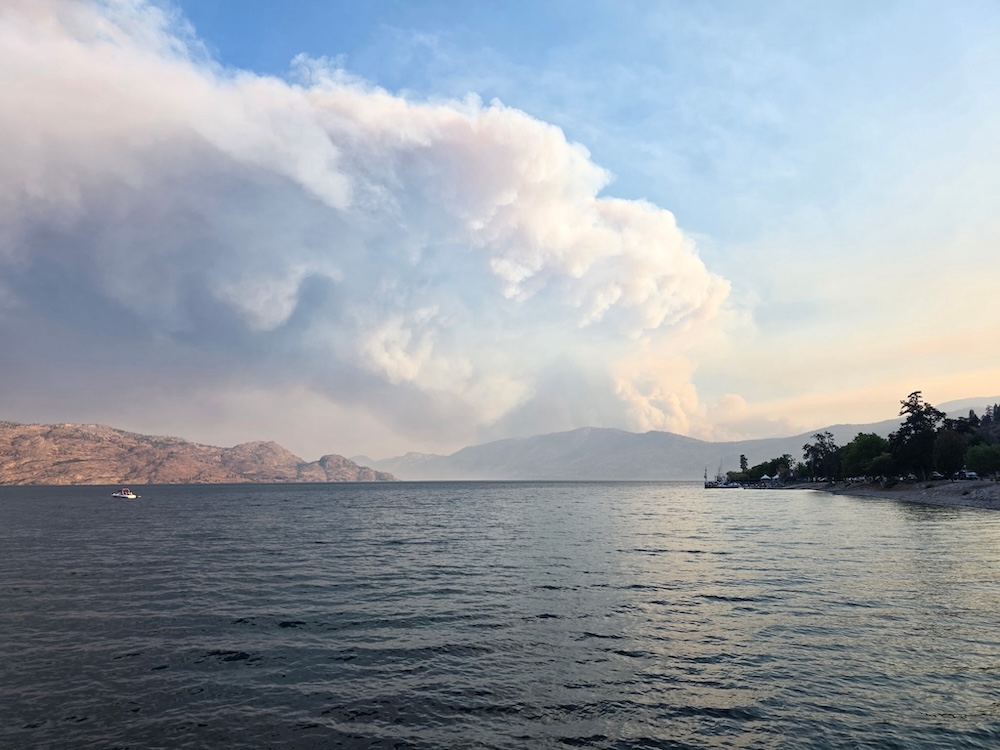
Twelve hours after Summerland had been evacuated, my mom and aunt had come to a stark conclusion.
“They lost Granny,” my mom told me.
My grandmother, a cantankerous 93-year-old woman with dementia and a government-subsidized spot in a private Summerland care home, may or may not have actually disappeared. The problem is that we didn’t know.
What we did know is that my aunt, who has Grandma’s power of attorney, was unable to find anyone to confirm that she was safe and receiving care, medicine and food.
My grandmother had, to our eyes, dropped off the map as flames raced toward her seniors home. And we could only hope that someone actually knew where she was.
A weekend of uncertainty
Because my grandma’s cognitive capabilities have declined with age and she doesn’t have the ability to participate in this, I’m going to avoid using her name or providing too many specifics. I’ll say only that her relationship with my family is, to use a euphemism, complex. But even difficult people need health-care advocates, and emergencies concentrate one’s focus on a single question: Is my family member getting the care and protection they need?
My grandma lived in a facility called Summerland Seniors Village with a mix of private and publicly funded beds at a range of care levels. She lived in an assisted-living bed but, like many in B.C., was awaiting a bed in a long-term care facility that would provide more support. She uses a scooter for mobility and has some, though not all, of her previous cognitive capabilities. Her power of attorney resides with my aunt, who for decades was a nurse; part of that work involved co-ordinating long-term care. That previous experience informed my aunt’s pursuit of information and her (and our) understanding of how health-care systems are supposed to function.
Here is what we heard, as we heard it:
Saturday morning
My aunt, having failed to reach anyone from Summerland Seniors Village, begins to search online for information about my grandma’s potential whereabouts. She hears residents from Summerland Seniors Village have been taken to Penticton’s hockey arena and/or its conference centre, where evacuation centres had been organized. Facebook posts by other families suggest some or all patients had been, or were in the process of being, moved to other long-term care homes in the Okanagan. Again, details are vague. Those facilities do not answer the phone.
Interior Health, which regulates seniors care and publicly funds and subsidizes many of the beds in the facility, has set up a hotline for families to call. My aunt calls the number, but no one has my grandma’s name on file. The call respondent suggests my aunt call Kelowna General Hospital. My aunt does so, inquiring whether my grandma had been admitted — or in the morgue. My grandma is not at the hospital.
My aunt is told to keep checking with Interior Health. The health authority’s hotline, however, stops operating at 4 p.m. Emergency or no emergency, it is still the weekend.
We speculate on Grandma’s potential location. We agree the most likely thing is that Grandma is sitting at the conference centre. We are unsure whether she is receiving food, care, medication or other help, or whether her movements are monitored. We consider the likelihood she may be attempting to play the slots at the adjacent casino, though she does not have money. We debate whether she might attempt to travel somewhere. We consider the possibility that she may have been overlooked during the evacuation itself. We think that is unlikely, but the question and its implication linger.
Sunday
In the morning, my aunt calls the Interior Health hotline. They have no record of Grandma and say to call back later. The respondent, who seems to be reading from a script, suggests my aunt call Penticton’s hospital this time, which she does.
We discuss solutions to increase the pressure on authorities to find us information. I contact a reporter I know. We consider filing a missing person’s report with police.
Finally, around 11:30 a.m., my grandma’s occasional caregiver, who has also evacuated, texts my aunt with second-hand confirmation that my grandmother is at the conference centre. Shortly after, an Interior Health representative confirms the news and says my grandma will be moved to a facility in Osoyoos.
Just after midnight, the head of the company that owns Summerland Seniors Village calls my aunt to confirm the safety of my grandmother.
Not alone
In the past two days, I’ve spoken to the families of other residents, briefly exchanged emails with the president of the company that operates Summerland Seniors Village, emailed various provincial ministries and interviewed an Interior Health official in charge of evacuations.
The first thing to be clear about is that the urgent evacuation of the care home was a complex effort under extraordinary circumstances. More than 200 residents, many in long-term care and in worse physical condition than my grandmother, were evacuated in just a couple of hours as flames bore down on Summerland. Unlike in most other evacuations Interior Health has undertaken and prepared for, there was very little notice, since the fire had broken out just hours prior.
Interior Health had to co-ordinate the transportation of patients with very different needs. Buses, ambulances and other vehicles were used. Some patients required stretchers and ambulatory care.
Summerland Seniors Village seems to have fulfilled its immediate duty to residents, evacuating them, keeping them safe and eventually getting them to other facilities. So did Interior Health. With the residents hastily and effectively evacuated out of harm’s way, the immediate attention seems to have revolved around the long-term care residents in the greatest need of ongoing care.
Interior Health arranged to have those residents driven north, through a roundabout route, to a new care home in Kelowna that had just been built and was slated to open in the coming weeks.
But the process of finding spaces for seniors in assisted care and independent living, like my grandmother, took considerably longer. And while they waited at the convention centre, many families became increasingly uncertain that the seniors were actually safe. During this period, which lasted all through Saturday and into Sunday afternoon, those seniors’ families improvised ways to confirm the location of loved ones, very few of whom had cellphones.
As my aunt scrambled to find Grandma, she was hardly alone. On a local Facebook group, the children and grandchildren of seniors swapped information about what they had heard about the potential location and destinations of their loved ones.
One family found their parents thanks to the Apple AirTag attached to the collar of their dog. The tag confirmed their location at the convention centre, but the couple’s daughter told Global News she needed to recruit a Penticton local to visit the convention centre to ensure they had their medication, food and a bed.
When Donna Szucs heard her 89-year-old mother-in-law was evacuated, she called a Penticton friend who was also pals with the evacuated senior. The friend drove to the convention centre, where the seniors seemed healthy but isolated and uninformed, Szucs said. They had been told to not leave the convention centre, an order that was being strictly followed — though it created some resistance when the friend sought to get Szucs’s mother-in-law to come with her, rather than wait to be taken to an unfamiliar care home. Close to noon, Szucs said, the seniors were told to move to a designated room. By the time Szucs’s mother-in-law was persuaded to leave around 3 p.m. that afternoon, the seniors had been sitting in the room for hours with little communication.
Janet Mervin, who lives in New York, spent days trying to confirm the location of her 98-year-old grandmother.
“I kept telling myself, ‘Of course she got on the bus, of course she’s safe and she probably didn’t wander off,’” she told me. “But I didn’t know, and that was the worst part.”
Eventually, on Sunday, more than a day after the evacuation, Mervin created a Facebook post seeking information. A Penticton stranger volunteered to visit the convention centre and attempt to find her grandmother. A second respondent recruited her own mother to join the search. They found her grandmother — but Mervin said there was initial confusion because her grandmother had medication in her pocket that had somebody else’s name on the label. The two women waited with the evacuated senior until Mervin’s own parents, who are in their 80s and live in Kamloops, could make the winding drive south to retrieve her.
Szucs, Mervin and my aunt all say the lack of communication and the seemingly improvised post-evacuation process should prompt reflection and better protocols to guide future care home evacuations.
“I am not thrilled with the fact that they did not have a plan after evacuation,” Szucs said. “I’m not bashing them. They did an excellent job getting all those people out… but it’s when they got them into the evacuation centre, I don’t understand why there wasn’t a mass email sent out or a mass text message sent out to primary contact people.”
In an initial email, Robert Freeman, the president of the company that operates the facility, wrote that staff had sent two email blasts and posted a notification on the facility’s website. He said the company did not have email addresses on file for many families.
Neither Szucs nor Mervin said they received an email. Mervin said the website message was only posted on Sunday after she had confirmed the safety of her grandmother and had subsequently received a call from Freeman and suggested the company post such a notice.
Given the potential trauma of the evacuation and the prolonged period they sat in the convention centre, Szucs suggested wristbands with vital information, a buddy system and other preplanned safeguards could have helped ensure the protection of the seniors. Mervin said the nursing home should have had a comprehensive contact list that would have allowed it to swiftly contact residents’ families soon after the evacuation.
Triaging priorities
The urgency of the evacuation required triaging priorities, Freeman wrote in an initial email Monday after I first described the concerns and asked for an interview.
In a followup email, Freeman wrote: “It really was about a priority of issues, getting out, ensuring life safety, residents being accounted for and safe transfer in those first 12 hours. But as you can imagine, evacuations leave a lot that is needed behind so triage doesn’t end, just evolves.”
He promised to get back to me. I then requested a copy of the care home’s evacuation plan.
Freeman later wrote that the company did “not have the bandwidth to support the inquiry at the moment. We have diverted much of our bandwidth regionally, the site team does not have access to the residence and we are still very much focused on finding and supporting moves and migrations of residents and team members in multiple locations.”
I wrote back, saying only that I had assumed the plan would be remotely accessible and not require a physical effort to retrieve. I did not receive a response.
What went wrong?
The triaging of priorities is inevitable in an emergency. But which tasks get shunted aside can reveal the preparedness of the systems we trust to keep ourselves and our loved ones safe. Every long-term care home in B.C. is mandated to have an emergency preparedness plan. Interior Health has its own emergency plans and protocols.
But having a plan is not the same as having enough resources to execute it or having a plan that can meet the moment of a community-wide evacuation and the immediate aftermath.
My grandmother’s evacuation prompted me to question what tracking and monitoring would happen in similar scenarios involving children. That’s a story I’ll pursue at another time, but I did ask the Ministry of Education and Child Care what the province does to support evacuation of children. A communications officer with the minister provided a response that said child-care and summer camps are responsible for developing evacuation plans and following them, and that local officials are responsible for co-ordinating emergency response and support.
Many of my questions revolve around the operation of Penticton’s evacuation centre and how it is managed. I called and left a message with the Regional District of Okanagan-Similkameen’s communications line but did not hear back.
I did exchange text messages with an emergency manager in another jurisdiction who described “huge inconsistencies” in how evacuation centres are managed from community to community and a lack of capacity by the province to co-ordinate the efforts.
I asked repeatedly for an interview with Minister of Emergency Management and Climate Readiness Kelly Greene. A communications officer with the ministry said they would do their best and also urged me to attend a Tuesday press conference virtually. I did so but the press conference concluded after an hour without me being called upon to ask a question. I continued to ask for an interview with no success. I virtually attended a second press conference Wednesday but again was unable to ask questions.
Nothing I heard from the province was reassuring. To my family and others, it appeared that something fundamental might have failed when it came to tracking, managing and caring for the assisted-living seniors in the two days following their evacuation.
‘The public needs confidence’
On Wednesday, I spoke for half an hour with Brent Hobbs, Interior Health’s program director in charge of patient access, transport and emergency. He promised me that my grandmother had not been “lost” as we had feared, and that Interior Health did know where each patient was at every step of their evacuation journey. But he also said the inability of the health authority to communicate that information to families was a problem that will need to be examined and fixed.
“The public needs confidence that we have systems in place that we can identify patients in real time, and we can, and we did,” he said.
Hobbs hailed the work of Interior Health and Summerland Seniors Village staff in evacuating the patients within a couple of hours Friday. (I told him I also appreciated the efforts.) He said the tracking of patients occurred every step of the way.
“We make sure every patient is identified before they get into a vehicle,” he said. Each Summerland Seniors Village resident had a laminated identification card and a care plan, Hobbs added. The tracking of patients and their needs, Hobbs said, is critical to an operation that uses vehicles ranging from ambulances to BC Transit buses to move more than 200 people with vastly different needs.
“We knew where the patients were at all times. Our first priority is making sure they get to the right place in the right time.”
The operators of private facilities are expected to take the lead in contacting families, but Hobbs said that doesn’t preclude Interior Health from sharing what it knows.
Hobbs said tracking information and lists of patients were generated throughout the evacuation process. A team of three analysts later spent an entire night reconciling that information, he said.
I told Hobbs that the fact Interior Health representatives — particularly those manning a hotline specifically created to help families seeking evacuated seniors — couldn’t say where our loved ones were suggested to families that the health-care system might not actually have that information.
Hobbs said he understood the concern.
“We knew where our patients were at all times, and we created call centres, so is it a human error that happened?” he asked. “I think the system is very strong because we have lots of experience in this space; we have to look into the matter to understand what happened here.”
After an evacuation, Hobbs said, Interior Health holds an internal review to evaluate its response and seek ways to improve. He said the organization will probe the communication challenges that happened following the Summerland evacuation.
“Where the miscommunication occurred, we have to look and learn from it.”
Families want to be part of that conversation.
Evacuations are stressful times, and seniors are particularly vulnerable. When Mervin and her grandmother spoke on the phone following the evacuation, her grandmother called her by the wrong name. That hadn’t happened before, and Mervin suspected it was because her grandmother may have been dehydrated. She said that when her mother arrived to pick up her grandmother, the evacuation centre appeared to have bags of clothes littered around it.
Szucs is trying to assemble a group of family members who can advocate for improvements that might solve some of the challenges they encountered.
“I’m not putting them down,” she said. “They did a great job [to evacuate the seniors] but they need to do something to make this better so this doesn’t happen again.” ![[Tyee]](https://thetyee.ca/design-article.thetyee.ca/ui/img/yellowblob.png)
About the Author