Earlier this week, the Centers for Medicare and Medicaid Services (CMS) published information about the Medicare Advantage plans that will be available for the coming 2027 plan year. Starting October 1st, insurers, brokers, and other third-party entities can market Medicare Advantage plans, and during the annual open enrollment period, which runs from October 15th through December 7th, Medicare beneficiaries can make changes to their Medicare coverage for the coming year. In a press release, CMS emphasized stability in the Medicare Advantage marketplace overall. This analysis explores Medicare Advantage plan availability for the average beneficiary and at the state level.
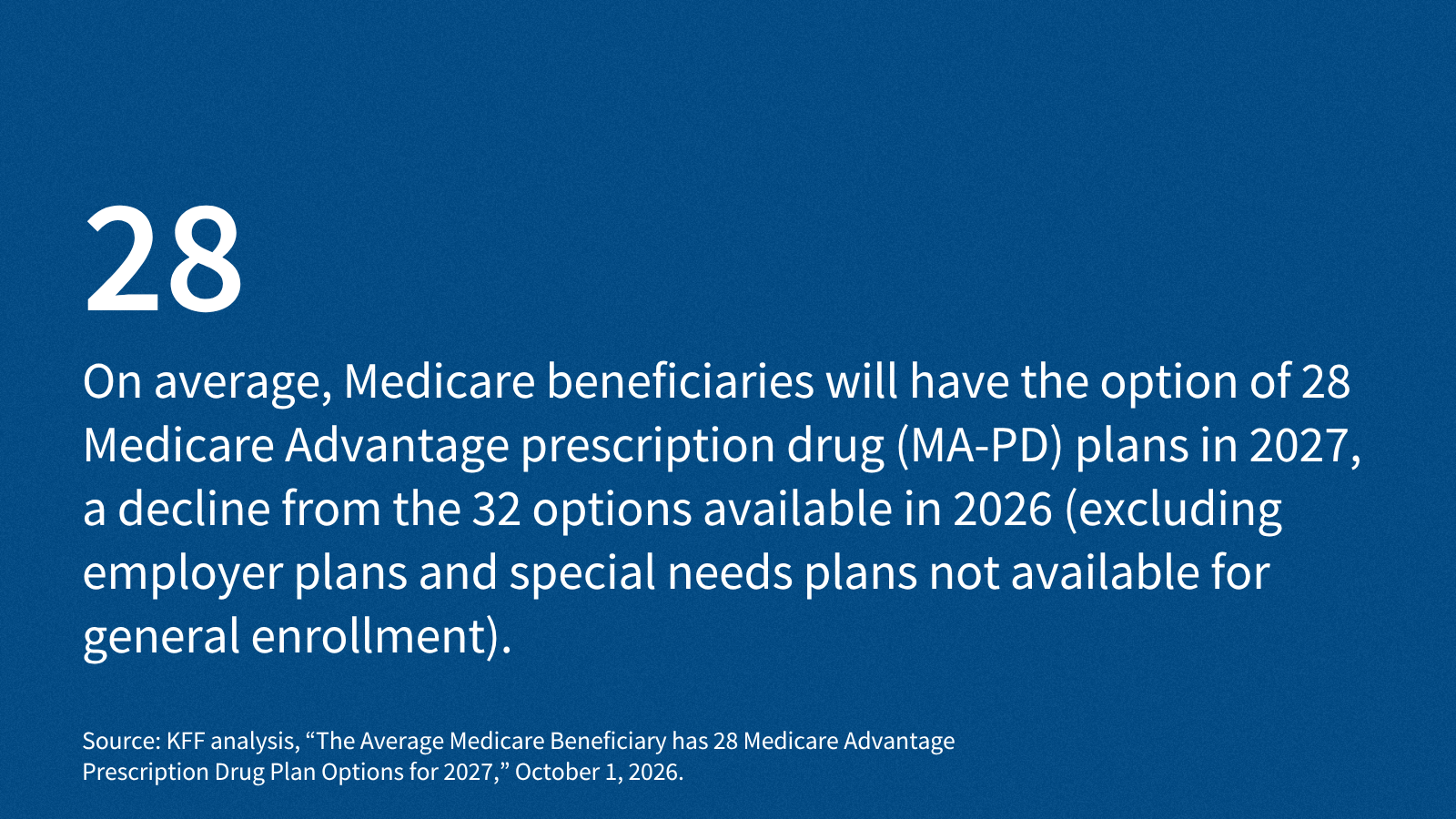
KFF’s analysis of plan offerings shows that, on average, Medicare beneficiaries will have the option of 28 Medicare Advantage prescription drug (MA-PD) plans in 2027, a decline from the 32 options available in 2026 (excluding employer plans and special needs plans not available for general enrollment). The number of MA-PD options grew steadily between 2010 and 2024, reaching a peak of 36 options for the average Medicare beneficiary in 2024. The number of options available for 2027 will be higher than the number available in 2021 (27) and every year before (Figure 1).
Across all Medicare Advantage plans for general enrollment, including those with and without prescription drug coverage, the average Medicare beneficiary can choose from among 35 plans in 2027, compared to 39 plans in 2026. Similar to the trend for MA-PDs, the total number of Medicare Advantage plans available to the average beneficiary is higher than the average number of plans available in every year between 2010 and 2021. While Medicare Advantage plans are required to cover all Medicare Part A and Part B benefits, plans decide whether to include Part D prescription drug coverage as part of the benefit package. Enrollees may pay a separate premium for Part D coverage, or plans can use the rebate portion of their payment from the federal government to cover these costs. Most Medicare Advantage enrollees are in plans that include prescription drug coverage and most pay no premium beyond the Part B premium.
The modest decrease in the number of Medicare Advantage plans available to the average beneficiary means that some Medicare beneficiaries will find that their current coverage is no longer an option for next year. In most cases, these beneficiaries live in counties where they will continue to have robust Medicare Advantage plan options available for 2027, as well as traditional Medicare. Some beneficiaries in plans that have exited the market will have the option to enroll in a plan offered by the same insurer, and in many cases, enrollees will be moved into a new plan offered by the same insurer automatically if the contract includes another plan of the same type (i.e., HMO or PPO) in the same county. Others will have to make an active choice about their Medicare coverage if they wish to enroll in another Medicare Advantage plan or will be automatically covered by traditional Medicare.
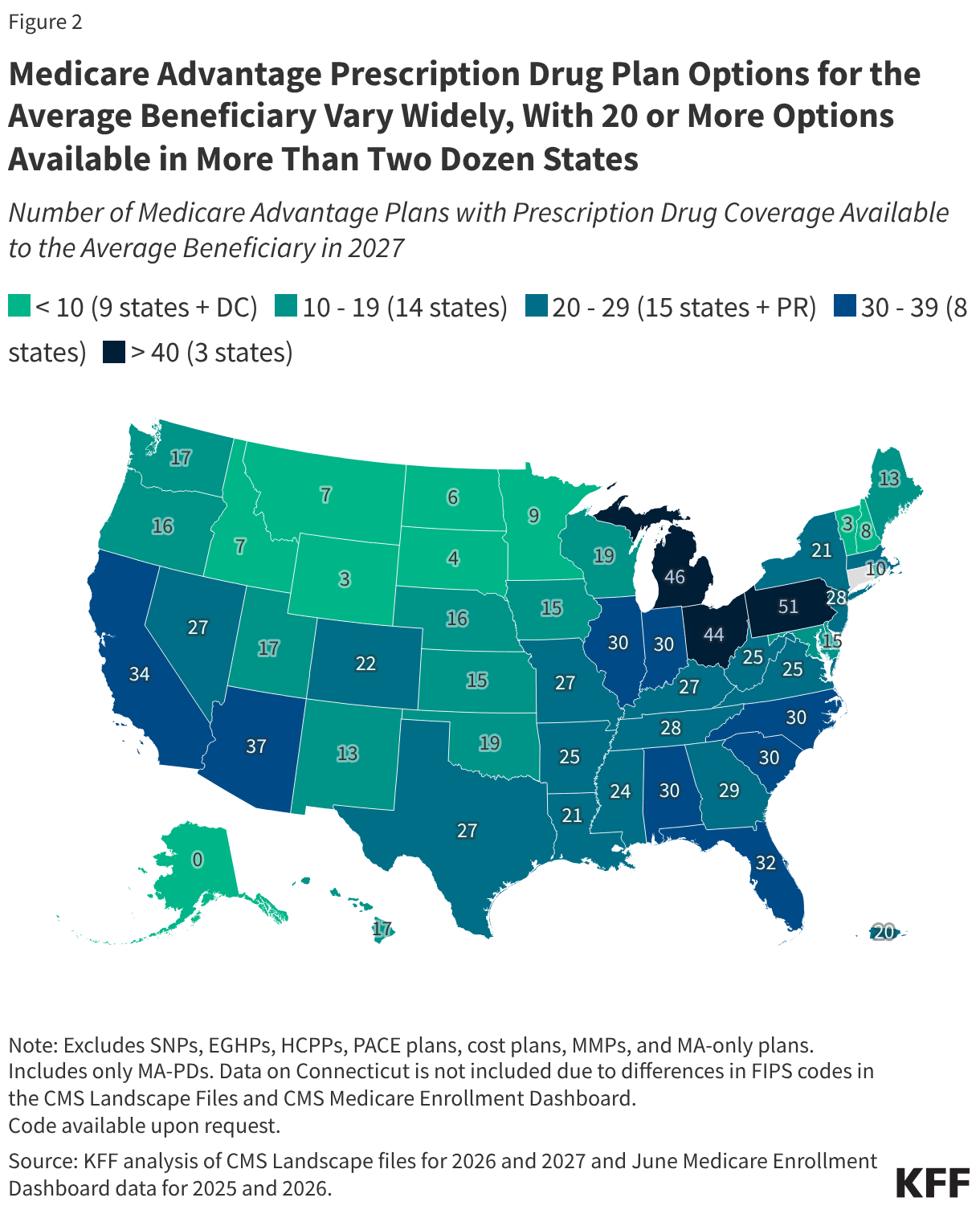
The number of Medicare Advantage plans with prescription drug coverage available to the average beneficiary varies across states (Figure 2). In 26 states and Puerto Rico, the average Medicare beneficiary has at least 20 MA-PD options in 2027, including 3 states (PA, MI, and OH), where the average beneficiary has at least 40 MA-PD options. In 9 states and DC, the average Medicare beneficiary has fewer than 10 MA-PD options in 2027. This includes Alaska, which has no plans available in 2027, as in 2026 (Alaska has historically had few or no Medicare Advantage plans available for general enrollment). Connecticut is not included in this calculation because of differences in how counties are reported across CMS enrollment and plan files.
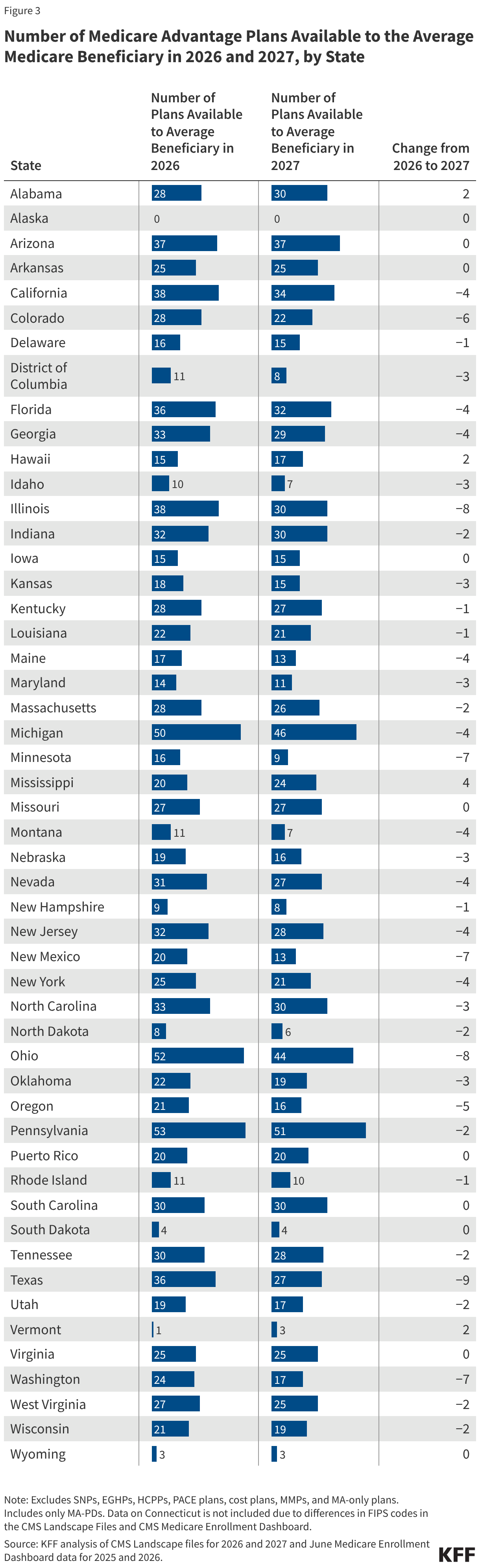
Across most states, the average beneficiary will have fewer Medicare Advantage plan options in 2026 compared to 2027. The states with the largest drop in the number of MA-PDs available for general enrollment are Texas (-9), Illinois and Ohio (-8), and Minnesota, New Mexico, and Washington (-7). In nine states beneficiaries will have the same number of MA-PD options in 2027 as in 2026 (excludes Alaska where no MA-PDs are available in 2026 or 2027), and in four states beneficiaries will have more options (Figure 3).
Choosing how to receive Medicare benefits remains a challenge for Medicare beneficiaries. Beyond the number of plans available, every year there are changes to Medicare Advantage plan benefits and costs, including the scope and generosity of extra benefits, cost sharing for Medicare-covered benefits, out-of-pocket limits, rules for using covered services (such as referral requirements and prior authorization), drug formularies, and provider networks. (These data are released separately by CMS and a comprehensive analysis from KFF will follow.) Despite these changes, most Medicare beneficiaries report that they do not compare coverage options on an annual basis. Further, prior Medicare focus groups indicate that Medicare enrollees are often overwhelmed by the number of Medicare Advantage choices and have difficulty sorting through all plan options. With more than two dozen MA-PDs available in 2027, on average, and year-to-year changes in benefits and costs, understanding how plans differ and how these differences could affect costs and access remains a challenge for beneficiaries.
About the Author