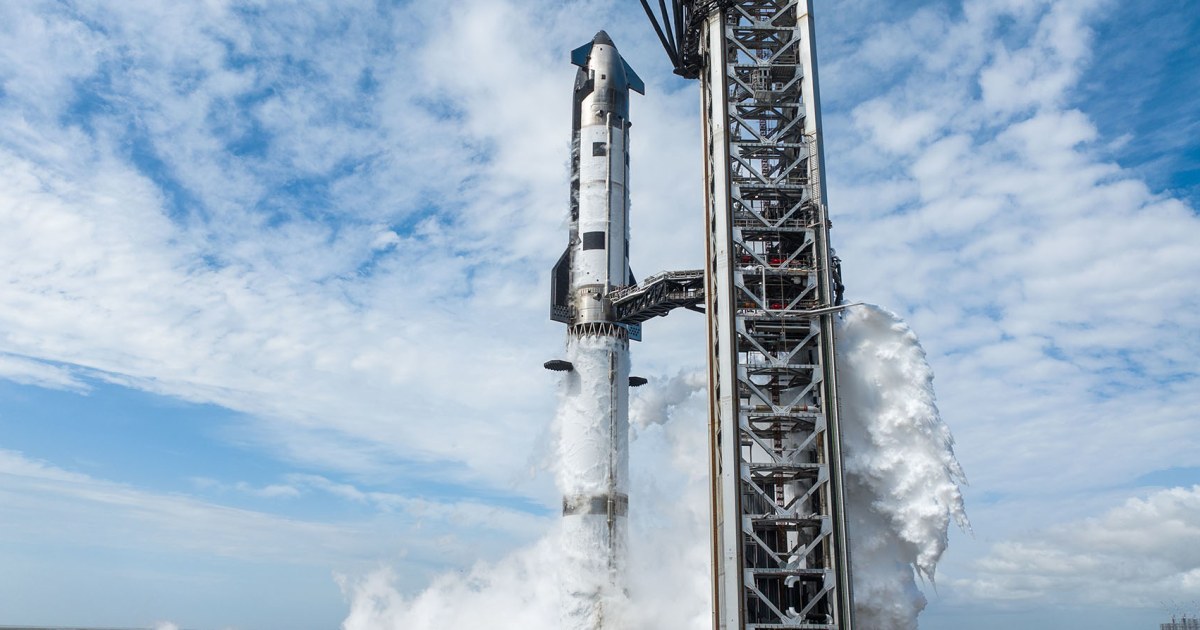
SpaceX is set to launch a new prototype of its Starship megarocket — the system NASA may use to land astronauts back to the moon — on a key test flight Thursday.
Subscribe to read this story ad-free
Get unlimited access to ad-free articles and exclusive content.

The test will be the 12th such flight for Starship but the first launch of the new third-generation Starship, dubbed V3, which is bigger, more powerful and a step closer to being fully reusable.
The rocket is scheduled to lift off from a new launchpad at SpaceX’s Starbase facility on the southern tip of Texas during a launch window that opens at 6:30 p.m. ET. Weather conditions are 55% favorable for the flight, according to SpaceX.
The company plans to broadcast the event live beginning at around 5:45 p.m. ET.
Thursday’s test will be closely watched because NASA hopes to use Starship to land its astronauts on the lunar surface. As part of the agency’s Artemis program, SpaceX and Jeff Bezos’ Blue Origin are each building lunar landers that NASA could use for a planned moon landing in 2028. The space agency aims to test one or both new vehicles in low-Earth orbit on the Artemis III mission late next year.
Additionally, SpaceX CEO Elon Musk on Wednesday confirmed plans to take the company public in what might be the biggest-ever initial public offering. That could make Musk — who will hold 85% voting control over the company after the IPO and remain its CEO, chairman and chief technology officer — a trillionaire.
Starship’s last test flight was seven months ago. Since then, the rocket’s booster, known as Super Heavy, and its upper stage, called Ship, have undergone extensive redesigns.
Starship V3 measures 408 feet tall fully stacked, a few feet taller than its predecessor. SpaceX also added new engines on Super Heavy and Ship, so together they will be able to generate around 18 million pounds of thrust.
Other upgrades included reducing the number of “grid finds” on the booster, which are features at the top that help to guide the rocket’s first stage back to Earth, and increasing the volume of Starship’s propellant tank.
“Together, these new elements are designed to enable a step-change in Starship capabilities and aim to unlock the vehicle’s core functions, including full and rapid reuse, in-space propellant transfer, deployment of Starlink satellites and orbital data centers, and the ability to send people and cargo to the Moon and Mars,” SpaceX said on its website.
During Thursday’s suborbital test flight, Starship will try to deploy 22 mock Starlink satellites. SpaceX will also try to relight one of the upper stage’s six Raptor engines in space, an important capability for deorbit burns when the vehicle eventually returns to Earth from space.
The test flight is expected to last about 65 minutes. Similar to previous outings, the upper stage should splash down in the Indian Ocean at the end of the mission. SpaceX eventually plans to make Ship reusable and “catch” the spacecraft with mechanical arms on the launch tower at its South Texas facility.
SpaceX has demonstrated similar catch maneuvers with Starship’s Super Heavy booster on previous test flights. This time around, the booster is set to land offshore in the Gulf of Mexico and will not try to return to the Texas launch site for a catch, according to SpaceX.
The company faces a tight timeline for its development of Starship. The rocket, which made its debut flight in 2023, suffered a string of failures last year, including an uncontrolled re-entry through Earth’s atmosphere and two midflight explosions as the upper-stage vehicles were accelerating into space. SpaceX is aiming to have Starship ready for next year’s Artemis III mission, when NASA hopes the rocket’s upper stage will rendezvous with the agency’s own Orion capsule (the vehicle that carried the Artemis II astronauts around the moon) in orbit.
If all goes well, SpaceX will then work to get Starship certified to carry NASA astronauts to the moon in 2028.
About the Author