Listen to this article
Estimated 4 minutes
The audio version of this article is generated by AI-based technology. Mispronunciations can occur. We are working with our partners to continually review and improve the results.
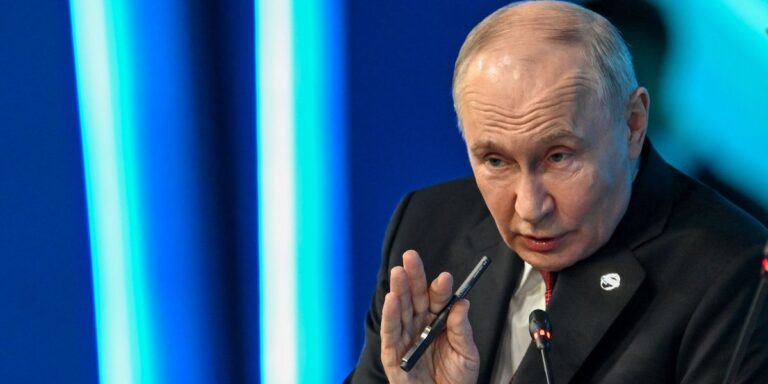
Russian President Vladimir Putin said Thursday that the world was living through a dangerous moment and warned the West not to escalate a standoff over Ukraine by threatening the Russian exclave of Kaliningrad, which Moscow has made clear it would defend with nuclear weapons if necessary.
Putin, who has said Russia had no choice but to launch its full-scale invasion of Ukraine to safeguard its security, said Russia had no plans to attack any European country and wanted to coexist peacefully.
But he reiterated that Moscow would resort to all weapons in its arsenal, including nuclear ones, if its most westernmost territory — Kaliningrad, wedged between Poland and Lithuania — were threatened.
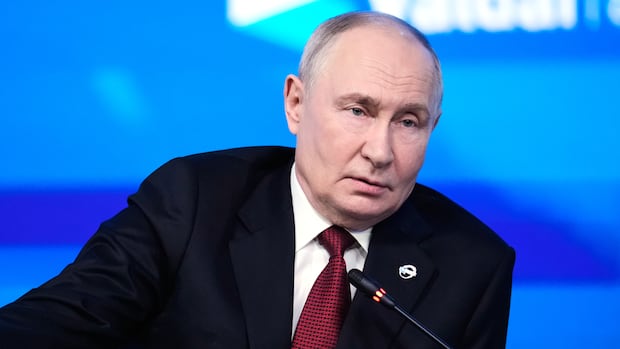
“If it comes to a direct attack on the Russian Federation — in this case, we are referring to Kaliningrad, and perhaps other territories as well — the question of the Russian Federation deploying all the weapons at our country’s disposal will, of course, inevitably and immediately be on the agenda,” Putin told the Valdai Forum of international Russia experts in Moscow.
“This is inevitable,” he said.
Putin said Russia realized it would be facing “an enemy (NATO) twice our size.”
“And we will have to make use of our competitive advantages in this struggle. Yes, of course, France and Britain are nuclear powers — we understand that perfectly well and are fully aware of it,” he said. “But no one else possesses the kind of weapons that Russia has today. That is our competitive advantage.”
Prior warning delivered to NATO
Putin’s comments followed a diplomatic note that NATO said this week it had received from Russia, warning the Western military alliance Moscow would be ready to resort to nuclear weapons if NATO attempted to cut off Russia’s Baltic exclave.

Russia’s warning highlighted Moscow’s urgent concern over what it has portrayed as a growing NATO threat to Kaliningrad, a heavily militarized Russian territory slightly larger than the U.S. state of Connecticut. NATO Secretary General Mark Rutte said the alliance responded by emphasizing that it is defensive alliance and that nuclear threats are not helpful.
Relations, already dire since Putin’s decision to send troops into Ukraine in 2022, have worsened this year, with European governments accusing Moscow of stepping up a “hybrid war” on the continent through acts including sabotage and arson.
Russia denies those allegations and rejects repeated statements by Western politicians that it is preparing for a possible military attack on a NATO country.
Putin warned that cycles of escalation in international conflict could quickly lead to dangerous scenarios.
“We must realize that the moment when nothing can be changed any longer may come very quickly and unexpectedly for everyone. The logic of escalating, increasingly harsh retaliatory measures leads to a fatal point of no return,” he said.
“At the heart of this escalation lie arrogance and overconfidence. This is a path to the brink of the abyss. All the more so today, when the arsenals of the world’s leading powers contain weapons capable of destroying all life or, at the very least, reducing the Earth to a catastrophic state,” Putin said.
“Can we be certain that these weapons will never be used? Well, of course not. We must bear this in mind and avoid such an outcome.”

As Western intelligence warns about a planned escalation in Ukraine, Russian airstrikes have killed at least 12 people in Kyiv over six days. Meanwhile, Germany formally accused Russia of sabotage on a Ukrainian plane at the Leipzig airport.
Putin, who said he was ready for a trilateral meeting with Chinese President Xi Jinping and U.S. President Donald Trump if a proper agenda were worked out first, ruled out stopping Russian strikes on Ukrainian targets in the Black Sea region. He also acknowledged that Ukrainian strikes on oil refineries across Russia had cost the country one per cent of its gross domestic product (GDP).
He said Russia was now responding to Ukraine in kind.
But while he portrayed Western assistance to Kyiv in launching deep strikes inside Russia as a future threat, he said Moscow was not planning to attack European arms factories supplying Ukraine “tomorrow.”
About the Author