Federal vaccine policy has shifted toward fewer recommended routine childhood vaccinations, more emphasis on individual decision-making, and greater skepticism about the safety and efficacy of some vaccines. In response, some states are relying less on federal recommendations in setting vaccination requirements. The changes coincide with declining childhood vaccination rates, rising exemptions from school vaccine requirements, and a major measles resurgence. The public’s trust in federal health officials remains low.
Overview
Since January 2025, the Trump administration has made major changes in federal vaccine policy, including which vaccines the federal government recommends, who makes those recommendations, and the kinds of messages that it is providing to the public.
The changes represent a shift from an expert-driven federal vaccine framework with broad support for routine childhood immunizations toward narrower federal recommendations, fewer recommended childhood vaccinations, greater state variation and greater reliance on individual decision-making. They are unfolding against a backdrop in which childhood vaccination rates were already declining and as vaccine-preventable diseases such as measles are resurging in several states.
Key Developments
Health and Human Services Secretary Robert F. Kennedy Jr., a longtime critic of federal vaccine policy who has questioned the safety and effectiveness of vaccines, has spearheaded the overhaul. Kennedy also is a leading figure in the Make America Healthy Again (MAHA) movement, which has elevated issues such as vaccine safety, the role of corporate interests in federal health agencies, and the presence of chemicals in the food supply.
In June 2025, Kennedy fired and replaced all the members of the Advisory Committee on Immunization Practices (ACIP), the expert panel charged with providing evidence-based recommendations to the Centers for Disease Control and Prevention (CDC).
During 2025, among other policy changes, the CDC revoked its recommendation that healthy children and pregnant women receive routine COVID-19 vaccines and later, in line with guidance from the reconstituted ACIP, revised its immunization schedule to recommend “shared clinical decision-making” for COVID-19 vaccines. In December, ACIP members voted to end the 34-year-old recommendation that all newborns receive the hepatitis B vaccine within 24 hours of birth.
That same month, federal health officials made vaccination reporting measures voluntary rather than mandatory in Medicaid and the Children’s Health Insurance Program, which could make it harder to monitor and understand vaccination trends for children.
The most significant changes came in January 2026, when HHS adopted a substantially revised childhood vaccination schedule. This reduced the number of diseases targeted from 17 to 11 and the number of routine vaccines from 13 to 7, making the U.S. an outlier among peer nations. As a result, six vaccines are no longer recommended for routine use by all children in the U.S.: rotavirus, COVID-19, influenza, hepatitis A, hepatitis B, and meningococcal vaccines. Some of these vaccines are now recommended for a narrower group of children, and all six have been moved from the routine category of vaccination to “shared clinical decision making.” (A federal judge has temporarily blocked the revised HHS recommendations.)
In August, The White House released an executive order reiterating the changes to the childhood vaccination schedule. It also called on the HHS Secretary to offer some childhood vaccines such as measles, mumps, and rubella (MMR) as “single vaccines rather than combination products”, meaning they would be delivered in three separate shots rather than in a single vaccination covering all three.
More generally, President Trump and Secretary Kennedy have repeatedly raised safety concerns about vaccines, including advancing the idea that vaccines cause autism and linking childhood vaccinations with a rise in chronic diseases in children — assertions for which there is no evidence.
At the state level, at least nine states have enacted changes since 2025 that make non-medical exemptions to mandatory school vaccinations more permissive, including by reducing documentation or procedural requirements. Research indicates that easier-to-obtain non-medical exemptions are associated with higher exemption rates and declining childhood vaccination coverage.
Recent Issues and Looking Ahead
In response to the federal changes, a growing number of states has begun to separate their vaccination requirements from federal recommendations. As of August 2026, 30 states and DC had announced they would no longer follow CDC/ACIP recommendations for one or more childhood vaccines, with 27 states delinking from CDC/ACIP recommendations for all childhood vaccines. States are relying instead on prior recommendations, state recommendations, and/or the guidance of external entities such as the American Academy of Pediatrics (AAP) in shaping their state vaccination requirements for children.
The federal changes also have raised concerns about insurance coverage of vaccines. Many private insurers, Medicaid programs, and the federally funded Vaccines for Children program are required to cover ACIP-recommended vaccines without cost-sharing. Changes in recommendations can affect which vaccines insurers must cover at no cost. In practice, the effects vary because states can establish additional requirements, particularly for state-regulated insurance plans and school entry. As a result, vaccine recommendations and potentially the coverage available to families can differ by state. For now, insurers have said they will continue to cover the same vaccinations, and the federal court ruling means the HHS changes to the childhood vaccination schedule remain blocked.
All of this is occurring in a landscape in which childhood vaccination rates were already falling. Data show that 92.4% of kindergarteners had been vaccinated against measles, mumps, rubella (MMR) and polio and 92.0% against DTaP (diphtheria, tetanus, and acellular pertussis) for the 2025-2026 school year. That was down from 95% across all three vaccines for the 2019-2020 (pre-pandemic) school year and below coverage levels of the past decade. At the same time, the share of kindergarteners with exemptions from one or more school vaccination requirements rose to 4.2%, up from 2.5% in 2019-2020.
A vaccination rate of at least 95% is needed to prevent community transmission of measles. Thirty-nine states had MMR coverage below the 95% level, and 18 states were below 90%.
Although measles has been officially “eliminated” from the U.S. since 2000, measles cases have surged over the past two years. In 2026, the U.S. has reported nearly 3,887 confirmed cases of measles as of October 1, more than in any year since 1991, already exceeding the total for all of 2025 and putting the U.S.’s elimination status at risk. Measles cases have been reported in most states, with South Carolina, Utah, Pennsylvania, Texas, and Virginia seeing the largest outbreaks so far in 2026.
The Public’s Views
KFF polling finds that the public’s trust in the CDC remains at its lowest point following the Trump administration’s revisions to the childhood vaccination schedule. Fewer than half (47%) now say that they trust the agency at least “a fair amount” to provide reliable vaccine information, down more than 10 percentage points since the beginning of the second Trump administration, and continuing a downward trend first measured during the COVID-19 pandemic. Views differ along partisan lines, and the recent decline reflects falling confidence in the CDC among Democrats.
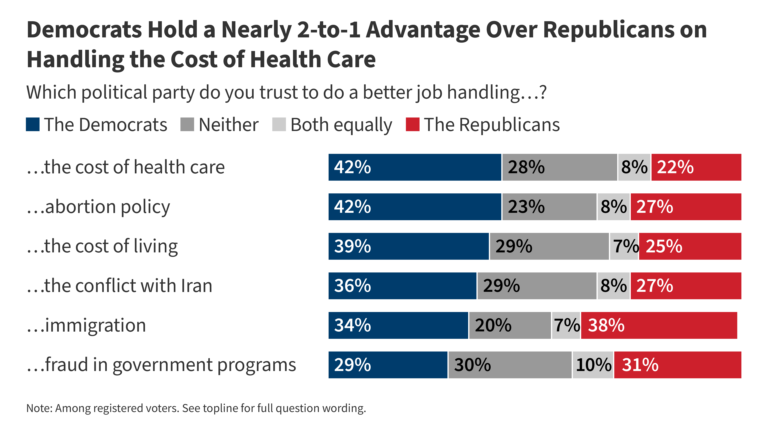
About four in ten voters approve of the Trump administration’s handling of vaccine policy (38%) while six in ten disapprove (61%). Democrats hold the advantage over Republicans in whom voters trust to handle vaccine policy (41% vs. 25%), though one quarter trust neither party. While some of the administration’s vaccine policy changes may have been intended to appeal to MAHA voters, among voters who support MAHA, four in ten say lowering health care costs should be the government’s top health care priority, while only one in ten choose reevaluating vaccine safety.
KFF Experts
Jen Kates, a Senior Vice President and Director of the Global and Public Health Policy Program
Josh Michaud, an Associate Director for Global and Public Health Policy
Liz Hamel, a Senior Vice President and Director of Public Opinion and Survey Research
Journalists with questions about this topic should reach out to KFFMedia@kff.org.
About the Author