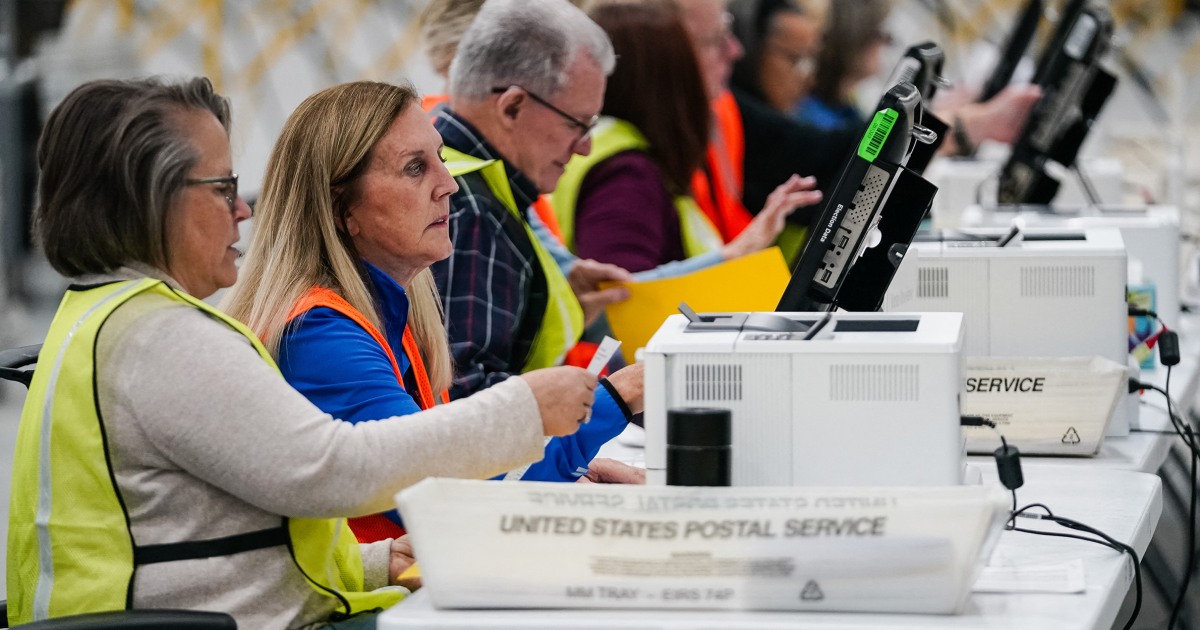
Democrats are changing how they vote, requesting fewer mail ballots than in past elections but returning the ones they do request more quickly, according to a new NBC News Decision Desk analysis of the early vote conducted in coordination with the University of Pennsylvania.
The findings, which come less than four weeks before Election Day, reflect a midterm landscape shaped by concerns about mail-in voting and doubts about the reliability of the U.S. Postal Service. The shift among Democrats suggests they may be abandoning mail ballots in favor of in-person voting, or taking precautions to ensure their ballot arrives on time.
The implications could be significant. Since 2020, Democrats have been far more likely than Republicans to vote by mail, creating predictable patterns in how early election tallies shift as additional votes are counted. But if those habits are changing, it will be more difficult to gauge which party has more enthusiasm from early voting figures, while the now-familiar red and blue “mirages” seen on recent election nights could unfold differently.
For the analysis, we compared current and historical data on mail ballot requests and returns at the same point in time across four states: North Carolina, Georgia, Virginia and Pennsylvania. We gathered publicly available data from three states and sourced Virginia data from L2, a leading voter data firm.
Trump order supercharges concerns about the Postal Service
President Donald Trump has long attacked mail voting as rife with unfounded claims of fraud. Heading into the midterms, his administration exerted increased control over the Postal Service, whose slowed delivery times had already prompted voting rights groups and Democrats to push their voters to consider using other methods of voting.
Just months before the first mail ballots of the midterm elections were scheduled to go out, the Postal Service followed a Trump directive to impose new rules about how election officials could send those ballots to voters. The new requirements will ultimately not apply to this year’s midterm election, but the high-profile legal battle magnified worries about the reliability of the Postal Service.
Confidence that the Postal Service would deliver mail ballots on time plummeted among Democrats from 86% before the 2024 election to 60% now, according to polling conducted by Marist in September, just after the Supreme Court blocked the new Postal Service rules from going into effect. Confidence among Republicans remains unchanged. Meanwhile, more Democrats said they planned to vote in person this year than said the same at this time in 2024, according to NBC News polling.
The early vote data we examined suggests that what these Democratic voters may actually do is dependent on when voters may request mail ballots in each state.
In some states, voters may join a permanent list of mail voters or an annual list at the start of each year. If voters could request their ballot long before concerns about the Postal Service became national news, Democrats are still voting by mail, but taking steps to get those ballots back to election officials more quickly, the analysis shows.
But if Democrats face the choice about whether to request a mail ballot only after the Postal Service challenges, it’s more likely that ballot requests are down from previous election years.
Changing early voting patterns
In North Carolina, where the Senate race is poised to help decide control of the chamber, registrants typically apply for a mail ballot in the months before each particular election. As a result, few individuals had requested mail ballots for the upcoming midterm before the Postal Service attempted to impose its new rules.
So far, Democrats in the state are both less likely to request and more likely to return mail ballots compared to 2022, the most recent midterm election year. The decrease is larger among Democratic registered voters at 40% than among Republican registered voters or independent or third-party registrants at 18% and 23%, respectively. Further, the Democratic registrants who have requested mail ballots are more likely to have already returned them in 2026 (22%) than in 2022 (17%).
In Georgia, a state with competitive Senate and gubernatorial contests and a similar mail ballot request policy, we see the same pattern. While it’s not possible to directly replicate the North Carolina analysis because registrants in the state do not declare a party of registration and domestic mail ballots only went out this week, we can use how each precinct voted in 2024 as an approximation of the partisanship of voters.
As in North Carolina, the analysis shows that mail ballot requests are down more in precincts that overwhelmingly supported Kamala Harris (52%) than in precincts that overwhelmingly supported Donald Trump (39%).
The story is different in Virginia. Unlike North Carolina or Georgia, Virginia allows registrants to sign up for a permanent absentee mailing list, and a substantial share of returned mail ballots are cast by registered voters on this permanent list. As a result, there’s been no drop-off in mail ballot requests compared to the last general election held in the state.
But as in Georgia and North Carolina, Democrats are returning their mail ballots faster. In the most Democratic precincts, 69% more ballots were returned at this point in the 2026 election compared to 2025, compared to 5% fewer returned ballots in the most Republican precincts.
One advantage of analyzing Virginia is that it is one of the few states with a significant amount of early in-person voting at this point in the electoral calendar.
Relative to 2025, there are more early in-person ballots already cast in precincts that overwhelmingly supported Harris (+10%) in 2024 than in precincts that overwhelmingly supported Trump (-14%). But only a small portion of this increase is caused by people shifting from voting by mail to voting early in person, so it does not explain most of the increase in early in-person voting.
Still, the relatively higher rate of people voting early in person in Democratic precincts compared to Republican precincts suggests that most Democrats who are shifting away from mail balloting, including in North Carolina and Georgia, may move to voting in person rather than not voting at all.
Finally, consider Pennsylvania, which maintains an annual list for mail ballot applications. Of the four states analyzed, it had the highest share of ballots cast by mail in the 2024 presidential election — 27%, versus Virginia at 11%, North Carolina at 5% and Georgia at 5%.
When registrants request a mail ballot in Pennsylvania, they are permitted to request a mail ballot for every subsequent election in that calendar year. Many registrants who request a mail ballot for the May primary election also request a mail ballot for the upcoming general election.
As in North Carolina and Georgia, there are fewer mail ballot requests from Democrats at this point in 2026 than in 2022. However, there is no difference among Democrats requesting mail ballots by May. Instead, the decline is concentrated among mail ballot requests after May, likely reflecting the increased uncertainty about the Postal Service since the summer.
Further, consistent with the other findings, Democrats are returning their mail ballots faster than in the past. A higher percentage of mail ballots requested by registered Democrats have already been returned (20%) than at this same point in 2022 (15%).
Why changing voting habits could complicate election night analysis
These changes in Democratic voting behavior present two challenges for election analysts: determining what the early vote data reveal about voter enthusiasm, and understanding what’s happening on election night as results are processed.
At this point, it is difficult to use the initial mail ballot data to gauge each party’s likelihood of success.
The relative decline in mail ballot requests could be interpreted as a sign that Democrats have less momentum heading into the midterm election than current polling indicates. But Democrats may also be shifting from voting by mail to voting in person, as the findings in Virginia suggest.
Conversely, the relative increase in mail ballot returns among Democrats might mean the party’s voters are particularly enthusiastic about the upcoming election. But this pattern is also consistent with these Democrats returning their mail ballots faster to address concerns about Postal Service slowdowns.
Observing who casts early in-person votes over the next several weeks will help test these competing narratives. Still, we won’t have a clear picture of voter enthusiasm until we see who turns out on Election Day.
Beyond that, our findings underscore the need for caution when interpreting early voting data and election-night results.
Analysts often rely on voting patterns from past elections as key benchmarks to assess how each party is performing on election night. But if more Democrats vote in person, or get those mail ballots in faster, the timing of when Democratic votes are reported and counted could change in important ways. Thus, what may seem to be either a Democratic over- or under- performance on election night could instead be the reflection of the election landscape shifting once more.
About the Author