Private Coverage
Despite high rates of employment, noncitizen immigrants have limited access to employer-sponsored coverage. Although most noncitizen immigrant adults report being employed, they are significantly more likely than citizens to report being lower income (household income less than $40,000) (Figure 5). This pattern reflects disproportionate employment of noncitizen immigrants in low-wage jobs and industries that are less likely to offer employer-sponsored coverage. Given their lower incomes, noncitizen immigrants also face challenges affording employer-sponsored coverage when it is available or through the individual market.
Federally Funded Coverage
Some lawfully present immigrants may qualify for Medicaid and the Children’s Health Insurance Program (CHIP) subject to eligibility restrictions. Prior to the 2025 reconciliation law, lawfully present immigrants who have a “qualified” immigration status have been eligible for Medicaid or CHIP if they meet other eligibility requirements such as income. Qualified immigrants are a subset of lawfully present immigrants and generally include lawful permanent residents, refugees, asylees, survivors of trafficking, Compact of Free Association (COFA) migrants, Cuban/Haitian entrants, members of federally recognized tribes, and some parolees (Appendix A). Many immigrants with qualified status, including most lawful permanent residents or “green card” holders, must wait five years after obtaining qualified status before they may enroll. Some immigrants with qualified status, such as refugees and asylees, as well as citizens of COFA nations, do not have to wait five years before enrolling. Some immigrants, such as those with temporary protected status, are lawfully present but do not have a qualified status and are not eligible to enroll in Medicaid or CHIP regardless of their length of time in the country (Appendix A). Once changes in the 2025 reconciliation law go into effect, fewer qualified immigrants will be eligible for Medicaid and CHIP (see below).
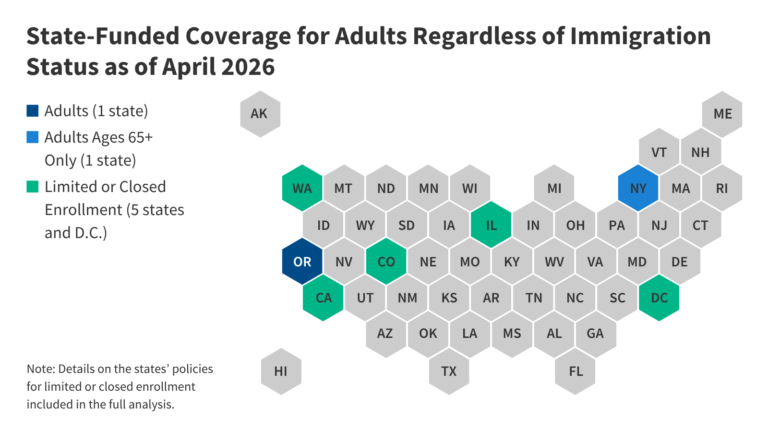
For children and pregnant people, states can eliminate the five-year wait and extend coverage to some lawfully present immigrants without a qualified status. As of April 2026, 38 states, including DC, have taken up this option for children and 32 states, including DC, have elected the option for pregnant individuals. A total of 25 states, including DC, have also extended coverage to pregnant people regardless of immigration status through the CHIP From-Conception-to-End-of-Pregnancy (FCEP) option. States have the option in CHIP to provide prenatal care and pregnancy related benefits to eligible low-income children beginning from conception to end of pregnancy regardless of their parent’s citizenship or immigration status. While other pregnancy-related coverage in Medicaid and CHIP requires 60 days of postpartum coverage, the CHIP FCEP option does not include this coverage. However, some states that took up this option provide postpartum coverage through a CHIP health services initiative or using state-only funding. Eleven of the states that have implemented the FCEP option (California, Colorado, Connecticut, Illinois, Maine, Massachusetts, Minnesota, New York, Oregon, Rhode Island, and Washington) have used state funding or CHIP health services initiatives to extend postpartum coverage to 12 months to align with the Medicaid extension established by the American Rescue Plan Act. Maryland extends coverage for four months postpartum, and Alabama, Texas, Virginia, and DC extend coverage for 60 days postpartum using CHIP health services initiatives.
Lawfully present immigrants can purchase coverage through the ACA Marketplace and, like citizens, may receive tax credits to help pay for premiums and cost sharing that vary on a sliding scale based on income. Generally, these tax credits are available to people with incomes starting from 100% of the federal poverty level (FPL) who are not eligible for other affordable coverage. In addition, lawfully present immigrants with incomes below 100% FPL had been eligible to receive tax credits if they were ineligible for Medicaid based on immigration status, for example due to being in the five-year waiting period for Medicaid or CHIP or because they did not have a “qualified” status. However, this coverage was eliminated effective January 1, 2026, under the 2025 reconciliation law (see below).
Individuals with Deferred Action for Childhood Arrivals (DACA) status are not considered lawfully present for purposes of health coverage eligibility and remain ineligible despite having a deferred action status, which is otherwise considered a lawfully present status. The Biden administration published regulations in 2024 that changed the definition of lawfully present to include DACA recipients for purposes of eligibility to purchase coverage through the ACA Marketplace and to receive tax credits to help pay for premiums and cost sharing, but this change faced legal challenges. The Trump administration published regulations in June 2025 that once again made DACA recipients in all states and DC ineligible for ACA Marketplace coverage. Most states terminated coverage for enrolled DACA recipients on September 30, 2025.
Lawfully present immigrants also can qualify for Medicare subject to certain restrictions. Specifically, lawfully present immigrants must have sufficient work history to qualify for premium-free Medicare Part A. If they do not have sufficient work history, they may qualify if they are lawful permanent residents and have resided in the U.S. for five years immediately prior to enrolling in Medicare, although they must pay premiums to enroll in Part A. Once changes in the 2025 reconciliation law go into effect, fewer lawfully present immigrants will be eligible for Medicare (see below).
Undocumented immigrants are not eligible to enroll in federally funded coverage including Medicaid, CHIP, or Medicare or to purchase coverage through the ACA Marketplaces. Medicaid payments for emergency services may be made to hospitals on behalf of individuals who are otherwise eligible for Medicaid but for their immigration status. These include lawfully present immigrants who are subject to a five-year waiting period for Medicaid, lawfully present immigrants who are not eligible for Medicaid, and undocumented immigrants. These payments may help cover the costs for emergency care provided to immigrants who remain ineligible for Medicaid but are not coverage for individuals. Much of Emergency Medicaid spending goes towards labor and delivery costs and Emergency Medicaid spending represented less than 1% of total Medicaid spending in fiscal year 2023.
About the Author