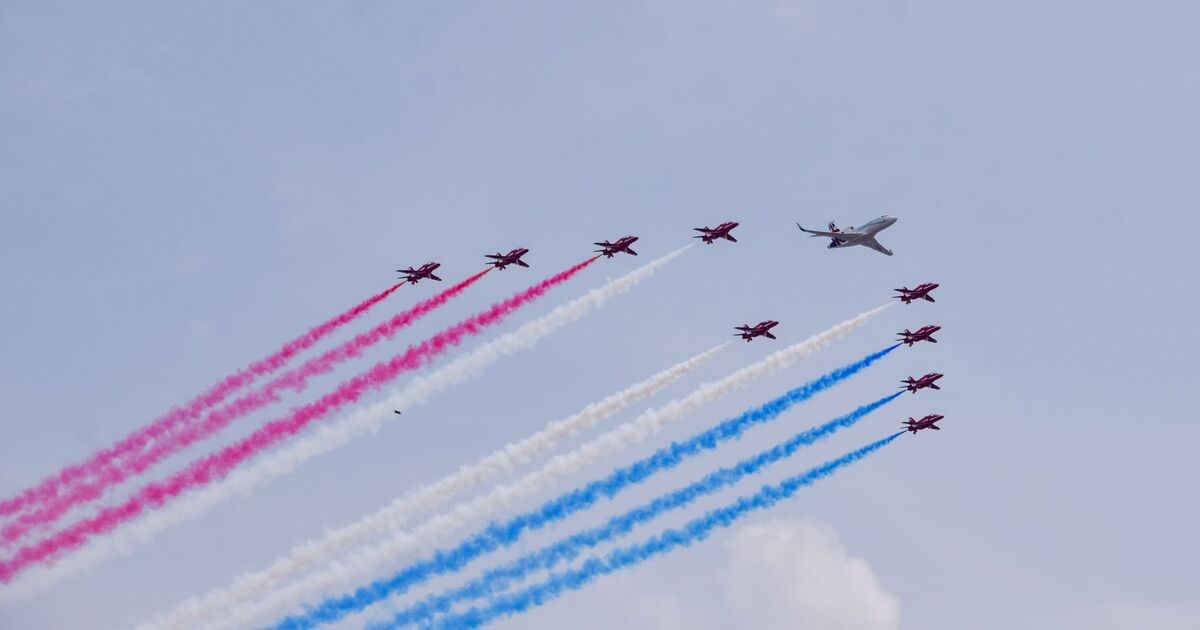
The Flypast will take place at 1pm (Image: Getty)
Members of the Royal Family will observe the annual Trooping the Colour parade in central London today, which includes a spectacular display of pomp and pageantry. The event sees an impressive carriage procession down The Mall and concludes with senior royals stepping out onto the Buckingham Palace Balcony to watch a Flypast by the RAF.
This will take place at 1pm, with a series of jets soaring over the royal residence. The numerous aircraft types and formations showcase the RAF’s contemporary capabilities and their critical contribution to recent and ongoing Operations. Below, the Daily Express looks at what aircraft will perform in the flypast, which will fly directly down the length of The Mall over Buckingham Palace.
Wave 1 – 3 Chinook’s
The flypast begins with three RAF Chinook (CH-47) aircraft from 7, 18 and 27 Sqn’s from RAF Doiham. This year marks 45 years of Chinook service with the RAF.
The Chinook is fitted with two Honeywell 55-L-714A Free-Turbine engines. It can carry up to 55 troops or up to 10 tonnes of freight. Secondary roles include search, rescue and battlefield Casualty Evacuation.
It has a maximum altitude of 15,000 ft, with a maximum speed of 160Kt and is 30.14m in length.

The Flypast will take place at 1pm over Buckingham Palace (Image: RAF)
Wave 2 – Dakota
The unmistakable sound of the iconic Dakota will form the second wave, operated by the RAF’s Battle of Britain Memorial Flight based at RAF Coningsby.
The Douglas C47 Dakota is one of the most successful military transport aircraft designs in history and was widely used by the Allies during World War Two.
Dakotas served in every theatre of the war, notably in Burma, during the D-Day landings and the airborne assault on Arnhem in 1944.

Typhoon jets arranged in a CR formation (Image: Getty)
Wave 3 – Phenom and Texan
In the third wave of the flypast is the Embraer Phenom 100 T Mk1 from RAF Cranwell. This is joined by two Texan T1s from RAF Valley.
The Phenom T Mk1 is 12.82m in length with a wingspan of 12.30m. Its maximum altitude is 41,000ft. It can carry a maximum of 5-7 passengers.
Texans are used for basic flight training, with a wingspan of 10.20m, a maximum speed of 316kt and a maximum altitude of 31,000ft. The aircraft can take one pilot and one passenger/ instructor.

The Red Arrows will conclude the flypast (Image: Getty)
Wave 4 – A400M
In the fourth wave of the flypast is the A400M Atlas from RAF Brize Norton in Oxfordshire.
The A400M Atlas entered operational service in the RAF in 2014. It provides a tactical air lift and strategic oversize lift capability that complements the Royal Air Force’s C-17A fleet.
It has a wingspan of 42.4 m, is 42.2m long and a maximum speed of 0.68 Mach. The aircraft can operate at high-level altitudes up to 40,000ft.
Wave 5 – C17
Following the A400M is the C-17, a long-range strategic, heavy-lift transport aircraft which can operate in combat, peacekeeping or humanitarian missions worldwide.
The aircraft transported the body of Queen Elizabeth II for her state funeral. The UK C-17As are also developing the ability to drop troops from the air and expanding their skills in night operations and landing on rough runways.
It is 53m in length with a wingspan of 52m and a maximum altitude of 45,000ft. It can carry up to 45,360 kg of freight over 4,500 miles and is used for long-distance medical evacuations

The Flypast features 33 aircraft (Image: Getty)
Wave 6 – Voyager and Typhoon
On each wing of the Voyager is a Typhoon FGR Mk4 based at RAF Coningsby & RAF Lossiemouth.
The Voyager is the RAF’s sole air-to-air refuelling (AAR) tanker and also operates as a strategic air transport. The aircraft has the ability to carry up to forty stretchers and three critical care patients.
The Typhoon can be deployed in a wide range of air operations, including air policing, peacekeeping, and high-intensity conflict.

The formation of the RAF Flypast (Image: RAF)
Wave 7 – Poseidon MRA1
The seventh wave of the flypast consists of a Poseidon MRA Mk1 (P-8A) from RAF Lossiemouth
The Boeing Poseidon MRA1 (P-8A) is a versatile maritime patrol aircraft designed for anti-submarine warfare, surveillance, and search and rescue missions.
It has the latest cutting-edge technology to detect, identify and monitor hostile contacts both above and below the waves.

Members of the Royal Family watch the Flypast from the balcony (Image: Getty)
Wave 8 – Rivet Joint
Behind the Poseidon is the RC-135W Rivet Joint from RAF Waddington.
The Rivet Joint entered service in 2014 and has a proven track record of supporting coalition and NATO operations. It is 41.1m long, with a wingspan of 39.9m and a maximum altitude of 39,000ft.
Wave 9 – Typhoons
The Four Typhoons will fly in box four formation and are from 29 Sqn RAF Coningsby. 29 Sqn is the Typhoon Operational Conversion unit responsible training all new pilots how to fly and operate the Typhoon in all its roles before they transition to their Front-Line units.
With its multi-role capability and variety of weapons the Typhoon FGR Mk4 is capable of engaging numerous target types.
Wave 10 – Hawk T1 and F35B
The Hawk T 1 is a fully aerobatic, low-wing, transonic, two-seat training aircraft that is used by the Royal Air Force Aerobatic Team, the Red Arrows.
They are based at RAF Waddington. For this year’s flypast, there will be nine jets in the Red Arrow formation.
The aircraft has supported Red Arrows displays around the world, featuring in shows as far south as Australia; on California’s Pacific coastline to the west; at Zhuhai, China, to the east; and extensively across mainland Europe, the Gulf and in every corner of the UK.
The entire team comprises about 150 people – both air and ground crew – and are commanded by Wing Commander Nash.
Following Trooping today, the Red Arrows will cross the Atlantic to represent UK Armed Forces in a series of performances in the United States to mark 250 years of American independence.
About the Author