An earthquake has struck Yellowstone National Park just miles from an ancient supervolcano feared to be overdue for a catastrophic eruption.
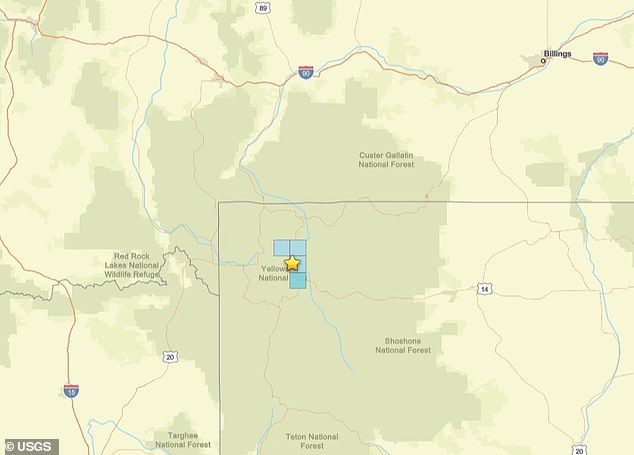
The US Geological Survey detected a magnitude 3.3 quake at 9.20am ET Thursday morning right along the Yellowstone River inside the Wyoming park.
The minor quake’s epicenter was recorded just seven miles from the Yellowstone caldera, the bowl-shaped volcanic depression within the famous national park.
Last year, scientists discovered tens of thousands of previously unrecorded earthquakes which could be hinting that Yellowstone’s supervolcano is building up to an eruption.
An international research team used AI to listen to 15 years of Yellowstone recordings and discovered 86,000 tiny earthquakes that human experts had missed. That was about ten times the number of quakes researchers previously believed had taken place.
In the past three weeks, 11 minor quakes have been recorded by USGS in the area around the caldera.
Thursday’s earthquake reportedly produced only light shaking in the 2.2 million acre park that spans across Wyoming, Montana and Idaho.
However, since the ancient site has not exploded in about 640,000 years, some experts and locals believe the volcano is overdue for an eruption that could potentially devastate the central US.
A magnitude 3.3 earthquake has been detected just miles from the caldera of the Yellowstone supervolcano in Wyoming

In 2025, scientists detected thousands of previously unknown earthquakes under the supervolcano in Yellowstone (Pictured)
A dramatic uptick in seismic activity is often a sign that a volcano may soon erupt.
Multiple studies have concluded that earthquakes around Yellowstone have been driven by magma movement, hydrothermal activity and regional tectonic stresses in the Intermountain Seismic Belt – an 800-mile active fault region stretching through Nevada, Utah, Idaho, Wyoming and Montana.
A 2025 study by scientists from the Universities of Utah and New Mexico found that the top of Yellowstone’s underground magma chamber sits just 2.3 miles, about 12,500 feet, below the surface.
A team from Rice University noted that previous estimates often placed the top of Yellowstone’s magma system as far as five miles deep.
Hot, molten material this close to the surface can create pressure and gases that drive volcanic activity, but scientists have said this does not guarantee an eruption is imminent.
In fact, the University of Utah study showed Yellowstone was currently stable, with gases venting through the park’s hot springs and geysers rather than building up dangerously.
‘In terms of large explosions, Yellowstone has experienced three at 2.08, 1.3, and 0.631 million years ago,’ USGS explained in a statement. ‘This comes out to an average of about 725,000 years between eruptions.’
‘That being the case, there is still about 100,000 years to go, but this is based on the average of just two time intervals between the eruptions, which is meaningless,’ researchers noted.
This is a breaking story. More details to follow.

Researchers used AI to review seismicity between 2008 and 2022, finding that earthquake records had been undercounted at Yellowstone by a factor of 10
USGS currently registers active at the supervolcano as ‘normal’ and noted that lava has not spewed from the caldera in 77,000 years.
About the Author