Key events
Healey said he is visiting Kyiv “soon” to continue discussions on supporting Ukraine’s long term armaments and policing of any ceasefire.
He added US envoy Steve Witkoff has given “strong commitments” over security guarantees for Ukraine.
“A secure Europe needs a strong Ukraine, but we can only get a peace deal if Putin is ready to make compromises,” Healey added.
On Ukraine, Healey said “lets make 2026 the year that peace is not only possible but that peace is achieved.”
On the Paris meeting of the Coalition of the Willing, he said yesterday’s declaration was about ensuring a peace agreement, supporting Ukraine’s defence, commanding a multinational force to Ukraine after a ceasefire has been agreed.
Healey said this operation is a stark reminder of how the world is changing and how it is becoming “less predictable and more dangerous”.
Healey said sanctions against the shadow fleet have forced 200 ships off the seas, which is almost half of the Russian fleet’s capacity.
Healey said the UK supported the US actions for three main reasons:
To enforce counter-Iran sanctions
To tackle the global security threat posed by “expanding shadowy maritime activity”.
To reinforce British homeland defence and security in an era of rising threats.
On the intercepting of the oil tanker, Healey said the UK and at the request of the US supported its efforts.
He said: “The vessel refused to comply with the US’s exercise of its sanctions jurisdiction on the 20th of December, after which the US Coast Guard vessel Monroe pursued the ship across the Atlantic.
“This is a sanctioned, stateless vessel which carries a long history of nefarious activity and shares close links with both Iran and Russia.”
Healey said there was a deployment of Royal Navy and RAF assets including airborne surveillance and RFA Tideforce.
No UK personnel took part in the operation.
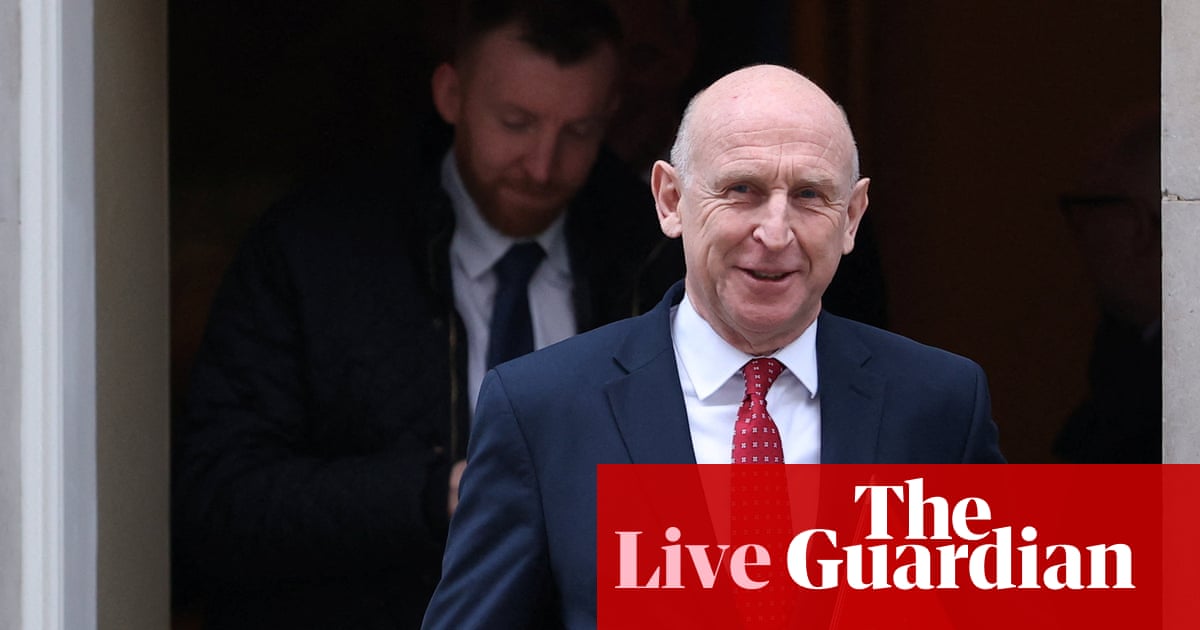
John Healey has stepped up to deliver his statement to the Commons.
Rachel Reeves has ordered regulators to do more to prevent red tape from strangling efforts to grow the economy.
The chancellor told bosses from 16 regulators that while progress had been made, businesses were still encountering “complex, costly and slow” bureaucracy.
At the first meeting of the Regulators Council, the chancellor is understood to have urged them to “go even further and act boldly” to remove barriers to business.
At meetings also attended by Business Secretary Peter Kyle, Reeves said every delay or unnecessary requirement placed on firms added costs and acted as a drag on growth, telling regulators to “remove these barriers and unlock investment, innovation and confidence”.
The chancellor has been pushing for regulators to boost growth since taking office and said “the conversation has already moved on in a positive way”.
Reeves pointed to the Office of Rail and Road’s decision to introduce competition on train routes to Europe and Natural England’s role in the Lower Thames Crossing project as examples of pro-growth regulation.
But she said “businesses continue to say that too often, the regulatory system is complex, costly and slow; that regulator mindsets favour process over outcomes; and prevailing risk aversion stifles innovation”.
A British deployment to Ukraine risks “overstretching our armed forces”, the chairman of the Commons Defence Committee warned.
Labour MP Tan Dhesi said the announcement of a potential deployment “cements the UK’s position as a firm supporter and defender of Ukraine’s sovereign right to a secure future” but called for “robust scrutiny” of the details by MPs.
He added: “My Committee has previously raised serious concerns about the UK’s readiness for modern warfare.
“Although this announcement is welcome, it intensifies the very real challenges our armed forces are already facing.
“It also runs the risk of overstretching our armed forces and so calls into question the UK’s ability to sustain pre-existing commitments to our allies.”
Defence secretary to give statement on Ukraine and Marinera tanker seizure
The defence secretary, John Healey, will be making an emergency statement in the Commons at around 7pm on the seizure of the Marinera tanker and the Ukraine deal agreed.
It comes after the Ministry of Defence confirmed the armed forces provided support to the US during its seizure of a Russian-flagged oil tanker on Wednesday.
Shadow defence secretary James Cartlidge will be responding to the statement for the Conservatives.
Early evening summary
The Ministry of Defence has confirmed that the UK helped the Americans interecept a Russian-flagged tanker in the North Atlantic. (See 3.43pm.) Frances Mao has more coverage of this on our Europe live blog.
For a full list of all the stories covered on the blog today, do scroll through the list of key event headlines near the top of the blog.
Mandelson says Trump’s ‘decisive approach’ to foreign affairs often better than ‘analysis paralysis’ of UN, EU, and US in past
Donald Trump clearly made an impression on Peter Mandelson during the seven months he spent as the UK’s ambassador in Washington. Mandelson has written an article for the Spectator in which basically endorses Trump’s approach to foreign affairs, and credits the US president with recognising that the rules-based international order (RBIO) has not been working properly for years.
There is nothing particularly original about this observation. Kemi Badenoch delivered a version of this argument yesterday, and even No 10 admited that the RBIO was struggling. But most Labour figures who accept that the RBIO is at risk would argue that it is worth protecting. Mandelson seems less keen on that. And, in his article, he is far more complimentary about Trump than almost anyone in UK politics outside Reform UK.
It is also noticeable that Mandelson seems to show no interest in whether or not the overthrow of Nicolás Maduro complied with international law – which, for most other commentators, has been a key issue.
Here are the key points.
For a long time, the ‘rules-based system’ beloved of foreign offices, thinktanks and academic seminars has effectively not existed.
President Trump is not some populist disruptor bent on destroying it; it ceased to have meaning before he was elected. He has not single-handedly broken up the postwar ‘global order’: if that ever fully existed, it started to evaporate two decades ago when China emerged as a great power contesting the US-led unipolar world. Under Xi Jinping, China is no longer prepared to accept the status of junior partner. The implications of this new bifurcated world can be seen in Ukraine, where colonialist Russia is backed by Chinese diplomatic power, Iranian technology and North Korean fighters.
Donald Trump’s dramatic intervention in Venezuela has achieved much more than to bring a brutal, corrupt dictator and drug trafficker to justice in an American court of law, something which no amount of human rights declarations, international law or indictments in the international criminal court were able to achieve …
In Caracas last weekend, as earlier last year in the case of Iran’s nuclear enrichment facility at Fordow, Trump did more in a day than orthodox diplomacy was able to achieve in the past decade.
I am afraid I don’t think, even now, that European leaders have adjusted to the revolution under way. They are guilty of a lazy interpretation of ‘America First’ to mean ‘America Alone’, even though President Trump is expending huge effort to end the war in Ukraine and has acted in a decisive way to halt the conflict in Gaza, where he remains committed to the vital ‘phase two’.
Britain’s interests and those of other liberal democracies lie in how we harness the power of the US to continue safeguarding the principles – if not always the letter – of the UN Charter. This will mean accepting that Trump’s decisive approach when faced with real-world situations is preferable to the hand-wringing and analysis paralysis that has characterised some previous US administrations or, indeed, the deadlock and prevarication that so often characterise the UN and the EU respectively.
He says Europeans need to contribute more to their own defence. He says they should focus more on “how and when the piggybacking stops and Europe starts assuming its full military and financial responsibilities beyond fine words – which is what they amount to in most cases at the moment, notwithstanding the future ‘military hubs’ promised by Britain and France to Ukraine.”
The future of Greenland is being misunderstood. Trump is not going to ‘invade’ it. He doesn’t need to. He’s already there. What will happen is that the threats to Arctic security posed by China and Russia will crystallise in European minds, performative statements about ‘sovereignty’ and Nato’s future will fade, and serious discussion will take over. Together, the US, Denmark and other allies will address how the Arctic region is properly secured with a considerably beefed-up role and status and military deployment by America.
Wolfson says Starmer’s comments about him ‘wrong’, as he accuses PM of U-turning on past comments defending lawyers
Lord Wolfson, the shadow attorney general, has released the text of an open letter he has sent to Keir Starmer claiming that the PM was “wrong” in what he said at PMQs. (See 1.52pm.) In particular, he says he is not representing Roman Abramovich in relation to anything to do with sanctions or the sale of Chelsea Football Club.
Wolfson also accuses Starmer of going back on comments he made in opposition saying lawyers should not be judged by the views of their clients.
Farage and Cunningham accused of talking London down after depicting it as crime-ridden and unsafe
At their press conference this morning, Nigel Farage, the Reform UK leader, and Laila Cunningham, the party’s candidate for London mayor in 2028, repeatedly claimed the capital is dangerous and crime rates there are excessive – even when it was pointed out that there much evidence suggesting the opposite. (See 11.30am.) They also complained that some migrants in London don’t integrate well. (See 11.50am.)
The idea that London has become a crime-ridden hellhole is a common theme in the hard-right media, particularly in the US and with broadcasters like Fox News. This is partly because it is a claim repeatedly peddled by Donald Trump, and given that Trump gets a lot of his “information” from Fox, the falsehoods get firmed up by a confirmation bias loop. The fact that Sadiq Khan, the mayor, is Muslim, and that London is a very diverse city, probably has some influence on the way some rightwingers perceive London too.
The Liberal Democrats have criticised Reform UK for talking down the city. Luke Tayor, the party’s London spokesperson (and MP for Sutton and Cheam) said:
From its history to its culture to its people, London is the greatest city in the world but all Reform seem to do is talk it down.
Cunningham and Farage care more about sowing division than they do about solving the actual problems that Londoners face.
The Liberal Democrats will stand up for the millions of Londoners who love this city and its values and ensure London is a better place for everyone.
When Boris Johnson first ran for mayor of London in 2008, he campaigned on mostly crime – and this worked. But his claims about Ken Livingstone were relatively modest compared to what Farage and Cunningham were saying about Khan. And Johnson always sounded like someone who actually liked London; listening to Farage and Cunningham, you would wonder why they haven’t left already.
UPDATE: Here is Alexandra Topping’s story about this.
MoD says UK gave ‘enabling support’ to help US seize sanctioned, Russian-flagged tanker in Atlantic
The Ministry of Defence has confirmed that the UK helped the Americans interecept a Russian-flagged tanker in the North Atlantic.
In a news release, the MoD says:
The UK has provided enabling support to the United States at their request to interdict the vessel Bella 1 today.
UK armed forces provided pre-planned operational support, including basing, to US military assets interdicting the Bella 1 in the UK-Iceland-Greenland gap following a US request for assistance. RFA Tideforce provided support for US forces pursuing and interdicting the Bella 1, while the RAF provided surveillance support from the air.
The UK and US defence and security relationship is the deepest in the world and the UK provided enabling support in full compliance with international law.
Jakub Krupa is covering this story on his Europe live blog.
Justifying the operation, the MoD said:
The Bella 1 is sanctioned by the US under its counter-Iran sanctions, aimed at stopping Iran from fuelling instability in the Middle East through the profits of illegal oil sales.
The ship, initially flying a false flag, turned off its transponders while at sea and sought to reflag while being pursued, indicating its nefarious links to global sanctions evasion.
Recent assessments show that the Bella 1 has been involved in illegal activity, linked to international terrorism and crime including Hezbollah, and part of the web of rising shadow activity that fuels and finances nefarious activity across the globe.
The Russian flagging of the vessel shows their role in this interconnected shadow activity we are seeing across the world, which threatens our national security, harms our economy and undermines global security.
And John Healey, the defence secretary, said:
This ship, with a nefarious history, is part of a Russian-Iranian axis of sanctions evasion which is fuelling terrorism, conflict, and misery from the Middle East to Ukraine.
The UK will continue to step up our action against shadow fleet activity to protect our national security, our economy, and global stability – making Britain secure at home and strong abroad.
The US is the UK’s closest defence and security partner. The depth of our defence relationship with the US is an essential part of our security, and today’s seamlessly executed operation shows just how well this works in practice.
About the Author