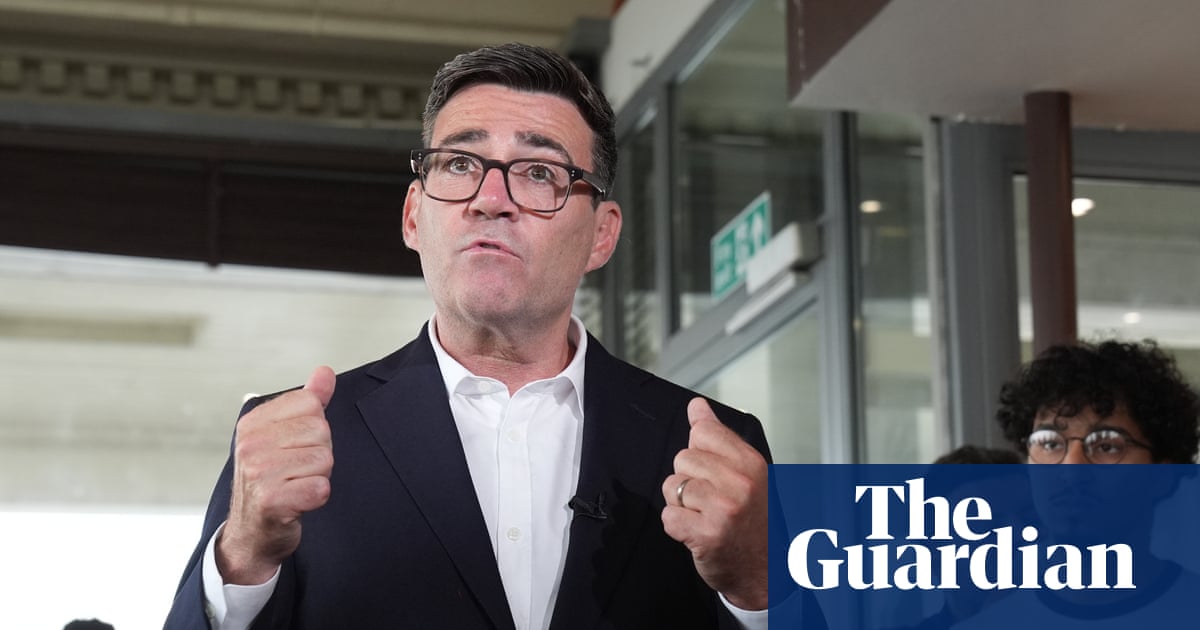
Andy Burnham will say Britain must be honest about the challenges it faces when he becomes its sixth prime minister in a decade on Monday, as he prepares to introduce measures to ease the cost of living and allow more North Sea fossil fuel drilling.
The Labour leader is expected to start making appointments in the afternoon after going to Buckingham Palace to accept the role of prime minister from the king.
Many cabinet ministers and even some of Burnham’s allies were still in the dark on Sunday about whether they would be offered positions in his top team, although there is a widespread belief Shabana Mahmood will be made chancellor and Ed Miliband foreign secretary.
The chief whip, Jonathan Reynolds, is also regarded as nailed on as business secretary of a department incorporating the current science and technology department. The former cabinet minister Lou Haigh is expected to be the leading Cabinet Office minister.
The former deputy prime minister Angela Rayner, is said to be lined up for the job of health secretary, but sources said she would take some persuading that it was the right fit for her when her main interests are in devolution, regional inequality, local government and the cost of living.
Before a policy blitz next week, Burnham’s first Downing Street address will seek to strike an optimistic but also realistic note about the problems facing Britain that must be confronted.
He is expected to say the country faces a moment for “reflection and resolution”, having previously said he was willing to spend political capital on fixing major problems such as social care that will require extra funding.
On measures to help people’s finances, he is likely to take steps to bring down energy billsand may target bus fares. Sources said he is also preparing to open the door to more oil and gas drilling in the North Sea in existing areas, despite a backlash from environmental campaigners and some MPs.
Burnham will also say he is “acutely conscious” of being the sixth person to walk up Downing Street in 10 years and argue that political stability is needed – in an implicit rejection of calls for an election when Labour potentially has another three years in power.
He will say Britain must be honest about the challenges it faces while demonstrating that it can again be recognised around the world for effective government.
The Labour leader will go on to set out his domestic priorities, saying he will deliver tangible improvements in people’s lives and give people “more breathing room” when it comes to the cost of living.
Burnham has not so far made any major policy commitments beyond saying he would stick broadly to Labour’s manifesto commitment of not raising VAT, national insurance or income tax, and scrapping the digital ID card programme.
His allies have signalled he would be prepared to speed up the pace of current drilling in the North Sea, including potentially adding to existing fields, without approving major new fields in line with the manifesto.
Donald Trump appeared to believe Burnham was preparing a significant policy shift, congratulating him on Saturday night for agreeing to go “all the way” in opening up new fields. He wrote on Truth Social: “The People of Aberdeen, in Scotland, are dancing in the streets because the new Prime Minister, Andy Burnham, has stated that he will be opening up, all the way, the invaluable North Sea Oil!”
Labour’s deputy leader, Lucy Powell, had earlier said Burnham would take a more pragmatic approach and that it was a “change of emphasis” rather than a change of policy.
Burnham’s greater openness on North Sea oil and gas was one factor in Miliband falling from favour as frontrunner to be chancellor, given his opposition to more drilling as energy secretary.
He is being tipped instead for foreign secretary and could take a more pro-Gaza position and greater steps towards setting the UK on a pathway towards restoring foreign aid to 0.7% of national income from its current level of 0.2%. The idea was immediately seized on by Reform UK. Its leader, Nigel Farage, said: “Andy Burnham plans to spend an extra £10bn of your money on foreign aid. I will always put British people first.”
Burnham’s team also declined to be drawn on his plans for Thames Water after the Sunday Times reported he was expected to push the London and south-east England utility company into a special form of administration in an intervention that could mean the state has to pay some of its running costs until a buyer is found.
Powell spoke on Sunday about Burnham’s plans for increased public ownership, saying the economy had been “overly privatised” and the “utilities and essentials of life don’t work in the interest of ordinary people.”
She said bills were “going up and up because they are run in the interests of private interest, not for the consumers or for taxpayers”.
The Conservatives have accused Burnham of planning to put up taxes in order to fund areas that will need more money, from social care to defence. When asked about a wealth tax, the new Labour leader said he did not want to create divisions, but that in the future an option “might be having to ask for a little more”.
Kemi Badenoch criticised Burnham on Sunday for not setting out his plans before Monday and not having done in-depth media interviews before taking office, describing his comments so far as “airy-fairy stuff”.
The Conservative leader told the BBC she thought Burnham was “a people pleaser” rather than someone who would make tough decisions.
As he prepared to hand over power, Keir Starmer released a video saying he was “so proud” to have left the country “in a much better state than we found it two years ago.”
About the Author