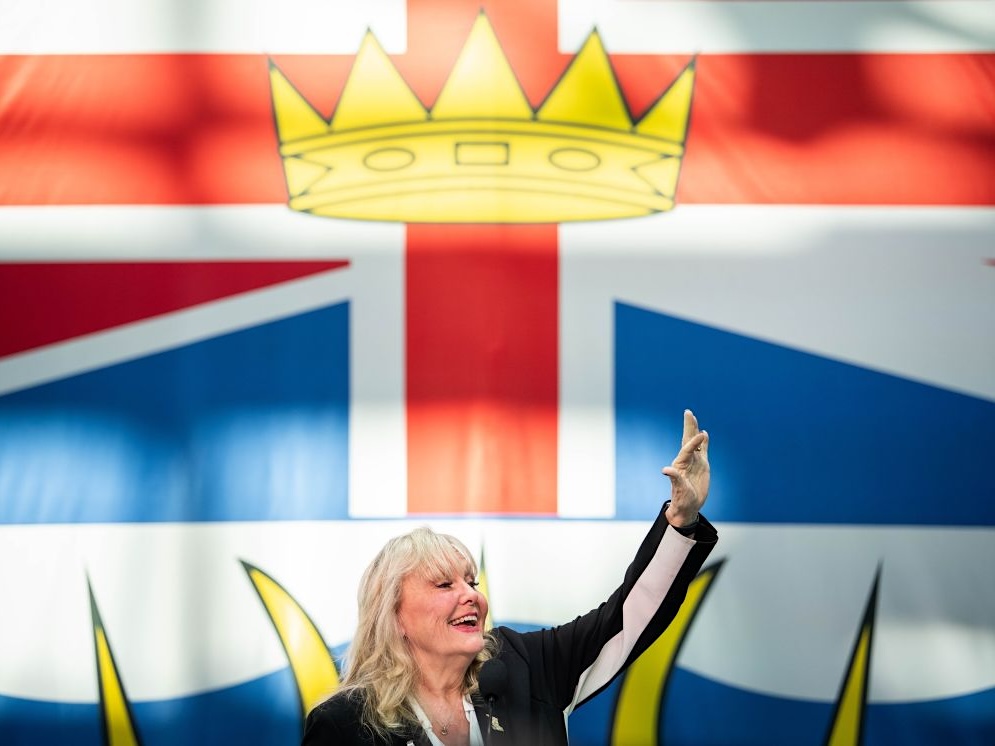
Kerry-Lynne Findlay won the hard-fought battle to become the next leader of the Conservative Party of BC, but before she can advance on the premier’s office, she must first secure the peace within her own party.
The former federal Conservative cabinet minister emerged as the leadership race’s unlikely insurgent. A political pugilist, Findlay cast herself as the grassroots outsider taking on the “insiders” with a “hidden liberal agenda” and “mainstream media gatekeepers.”
Accusations of racism and corruption against Findlay — the latter prompting the Conservatives’ Leadership Election Organizing Committee to consider disqualifying her — only reinforced her anti-establishment narrative.
Findlay’s biggest foil was political commentator and former BC Liberal Party executive Caroline Elliott, the leadership race’s enduring front-runner who was carefully crafted by a well-oiled political machine. Her campaign boasted the strongest fundraising operation, veteran out-of-province campaigners and endorsements from former B.C. premier Gordon Campbell, former Alberta premier Jason Kenney and the National Post.
Meanwhile, Kamloops Centre MLA Peter Milobar, who placed last in the leadership race, expressed uncertainty about whether he would remain in the party if Findlay won. Another leadership candidate, former BC Liberal cabinet minister Iain Black, accused Findlay of “dividing people based on race” and described it as a “clear pattern of behaviour.”
Yet when (verified) B.C. Conservative members cast their ballots, Findlay prevailed.
Leadership races rarely unite political parties. More often, they deepen divisions, some of which predate the candidates themselves and extend to organizers and long-standing factions.
So as Findlay’s focus shifts to defeating Premier David Eby and the BC NDP, her most immediate mission remains an internal one: uniting a diverse Conservative Party of BC bruised from an acrimonious leadership contest.
It is a difficult mission, one made even more difficult from outside of the B.C. legislature.
Making room in the legislature
“I want to be in the arena.”
In a media scrum following her leadership victory, Findlay insisted that she intends to run for a seat in the B.C. legislature “as soon as possible.”
The difficulty for Findlay is finding an MLA willing to surrender their seat. With 31 of the Conservatives’ 38 MLAs serving their first term, there is likely little appetite among the rookie legislators to step aside so soon after being first elected to the B.C. legislature.
Meanwhile, the remaining seven Conservative MLAs provide much-needed caucus experience that Findlay cannot afford to lose.
An obvious solution is Surrey South MLA Brent Chapman, Findlay’s husband. Having Chapman step aside would spare Findlay from asking another caucus member to make that sacrifice, eliminate any potential concerns around a spousal conflict of interest, and avoid forcing a potentially divisive decision on the caucus she is trying to keep united. It would also signal that Findlay is prepared to cede her own family’s interest before asking others to do the same.
Chapman did not rule out the possibility. He told Sitka Media that it would be a “big decision” but that he remained committed to running in the next general election regardless, whether in Surrey South or another riding.
Without a seat, Findlay cannot participate in question period, directly confront Premier Eby or exercise the day-to-day authority of leading a caucus inside the chamber. That challenge is compounded by the fact that the B.C. Conservatives remain a relatively new and, at times, unruly team.
For Findlay, finding a path into the legislature is a necessary, early test of her ability to manage personalities, maintain caucus unity and demonstrate the political judgment — and image — expected of a premier-in-waiting.
Maintaining a tenuously united caucus
Fortunately for Findlay, she inherits a caucus from interim leader Trevor Halford that is considerably more professional and functional than the caucus under former leader John Rustad.
A key architect of this transformation has been Halford’s outgoing chief of staff, Allie Blades, who is credited for “retraining caucus on basic roles, setting up procedures manuals and restructuring staff into a leaner crew.” This organizational clarity has helped shape the B.C. Conservatives into a smoother-operating official Opposition.
For his part, Halford managed caucus interpersonal dynamics that kept internal disagreements out of public scrutiny. The Conservatives became more disciplined and, perhaps most importantly, more effective. For a caucus that has struggled with public infighting, message discipline and professionalism, Findlay must harness that stability and not take it for granted.
While Findlay remains outside the legislature, retaining Halford as Opposition house leader and the public face of the caucus inside the chamber would provide important continuity. It would also allow Findlay to focus on securing a seat while relying on a trusted, reliable lieutenant to maintain caucus discipline in Victoria.
With the legislature on break until the fall, she already has the summer to tour the province and further cultivate relationships within caucus.
Once Findlay enters the legislature, those relationships will help her to establish her own authority without disrupting the stability that Halford has spent months building. Furthermore, elevating Halford to a prominent caucus management role may be the best way to preserve the unity he achieved, while consolidating her own leadership and influence over major caucus decisions.
One of Findlay’s first major caucus decisions could be whether to reopen the door to former Conservative MLAs who now sit as Independents. Both Peace River North MLA Jordan Kealy and Kelowna-Lake Country-Coldstream MLA Tara Armstrong endorsed Findlay in her leadership bid, after leaving caucus following then-leader Rustad’s expulsion of Vancouver-Quilchena MLA Dallas Brodie.
Presumably, Findlay wants Kealy and Armstrong back in caucus as allies, but some MLAs may view readmission as rewarding those who walked away from the team instead of resolving conflict.
Findlay has already indicated that any such decision would not be made unilaterally. Securing caucus support, especially through relationship-building prior to being in caucus, would not only smooth the reintegration of Kealy and Armstrong, but also demonstrate that Findlay has earned the trust and confidence of her MLAs.
Findlay has also said that she has spoken to “at least one” of the other Independent MLAs, suggesting that she is at least interested in a broader reunification of her party’s fractured ranks.
Bringing former members back into the fold may strengthen the party numerically, but only if it does not reopen the divisions that Findlay is trying to heal. Striking that balance will be a pivotal test of Findlay’s leadership and political judgment, one made more complicated by her promise to maintain ideological purity within the party.
Smoothing feelings, charting a direction
Even as she called for party unity in her acceptance speech following her leadership victory, Findlay made clear that the Conservative Party of BC would remain a conservative party, not a coalition.
This was consistent with her leadership campaign’s central message: “Keep it Conservative.”
While policy differences among the leadership candidates were modest, Findlay distinguished herself through populist rhetoric. Even in her victory speech, she described British Columbia as a province pitted against “eastern and global elites, predatory foreign nations and [Canada’s] own Constitution.”
Findlay’s unapologetic populist conservatism won the leadership race.
The challenge is that, in her effort to keep the party conservative, she openly challenged the conservative authenticity of her opponents. In one case she went so far as to assert an opponent was compromised because his wife is Indigenous. Now she must reconcile her divisive messaging with the practical realities of party-building.
Recent B.C. political history offers a cautionary tale. After Kevin Falcon won the 2022 BC Liberal leadership race, none of his six defeated rivals — or their organizers — were integrated into the party’s future plans. A seventh candidate, who was disqualified from that race, Aaron Gunn, formed the political group that eventually took over the Conservative Party of BC, installed John Rustad as leader and came within hundreds of votes of forming government in 2024.
To succeed, Findlay will need to prioritize incorporating rival factions — especially key, local organizers — into the party structure, identifying future electoral opportunities for former leadership candidates and preserving important roles for experienced caucus and party members.
There may be pressure to reward loyalists by filling key positions exclusively with members of Findlay’s team. But if the goal is long-term stability and electability, the party will need to draw on the strengths of its various factions, from Caroline Elliott’s fundraising network to Trevor Halford’s leadership skills to Peter Milobar’s legislative experience. That will be the key to election-readiness.
Otherwise, a short-term consolidation of power risks a short-lived stint as party leader that precludes Findlay from ever becoming premier.
Beyond managing competing factions within her own party, Findlay must also resist the temptation to rely exclusively on messages that energize her base while alienating persuadable voters. After all, in the 2025 federal election, roughly 1.1 million British Columbians voted Liberal (42 per cent).
That does not mean Findlay needs to abandon the conservative principles (or base) that propelled her to the leadership. It does mean recognizing that winning a leadership race and winning a general election are fundamentally different challenges.
Findlay’s three immediate challenges as the new leader are interconnected. How she enters the legislature, manages caucus and defines the party’s ideological direction will all influence whether or not the Conservatives can convert public frustration with the governing BC NDP into actual electoral support.
David Eby’s BC NDP is at its most vulnerable. Overwhelming dissatisfaction over cost of living, health care, housing, public safety and major infrastructure delays has created a genuine opportunity for the Conservatives. Many voters may be willing to look past Findlay’s rhetoric, the accusations levelled against her during the leadership race, and her social conservatism.
But this genuine opportunity for the Conservative Party of BC to form government is not an inevitability. Defeat can be snatched from the jaws of victory.
Findlay will need to do more than keep the party conservative. She will need to keep the party united, broaden its appeal beyond its activist base and convince British Columbians that she can govern as effectively as she campaigns.
Kerry-Lynne Findlay won her leadership race, but the much harder test of leadership begins. ![[Tyee]](https://thetyee.ca/design-article.thetyee.ca/ui/img/yellowblob.png)
About the Author