Donald Trump and members of his Republican party seem to think it makes them look stronger to disparage Canada.
“Unless you want to become the 51st state, learn to manage your forests,” scolded Aric Nesbitt, a Republican state senator in Michigan on July 16. The same day, a Michigan member of Congress issued an all-caps “final warning” to Canada, informing us that “sovereignty comes with responsibility.”
Ever since Trump called Canadians “very spoiled” back in 2018, the insults have dripped with a sense of superiority.
On the face of it, the United States does seem to have all the cards — an economy worth north of $32 trillion, 10 times more people than Canada, and the world’s mightiest military. Why are hardly any Canadians envious?
Start with the fact that the glowing numbers, particularly on the economy, are deceptive. Along with its big gross national product, the United States saddles its citizens with a $40-trillion public sector debt that shows no signs of shrinking. Though the U.S. military alone commands a nearly trillion-dollar budget, the Pentagon recently had to beg Congress for even more billions to continue the Iran conflict.
According to the statistics, U.S. productivity is clearly higher than Canada’s by about 15 per cent. The United States also has higher per capita income and lower unemployment. Canada obviously trails, right?
Not so fast. Only 16 per cent of Americans consider their economic status good or excellent. And there is a simple reason for that. It turns out that only the top 10 per cent of U.S. wage earners are doing better than their Canadian counterparts. Average workers in Canada are actually doing better than their U.S. cousins.
Accordingly, one-third of Canadians rate their economy as good or excellent, double the approval rating Americans give theirs. Canadian workers not only rate their economy higher; they are more satisfied with the economy.
And the economy isn’t the United States’ only problem. Roughly seven in 10 Americans are dissatisfied with how their democracy is operating.
The Iran war provides a good example. Only 29 per cent of Americans support Trump’s war of choice. The rest are not shy about letting their president know they are not thrilled with his performance. Soccer fans lustily booed Trump when his face went up on the Jumbotron at the FIFA World Cup final.
Meanwhile, Americans are mired in a cynical malaise. As the Gallup polling firm reported earlier this month: “Americans’ confidence in major U.S. institutions remains near the lowest level… in more than four decades, averaging less than 30 per cent for the fifth consecutive year.”
The world takes a dim view of the American way, as well. Pew Research Center data shows that global opinion of the United States is at historic lows. Respondents in 25 of 36 countries actually prefer China to the United States. The main reason? They lack confidence in Trump.
Rather than attend to his own country’s waning civic spirit and tarnished reputation, Trump seems obsessed with bullying Canada.
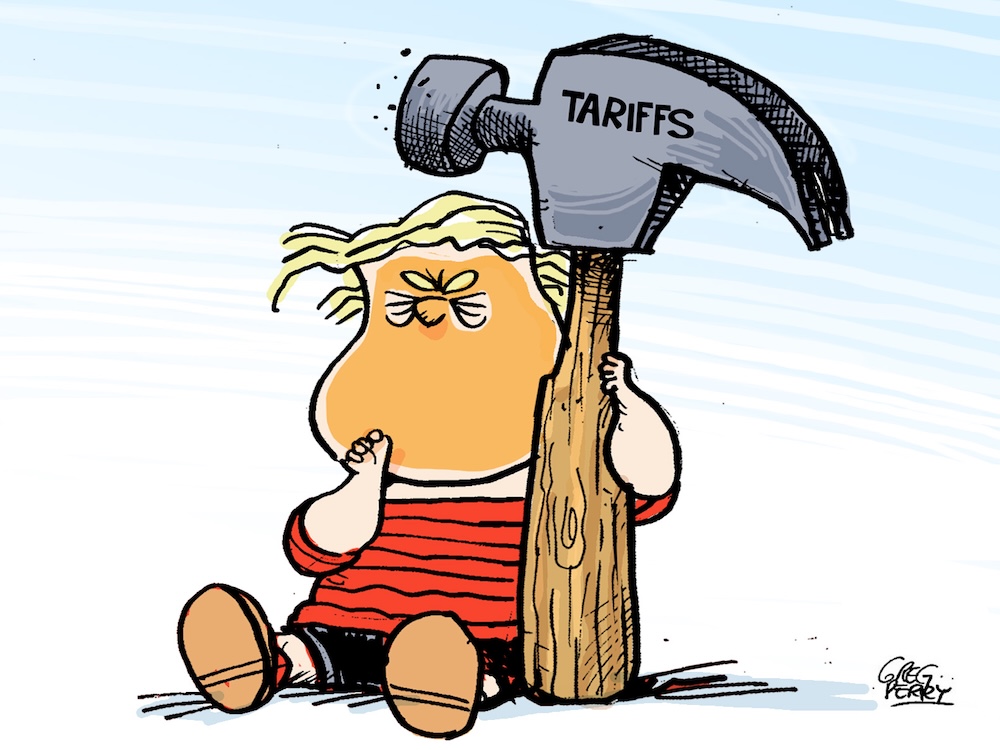
The president announced new 50 per cent tariffs on a wide swath of Canadian exports, from Christmas decorations to hockey sticks. He cited as his reason the pollution of U.S. air by smoke from wildfires burning in this country.
It was a tawdry show of callous petulance. When your neighbour’s house is on fire, you don’t complain that they are hurting your air quality. You help douse the flames. Instead, Trump announced his punitive tariffs and offered Canadians a lecture on forest management. Sweep the forest floor!
Moves like that have Canada and the world moving away from the United States.
Shunning the bully
Under Prime Minister Mark Carney, Canada is politely but clearly shunning Trump to build a more diversified future with partners who share the same values.
Carney is urging allies to use technology and space and weapons systems that are not under U.S. control. And they’ve listened. Europeans have started to remove U.S. technology from their systems, replacing it with European software. They’ve also looked for new ways to store data and process payments. They’ve even questioned buying more weapons from the United States.
Carney practises what he preaches. Canada bypassed U.S. shipyards when he awarded a $100-billion submarine contract to NATO ally Germany. Canada has joined the massive, European Union SAFE defence procurement network. And it was not lost on Carney that Italy, Japan and the United Kingdom have formed the Global Combat Air Program to create a next-generation fighter plane. Canada has joined as an observer.
Meanwhile, Canada has established a critical mineral and energy pipeline to Japan and South Korea. In the process, Carney has expanded trade to three billion consumers across Asia, Europe and the Middle East.
Stay tuned. Canada will soon make a major a decision on the acquisition of new fighter aircraft, and it could be the European-built Gripen rather than the U.S.-made F-35 from Lockheed Martin.
Like Canada, European and Asian middle powers are turning away from the bluster and decay of the Trump presidency. It is a critical shift. The world no longer trusts the United States to honour treaties, keep its word or guarantee the peace and security of the West. Trump seems far more comfortable with dictator Vladimir Putin than with democratic leader of Ukraine Volodymyr Zelenskyy.
The Wall Street Journal recently published a powerful two-part series on Europe’s dramatic rupture with the United States. In January, European leaders held an emergency five-hour meeting in a remote castle in Brussels. They were there to ponder: Was the United States now a menace to Europe?
The question was not academic. After all, Trump had kidnapped the leader of Venezuela and his wife and threatened to annex Canada, invade Cuba and seize Greenland from NATO ally Denmark. The Europeans did not put this down to Trump’s usual silly bombast. Danish intelligence chiefs viewed the threat as serious — even identifying the United States as a potential military threat.
The security precautions taken indicate this high-level tête-à-tête was deadly serious. No phones were allowed at the meeting. There were no recordings of the proceedings or photos. Leaders were told to come alone, without the usual entourage of aides. Reportedly, the meeting was so emotional that some of the 30 leaders present called the session “therapy night.” A year of trying to placate Trump had not worked.
Around that time, as a result of Trump’s expansionist designs, Danish and French soldiers, as wells as other allied troops, were sent to Greenland preparing for the previously unthinkable — a potential shooting war with a predatory United States.
Since his Davos speech on Jan. 20, Carney has been messaging Europe’s leaders that “the old America isn’t coming back.” In Brussels, French President Emmanuel Macron emphasized that Europe’s overreliance on the United States was itself a security risk. His words, as if to echo Carney, were ominous: “There is no going back.”
Defiance and pity
When Britain’s foreign intelligence service, MI6, was tasked with figuring out how the United States is currently governed, it crafted this warning: “Trump’s second White House, it is said, is ‘The Crucible’ meets ‘Wolf Hall.’” This was a reference to the Salem witch trials and the court of Henry VIII, who had a proclivity for beheading unwanted wives.
Small wonder Canadians are taking little stock in the insults levelled at them by a mad king. Trump’s tariffs have not made Canada tremble and rush to appease. We have watched other countries try and fail at “flattery diplomacy.” Most Canadians support Carney’s different approach — calm and resolute when our country is mocked, energetic in his quest for more economic independence.
Canada’s other leaders feel the same. In Charlottetown, at their annual gathering, premiers rallied behind the prime minister in a show of unity. They also took down provincial barriers on alcohol to increase trade within the country.
Carney himself has not ruled out imposing retaliatory tariffs on the United States. “Everything’s on the table if there’s no agreement,” he said.
And some premiers are eager to retaliate. Ontario Premier Doug Ford floated the idea of using energy supply as leverage in the trade talks. He also said, “I’m tired of the bully trying to take our lunch money all the time.”
For many good reasons, Canadians are more inclined to look on today’s United States not with envy but with a mix of defiance and pity. If Trump thinks he can bring Canada to its knees with tariffs and tantrums, as recent reports have suggested, there is something he should know.
Hell will freeze over before that happens. ![[Tyee]](https://thetyee.ca/design-article.thetyee.ca/ui/img/yellowblob.png)
About the Author