Attention has naturally fixated on Labour’s leadership soap opera, since it involves the eviction of a prime minister elected on a landslide only two years ago and his replacement by a man for whom a by-election had to be engineered so he could return to the House of Commons as a necessary prelude to mounting his coup.
Unlike the Tories, for whom regicide is second nature, this is the first time since Ramsay Macdonald in 1931 that Labour has dumped a leader against his will – a decapitation in which even Labour members didn’t get to vote, never mind the electorate. So no surprise it’s captivated us, generating awe and disgust.
But the sheer undemocratic effrontery of it all has sidelined two other political developments that merit our attention: the trials and tribulations of Reform UK in general and its leader, Nigel Farage, in particular; and the emergence of Tory leader Kemi Badenoch as a politician of substance and ability.
Some commentators are already talking about the demise of Reform. They go too far, their judgement skewed because they wish it to be so. But there can be little doubt support for Reform has not only peaked – it has even started to wane.
Reform took a respectable 15 per cent of the vote in the 2024 General Election. It won only five Commons seats because its vote was spread thinly across the country. But its support started to surge as voters realised Keir Starmer was a dud and few wanted to give the toxic Tories the time of day.
Reform led in the polls throughout last year, inching up towards a 30 per cent share and in late 2025 even managing 32-35 per cent in some – taking it into overall majority territory. It became fashionable to muse on the prospect of Reform forming the next government.
But there’s been something of a falling off in 2026. By this month, Reform was hovering in the 25-28 per cent range, still leading the pack but its upward momentum replaced by steady slippage. A poll out at the end of this week put it on 24 per cent, only five points ahead of Labour – and that’s before Andy Burnham’s honeymoon has even begun.
Reform made huge gains in last month’s local elections. But even then its performance relative to last year was weaker: it secured a smaller vote share (just under 35 per cent) in the seats it contested in May compared to the 2025 local elections (41 per cent). When its local election vote share was converted into national share for a General Election it came out at 27 per cent – confirming recent polls showing Reform is still strong but sliding from its peak.
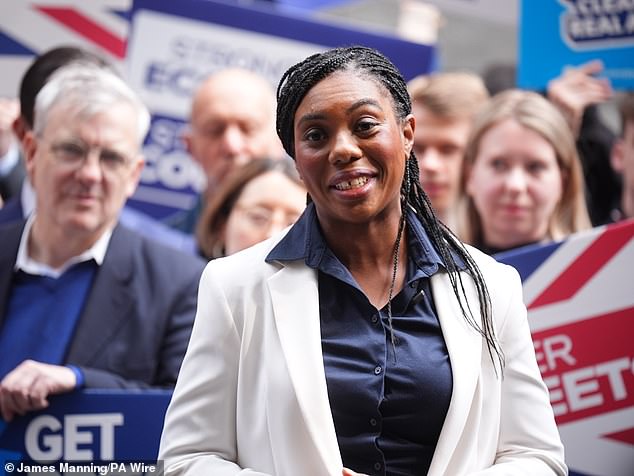
The emergence of Tory leader Kemi Badenoch as a politician of substance and ability merits our attention, writes columnist Andrew Neil

There can be little doubt support for Reform, led by Nigel Farage has not only peaked – it has even started to wane
By-elections are a lifeblood for insurgent parties. But Reform lost both this year’s English by-elections (Gorton and Denton, then Makerfield) in ‘Red Wall’ north-west constituencies where it should have done better.
Both revealed Reform to be cackhanded when choosing appropriate candidates and organising effective campaigns. It exuded a pervasive amateurism, which is fine in the early days of an insurgency but a liability when you’ve broken into the big time.
Then there is the Farage Factor. As the country’s premier Marmite politician he is at once Reform’s greatest asset and liability. Until now, the pluses have outweighed the minuses for his party. But perhaps no more.
In a series of excruciating interviews this week, when asked about an undeclared £5million ‘gift’ from a British cryptocurrency billionaire based in Thailand, he was tetchy, incoherent, shifty and contradictory. Farage’s avuncular style has made him something of a master in hostile interviews. But here he did himself no favours, unable even to explain what the £5million was for.
The parliamentary commissioner for standards, currently investigating the donation, will not settle for his obfuscation.
The usually publicity-hungry Farage has been curiously missing in action until this week, even during the Makerfield by-election. Perhaps we now know why. The £5million gift of uncertain provenance is haunting him, overshadowing all he wants to talk about.
His punishing work schedule and risky lifestyle – combining drink-fuelled dining with 18-hour days – could also be taking its toll. Until now, he’s remained sprightly despite his ‘work hard, play hard’ approach. But at 62 he’s lost weight, suddenly looks more careworn and is more easily riled.
Of course, it could be a temporary glitch. If the commissioner vindicates his handling of the gift, it will fade from the headlines. He could easily rediscover his mojo (he seems to have the constitution of an ox). But the problem with a one-man band like Reform is that when the one man starts playing the wrong notes, the whole band is out of tune.
Kemi Badenoch, by contrast, has never been in finer fettle.
After a sticky start as Tory leader, she’s come into her own, both her substance and sense of humour beginning to flower as she gains in confidence.
She has shown acute political antennae, embarrassing Starmer by offering Tory support for his welfare reforms and ruthlessly exploiting the Mandelson scandal. Her decision to turn the Aberdeen South by-election into a referendum on North Sea oil and gas was a personal triumph (the Tories romped home with 50 per cent of the vote).

Team Burnham briefed that Andy was so pro-woman that he’d be ‘Labour’s first female prime minister in all but sex’
In recent months she has regularly bested Starmer at Prime Minister’s Questions and on Wednesday, with him now yesterday’s man, she decided to goad the whole Cabinet for its treachery and incompetence. Labour ministers affected a fit of the vapours brought on by her blunt language, which was rich coming from a party whose anti-Tory lexicon has included ‘scum’, ‘racist’ and even ‘foetus in a jar’ (about Michael Gove). When she described the current Education Secretary as a ‘spiteful class warrior’, what bit did she get wrong?
When Team Burnham tried to combat the complaint that Labour was about to anoint yet another white male leader (the only kind it’s ever had in 130-odd years), it ludicrously briefed that he was so pro-woman, he’d be ‘Labour’s first female prime minister in all but sex’. To which Badenoch riposted that Labour might have a new leader but it ‘still doesn’t know what a woman is.’
People like plain-speaking rather than the usual obfuscating verbal gymnastics. That’s reflected in Badenoch’s improved poll ratings. By last month she’d reached a net favourability rating of minus 17. Not exactly top of the pops but her highest to date and the best for any Tory leader in years.
Whatever gains she’s making, clearly Badenoch still has a mountain to climb. It’s far from clear if her personal popularity will rub off to her party’s advantage.
The Tories still wallow around 20 per cent in the polls. Aberdeen South was a victory but peculiar to that constituency. Despite symbolic success in Wandsworth and Westminster, the local elections were pretty grim: the Tories lost 500 seats in England and came nowhere in the Scottish and Welsh elections. They won just 2 per cent of the vote in Makerfield, compared to 11 per cent in 2024.
But, interestingly, these results did not provoke calls for a new leader or even ignite any leadership speculation. Reviving Tory fortunes may prove mission impossible but there is nobody else on a lacklustre Tory fron bench better equipped to give it a try than Badenoch. The party has wisely decided to give her time to do her best. Her position is secure for the foreseeable future.
Politics has never been more febrile. Today’s supposedly significant trends can quickly become tomorrow’s irrelevant footnotes. Reform’s setbacks may be temporary. Badenoch’s new lustre might not be enough to polish a seriously tarnished Tory brand.
But Reform is no longer having it all its own way (neither are the Greens). Labour has a new leader which trounced them in Makerfield and thinks he has their measure. The Tories suddenly have a Badenoch-inspired spring in their step.
Since the election, it has looked as if Labour and the Tories were heading for the knacker’s yard. But who knows? Maybe there’s life in the old dogs yet.
About the Author