


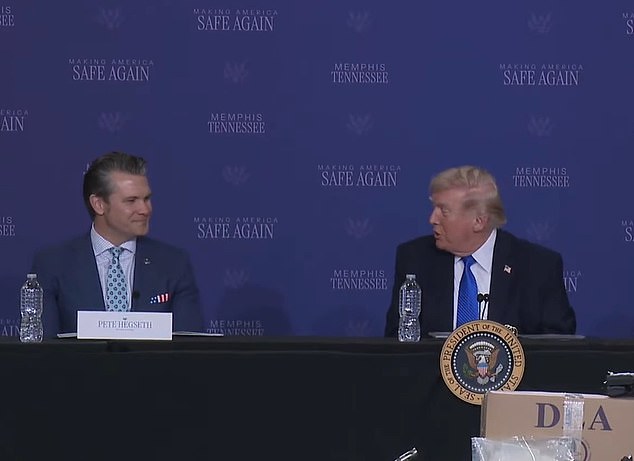
This is the uncomfortable moment Donald Trump appeared to shift blame onto Pete Hegseth, as the US President suggested his Secretary of War came up with the idea of striking Iran.
Speaking Monday at a conference in Tennessee, Trump said: ‘I called a lot of our great people… and I said, “Let’s talk. We got a problem in the Middle East. We have a country known as Iran that, for 47 years, has been just a purveyor of terror, and they’re close to a nuclear weapon.”’
Turning to Hegseth who was sitting to his right, Trump added: ‘And Pete, I think you were the first one to speak up. And you said, “Let’s do it, because you can’t let them have a nuclear weapon.”‘
The defense secretary forced an awkward smile as the US President continued discussing ongoing talks with Iran, claiming they had ‘started last night.’
‘I think they’re very good. They want peace to– they’ve agreed they will not have a nuclear weapon, you know etc., etc., but we’ll see. You have to get it done. But I would say there’s a very good chance.’
The US president went on to add that Israel has ‘been a great partner in this fight.’
Trump’s comments come as the war – now in its fourth week – is wrecking havoc across the region and causing economic chaos throughout the globe.
The showdown between Trump and Iran over access to the Strait of Hormuz has entered a critical stage as experts warn the world economy is under ‘major threat.’
Hegseth forced an awkward smile as the US President continued discussing ongoing talks with Iran
Iran maintains they have control of the strait, through which 20% of the world’s oil passes. The regime has barred access through the narrow waterway to anyone except countries allied with Iran.
International Energy Agency chief Fatih Birol has now warned that the global economy is under ‘major threat’ from the ongoing closure of the strait, and said ‘no country will be immune’ to its effects.
‘This crisis, as things stand, is now two oil crises and one gas crash put all together,’ he said at the National Press Club in Australia’s capital, comparing the current energy crisis to those of the 1970s and the effects of Russia’s 2022 invasion of Ukraine.
‘The global economy is facing a major, major threat today, and I very much hope that this issue will be resolved as soon as possible,’ Birol said.
‘No country will be immune to the effects of this crisis if it continues to go in this direction. So there is a need for global efforts,’ he added, noting that ‘at least 40 energy assets in the region are severely or very severely damaged across nine countries.’
Trump warned Tehran on Saturday it had 48 hours to allow cargo through the vital global shipping lane ‘without threat’ or he would ‘obliterate’ their power plants.
Iran responded to the threat on Sunday saying if its plants were targeted then energy infrastructure ‘across the entire region’ would be ‘irreversibly destroyed’.
Trump then wrote on his Truth Social platform on Monday that the US and Iran had held ‘very good and productive’ conversations about a ‘complete and total resolution of hostilities in the Middle East’.
As a result, Trump said he was postponing for five days a plan to hit Iran’s power plants.
However, the pause only applies to Iran’s energy sites and US strikes on the country continue.
Iran has effectively closed the key strait, which sees around 20 per cent of the world’s oil and liquefied natural gas pass through, since the U.S. and Israel launched their war on February 28.
According to a group of Austrian researchers, exports worth up to $1.2trillion (£893.5billion) could be affected if Iran keeps the Strait closed for an extended period.
While short disruptions of around two weeks would have limited consequences, blockages longer than four weeks could trigger ‘cascading issues’.
Worryingly, their findings show that the UK has the biggest exposure to these supply chain shocks of any country in Europe.
Britain imports $12billion (£8.9billion) worth of goods through the Strait of Hormuz each year, with Qatari liquefied natural gas (LNG) and propane alone totalling $5.9 billion (£4.4billion).
The researchers say that this creates a ‘genuine vulnerability’ that Britain won’t be able to substitute its LNG supply in the short term, driving up prices for consumers.
Co–author Dr Jasper Verschuur, of Delft University of Technology, told the Daily Mail: ‘What is unique about the Strait is that there are no alternatives to reroute goods.’
Meanwhile on Monday, Trump suggested he could jointly run the Strait of Hormuz with the Iranian Ayatollah when it fully reopens to the world.
Asked who would in charge of the key waterway in any deal to end the conflict, Trump said: ‘maybe me, me and… whoever the next ayatollah (is).’
Despite the economic consequences, Washington insists the war is an overwhelming success.
Speaking last week, Pete Hegseth blasted the media and America’s allies for ‘Trump Derangement Syndrome.’
The Defense Secretary tore into the press who ‘want President Trump to fail,’ but said that the American people ‘know better.’
He lashed out at ‘ungrateful allies in Europe’, claiming that the entire world ‘should be saying one thing to President Trump: Thank You.’
Meanwhile, members of Trump’s Cabinet including Hegseth have experienced a notable downturn in public esteem in recent weeks.

A building was reduced to rubble after missile strikes hit Tel Aviv on March 24

Israeli firefighters work to put out a fire following Iranian missile strikes on Israel on March 24
According to a Daily Mail/JL Partners poll the War Secretary, is now the joint most unpopular Cabinet secretary with a net approval rating of minus 10.
Hegseth’s net approval rating has plummeted 10 points since February 28, the day of the first strikes against Iran.
Others who have taken the biggest hits are officials connected to the Iran war.
EU chief Ursula von der Leyen called on Tuesday for an immediate end to hostilities in the region.
‘We all feel the knock on effects on gas and oil prices on our businesses and our societies,’ von der Leyen said alongside Prime Minister Anthony Albanese in Canberra.
She added: ‘It is of utmost importance that we come to a solution that is negotiated, and this puts an end to the hostilities that we see in the Middle East.’
On Tuesday, Iran launched missile strikes on Tel Aviv just a day after President Donald Trump declared peace talks with the country had been ‘good and constructive’.
Iran sent multiple waves of missiles towards Israel, hours after a source told the state-run Fars News Agency: ‘Tonight, special events are planned for Tel Aviv and some regional allies of the US and Israel that will completely remove the hope of negotiations from the minds of the aggressors.’
The missiles triggered air raid sirens in parts of Israel, including Tel Aviv where blasts from interceptions were heard.
In one attack, homes in northern Israel were damaged by falling debris following an interception. Israeli police said six people had been injured.
They said a munition carrying some 100 kilograms of explosives hit the city, causing widespread damage to buildings and vehicles.
Iran also hit Eilat in southern Israel, as well as the cities of Dimona and Yeruham. Residents in the Jerusalem area last night reported hearing loud explosions.
Israeli Prime Minister Benjamin Netanyahu has vowed to continue strikes in ‘both Lebanon and Iran’.
‘We are smashing the missile programme and the nuclear programme, and we continue to deal severe blows to Hezbollah,’ he said.
‘Just a few days ago, we eliminated two more nuclear scientists – and we are still active.’
An Israeli strike on Bshamoun, south of Beirut, killed two people on Tuesday, Lebanon’s health ministry said, while strikes on the capital’s southern suburbs continued throughout the night.

Smoke billows following an Iranian missile strike in Tel Aviv this morning

Rubble after an overnight Israeli airstrike that hit Amana fuel station in the town of Deir Qanoun al-Nahr near Tyre in southern Lebanon on March 24
The strikes come as last night Iran said it was planning ‘special events’ for the US and Israel which it says will ‘completely remove the hope of negotiations from the minds of the aggressors’, state media reported.
Information on the talks described by Trump remain in dispute with Iran, which denied discussions had been held.
‘No negotiations have been held with the US,’ Iranian parliament Speaker Mohammad Bagher Qalibaf posted on X, adding that ‘fake news is used to manipulate the financial and oil markets’.
In a message posted on Telegram by Fars News Agency, sources further appeared to reject Donald Trump’s claims of ‘major points of agreement’ between the US and Iran.
The message reads: ‘Informed officials in Iran announced that there were no negotiations and emphasized that until the US completely withdrew, evacuated its bases in the region, paid compensation, and received valid guarantees not to repeat the aggression, neither would the war end nor would the Strait of Hormuz be reopened.
‘According to this report, even after the possible end of the war, the situation in the Strait of Hormuz will not return to the pre-war situation.’
In an interview with Fars, an unnamed foreign policy analyst added ‘no sane official in Iran would indulge in such foolishness’ in regards to negotiating with the US.
Trump meanwhile said if upcoming talks go well the war could end within a week, before later adding: ‘Otherwise, we’ll just keep bombing our little hearts out.’
