


War in the Middle East has caused an enormous spike in the price of oil, as the cost of a barrel rocketed to above $100 for the first time in years.
An emergency meeting of the G7 has been called for today, where firefighting options including the release of oil reserves – held back for crises such as this – will be discussed.
The main issue is the near-total closure of the Straight of Hormuz, through which around a fifth of the world’s oil travels, which means major uncertainty hangs over short-term supply.
Iran’s Revolutionary Guard has threatened to ‘set ablaze’ any Western tanker that attempts to navigate the strait, and hundreds of ships laden with oil, as well as liquefied natural gas, have amassed either end of it.
For the first time since war broke out, the effect of this disruption was felt reflected acutely in the markets, when the price of a barrel of Brent crude shot up almost 24 percent.
It took just a minute for the price to rise by 10 percent, and 15 minutes for another 10 percent, seeing it surge beyond the $100 mark for the first time since the early days of Russia’s invasion of Ukraine in 2022.
Petrol prices at the pump are also likely to spike as the higher cost filters through to consumers.
UK Chancellor Rachel Reeves will attend an emergency meeting of G7 finance ministers at 1:30pm GMT, chaired by France, to address the economic fallout of the war.
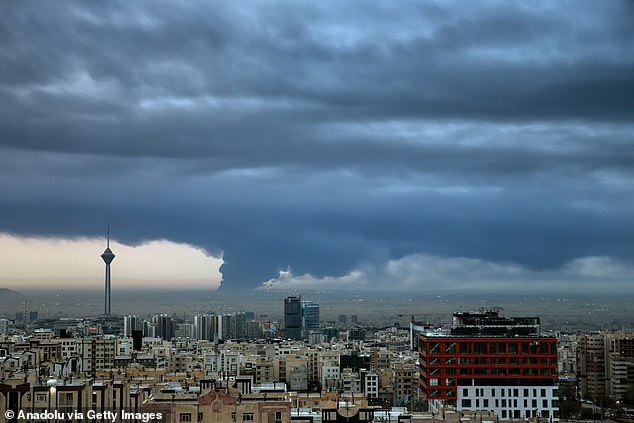
A thick cloud of black smoke hangs over Tehran after the Shahran oil depot was hit in a fresh round of US-Israeli strikes

Explosions erupt following strikes in Tehran over the weekend

Oil tankers anchored outside the Strait of Hormuz
Oil reserves are co-ordinated by the International Energy Agency (IEA), with 32 members of the group holding stocks as part of a collective emergency system designed to mitigate oil price crises.
Three G7 countries, including the US, have so far indicated their support for a possible joint release, according people familiar with the talks, the FT reports.
US President Donald Trump acknowledged the economic shockwaves that the conflict is having, but insisted temporary price rises are a small price to pay for eliminating Iran’s nuclear threat.
Last week, the markets had remained relatively relaxed about impact on the oil supply.
But escalations over the weekend, alongside scenes of destruction of energy infrastructure both in Iran and across the Gulf, spooked them this morning.
Fears emerged yesterday that Britain was also in trouble over its stocks of natural gas.
Figures suggested that, in a worst-case scenario, the country could have just two days’ worth of demand stored up.
Reserves dwindled from 18,000 GWh last year to the current 6,700 GWh, enough for just 1.5 days of demand, according to new data published by National Gas. There is a similar quantity stored as liquefied natural gas (LNG).
Meanwhile, Iran on Sunday named Mojtaba Khamenei to succeed his father Ali Khamenei as Supreme Leader.
This signals that, a week into the conflict, regime hardliners still wield control over the country.
Announcing the news, Iran’s foreign ministry said: ‘The selection of the new leader of the Islamic revolution at a time of grave challenge will reinforce national unity and safeguard the country’s independence, sovereignty and territorial integrity.’
