

Reed says crypto donations moratorium, and cap on donations to parties from Britons living abroad, to take effect from today
Steve Reed has just told MPs that the new rules imposing a cap on donations to political parties from Britons living abroad, and a moratorium on donations in crypto, will take effect from today. The legislation to implement them will be retrospective, allowing that to happen, he said.
Key events
Reed says new rules coming into force today to stop ‘malign actors’ taking advantage of any delay
James Cleverly, the shadow local government secretary, responded to Steve Reed in the Commons on behalf of the Tories. He said that there was much in the report with which the Conservative would “instinctively” agree, but he complained about not being given enough time to look at the recommendations before the statement. And he also criticised the government for rushing to implement its recommendations.
Reed said, if he hadn’t announced that some of these measures would take place from today, that would allow a “window of opportunity to open which would allow malign and hostile actors to evade the intent that we’re all seeking”.
Why Rycroft report says about how serious problem of foreign financial interference in UK politics is
Here is the full text of the report from Philip Rycroft.
This is what it says about how serious the problem of foreign financial interference in British politics is.
The public has been alerted to the techniques deployed by foreign states through the prosecution and conviction of Nathan Gill for taking bribes to act as an advocate for Russia; and the security alert issued by MI5 against Christine Lee for using donations to covertly influence politicians to further the interests of the Chinese state; as well as the 2022 cyber attack on the Electoral Commission.
Self-evidently, the security services do not reveal publicly the nature and extent of their live investigations, but the NPSA has issued guidance to all elected representatives to alert them to the risk that they may be the target of covert foreign influence campaigns.
The risk of impermissible donations of foreign money to political parties in the UK also remains high. Albeit from a low base, the number of donations that have had to be returned as impermissible is increasing15. By definition, the amount of foreign money that has actually leached into UK politics is unknowable.
The impact of foreign money and covert foreign activity is difficult to assess. My assessment from the evidence I have seen is that while there is persistent activity, the impact is still contained and felt only at the margins of UK political life.
And here is an extract from the report’s conclusions.
We as a nation also face, like all others, a radically new technology of information dissemination through social media. This is changing so much in the way that we go about our lives, much of it to our benefit, some of it not. Where those adverse effects are the consequence of hostile foreign interference, the public should expect the state to take robust action to counter the threat. There is, I believe, more that the Government should be doing in this space and I so recommend in this report.
I am not pressing the panic button in this report; that would serve the purposes of those who would undermine the trust in our democratic processes. But I am ringing the alarm bell. If Government does not act swiftly to gear up to counter these threats, there is a real risk they will run away from us. Recent allegations of attempted foreign interference in the electoral process in Moldova6 and Romania7 should serve as cautionary tales. It is a truism, but one apt for our times: the price of freedom is eternal vigilance.
Reed says crypto political donations ban coming into force today will cover even very small gifts
And this is what Reed said about the moratorium on crypto donations to politcal parties coming into force from today.
Mr Rycroft sets out clearly the deep reservations many people have about [crypto] donations. His conclusions are clear: “There is a risk crypto assets are used as a vehicle to channel foreign money into the political system in the UK”.
I accept Mr Rycroft’s assessment that the anonymity inherent in cryptocurrency transactions transactions could make it easier to mask the origin of donations and to evade robust checks on the true source of funds.
The clear route this creates for illicit channelling of money into our politics is unacceptable and undermines public confidence in our electoral system.
In light of this, I can confirm the government will take immediate steps to implement the recommendation made in the report and we will introduce an amendment to the representation of the people bill to place a moratorium on all political donations made through cryptocurrency.
I want to be crystal clear that, as the report recommends, I mean crypto in any amount, including donations of a value that would ordinarily fall below the threshold for control on donations.
There are specific risks posed by cryptocurrency donations, such as the risk of rapid multiple small donations being made just below our current thresholds.
This moratorium will remain in place until the Electoral Commission and this parliament are satisfied there is sufficient regulation in place to ensure full confidence and transparency in donations being made in this way.
Subject to parliamentary approval, this moratorium will be applied retrospectively to any crypto donations received from today by any political parties and regulated entities.
Once the provisions are in force, if a political party or regulated entity has received a donation in the interim, they will have 30 days to return it, after which enforcement action can be taken and criminal penalties will apply.
This is a win for the joint committee on national security strategy, which has been calling for exactly this measure. (See 9.28am.)
How cap on individual donations to political parties from Britons living abroad will work
And this is what Reed said about how the new law will work.
Once the provisions are in force, any donations by an overseas elector to any political party or regulated entity that exceed the cap for that overseas elector will be an unlawful donation.
Subject to parliamentary approval of the amendment I will table, the recipient of any unlawful donation will have 30 days to return that donation.
Once the legislation comes into force … enforcement action can be taken and criminal penalties will apply
This cap will apply to relevant donations from today in all elections in the UK.
This includes for parties at the upcoming English local elections, Scottish Parliament elections and Senate elections in Scotland and Wales. Donations to candidates rather than parties are devolved, or devolved matters.
But my intention is to seek a legislative consent motion for our amendment to ensure there are no gaps in our safeguards. And I will speak to my counterparts in the Scottish and Welsh Governments to emphasise my commitment to work together to protect our electoral system right across the United Kingdom.
Reed says from today Britons living abroad will only be able to give £100,000 a year to political parties
This is what Reed said in his statement to MPs about imposing an immediate cap on the amount that Britons living abroad can give to political parties.
British citizens living overseas have the right to participate in UK parliamentary elections, and this gives them the right to donate to parties or candidates they support.
However, the report raises two fundamental concerns about such donations from overseas.
Firstly, the report is clear that “inevitably tracing the source of funds offered by individuals living abroad is more complex than for domestic donations”.
The report also raises concerns about the democratic fairness of allowing people who have chosen to live abroad to have their wealth taxed abroad, but who nonetheless have the opportunity to make potentially game changing donations into British politics.
I will therefore take immediate steps to implement the report’s recommendation on donations from overseas electors.
We will introduce an amendment to the representation of the people bill to place an annual cap on the total political donations an overseas elector can make. That cap will be set at £100,000 a year.
In light of the gravity of the issues raised in the report, I am not prepared to allow any window of opportunity in which malign actors based overseas can funnel dark money into our politics.
This cap will therefore apply retrospectively, so it includes all donations from overseas electors received from today and all regulated transactions entered into from today.
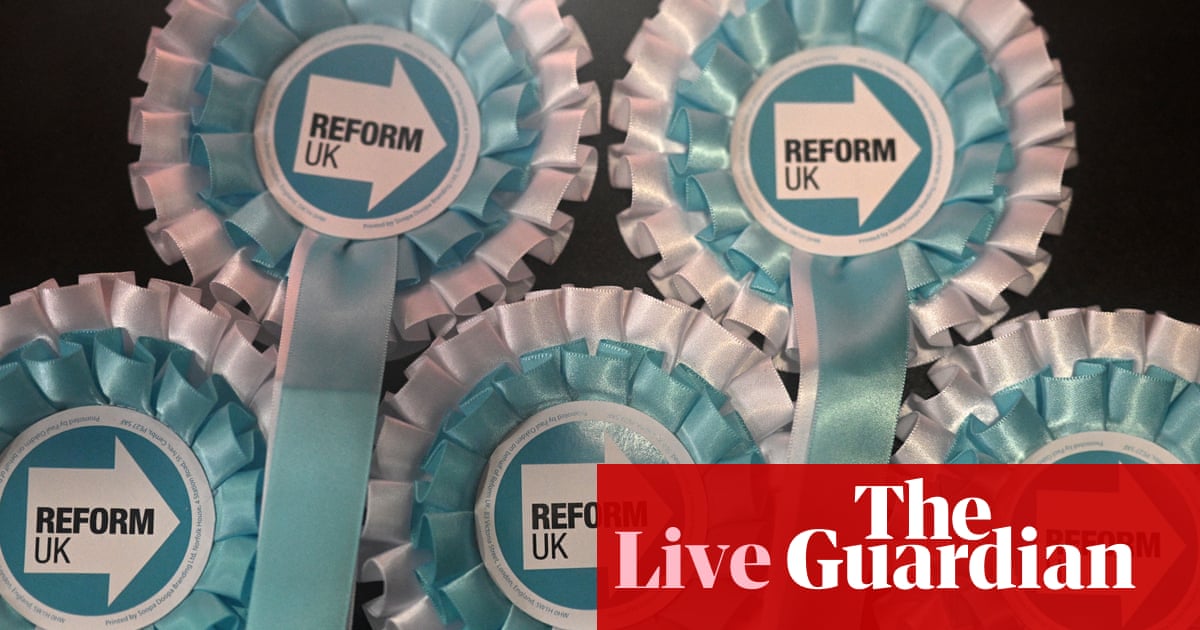
This is likely to have a particular impact on Reform UK, which has received about £12m in the last year from the Thai-based investor Christopher Harborne and other donations from a number of donors based in Monaco.
Reed says crypto donations moratorium, and cap on donations to parties from Britons living abroad, to take effect from today
Steve Reed has just told MPs that the new rules imposing a cap on donations to political parties from Britons living abroad, and a moratorium on donations in crypto, will take effect from today. The legislation to implement them will be retrospective, allowing that to happen, he said.
Steve Reed makes statement to MPs about crackdown on funding rules for political parties
Steve Reed, the local government secretary, is making his statement about the Rycroft review now.
Here is Rowena Mason’s story about the report.
And this is how it starts.
Political funding from British citizens living abroad should be capped at between £100,000 and £300,000 a year and donations in cryptocurrency temporarily banned, a government review has recommended.
The findings by Philip Rycroft, a former permanent secretary at the Home Office, will be a blow to Reform UK, which has received about £12m in the last year from the Thai-based investor Christopher Harborne and other donations from a number of donors based in Monaco.
Rycroft said the measures were needed to prevent the risk of foreign interference in British politics, saying donations from abroad are more difficult to trace and regulate. He also said there was a question of fairness when overseas donors were not subject to the same tax requirements as UK residents, recommending an annual cap at about £100,000 to £300,000.
He cited the threat of influence from hostile foreign states such as Russia, China and Iran, saying divisive internet commentary about Scottish independence had dropped by about a quarter when Iran’s internet blackout took place.
He also highlighted the risk of influence by actors from allies such as the US, where the billionaire Elon Musk has floated the idea of trying to put money into British politics.
PMQs- snap verdict
As PMQs finished Edward Leigh, the Conservative father of the Commons, stood up to complain that, in his PMQs appearances, Keir Starmer always keeps talking about the opposition party’s policies. A confident opposition party should want people to talk about its policies. Leigh’s questions, although not intended this way, amounted to a confirmation that Starmer’s points today hit home.
It was one of his strongest performances for some time. Badenoch went all-in on approving more oil and gas licences in the North Sea (motivated not least by the desire to shore up the Tory vote in the north-east of Scotland, where this is a key issue). On drilling generally, there are a lot of non-Tories who support Badenoch’s position (although quoting Tony Blair to support your case isn’t really an argument-clincher any more, particularly in the light of Blair’s decision to join Donald Trump’s Board of Peace and his call for the UK to fully support the US war in Iran). But on the narrow point of the Jackdaw/Rosebank licences, Starmer won the argument quite easily. And his broader points about Badenoch’s stance on the war, although off-topic, were compelling too.
Starmer praises the ways Muslim groups have spoken out to condemn this week’s antisemitic arson attack, just as Jewish figure spoke out to defend the Muslim mass prayer event in Traflaglar Square condemned by the Tories.
He says that sort of solidarity represents Britain – and that the comments from Nick Timothy did not represent what Britain is.
Iqbal Mohamed (Ind) asked what the government is doing to defend the independence of the interntional criminal court in the light of the accusations against its chief prosecutor, which he suggests are unfounded.
Starmer says the government supports the ICC, but does not want to get involved in its internal workings.
Iain Duncan-Smith, the former Tory leader, says we are now at war with Iran whether we like it or not. He says the government should proscribe the Islamic Republican Guard Corps.
Starmer says the IRGC is sanctioned. But he says the proscription regime is not designed for state organisations.
