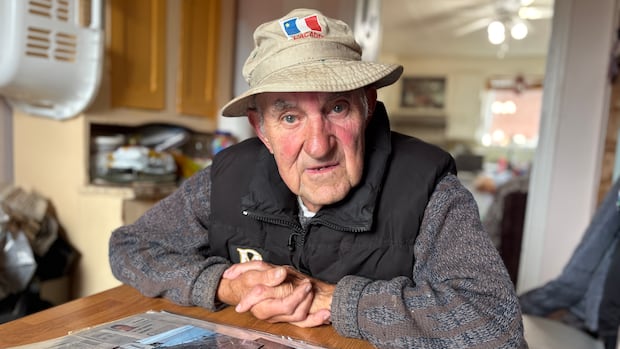
Year after year, Renald Guignard watches as more and more of his backyard slides away into the Gulf of St. Lawrence.
“It’s happening faster because the sea is rising,” said the 83-year-old Lamèque resident, seated at a small table near the back of the house. “The sea level is higher.”
Once upon a time, the gulf froze over here from November to May.
The ice absorbed most of the force of the waves during fierce late-autumn and winter storms.
“Today, there’s no ice,” Guignard said.
A tour of his shrinking backyard illustrates the impact.
The Guignards have lived in the same house since the mid 1800s. Now climate change is closing in.
He estimates that when he grew up here, the house was at least 150 metres from the shoreline. He has documentation showing 91 metres in 1968.
Today, the distance is less than seven metres — and seven metres is the amount washed away during one particularly violent storm in 2000.
The narrow space between the house and the cliff is a vivid illustration of a changing climate.
Marion Tétégan Simon, the research director at the Valores Research Institute in Shippagan, said the biggest storms in the area happen in late fall and winter.
Without the ice absorbing the pressure, “the big waves, high tide — if we have all these circumstances together, it can contribute to remove more sand along the coast,” she said.

While some shifting of sand along the coast is natural, there’s no question climate change caused by human activity has contributed to the loss of ice, she said.
The Guignard house, which dates back to about 1850 and has been home to the family for seven generations, is one of the most vulnerable on the island of Lamèque.
Valores projects that the cliff the house now sits on will be gone between now and 2050.
By the institute’s criteria, the house will be at risk in 2030.
“For someone who comes here to look at whether to live on a cliff like this, to live year-round, they won’t be convinced,” Guignard said. “It’s not liveable.”
No insurance company will insure the property, yet this year Service New Brunswick increased its assessed value by $10,000.
The couple have been paying more and more property taxes on a smaller and smaller property.
“One year, I called the government about the taxes,” he said.

“They came and they lowered my taxes by $30. The next year, they went up by $30. What can you do? I’m paying for land that’s in the water. The property is worthless, so why am I paying tax on it?”
In 2018 and 2024, it looked like the provincial government was ready to cover the cost of moving the house away from the shore, closer to the road.
“All the paperwork was in Fredericton, all the photocopies,” Guignard said.
Both times, an election led to a change in government, and he found himself back at square one trying to explain the situation.

The second time, in 2024, Shippagan-Lamèque-Miscou Liberal MLA Eric Mallet said, he had just about convinced Kris Austin, the public safety minister in the Progressive Conservative government of the day, to approve the funding.
“He told me that maybe the solution was near,” Mallet said.
“But when the election happened, somebody from the department told them it was not possible because the mitigation program was not considered [to apply to] them.”
In a written statement, the Department of Public Safety said cases of “ongoing erosion” are not eligible for its disaster financial assistance programs.
The programs “do allow for some assistance in cases in which ongoing erosion, coupled with a sudden major event like a storm or flood, creates a new threat to life or a primary residence,” the statement said.
“No current storm or flood event in this area has met the financial damage criteria to trigger a DFA program.”
Like climate change itself, the slow-motion nature of the phenomenon means there’s less urgency to act.

While the Guignard home is one of the most vulnerable properties, large parts of Lamèque’s coastline are at risk.
“We have very big challenges,” said Tétégan Simon, whose institute works with local communities to develop adaptation and mitigation projects.
The regional service commission for the Acadian Peninsula is encouraging municipalities to limit development along the coast.
“Our communities have got a lot of risks from floods and erosion, and if we want to build and continue to develop our communities, we have to change our way of thinking, to adapt,” said Benjamin Kocyla, the commission’s director of planning.
Thanks to their efforts, local populations are becoming more aware of the trends and risks, they both say.
Homes in flood-prone areas can be elevated, but for the Guignards there is not much that can be done.
“Just move us up to the road — that’s all I’m asking for,” Renald Guignard said.

If the province is worried about creating an expensive precedent, the government could adopt a threshold for funding, triggering the program only when the shore has eroded to within a set distance from a house.
“We are trying to make a program that will fit for everybody, because erosion is not a simple thing,” Mallet said.
Until then, Guignard said, he’ll continue to wait, and wonder, and watch the approaching shoreline.
One thing he doesn’t doubt is that climate change is real.
“I believe in it,” he said. “We’re living it. We’re living it.”
About the Author