About a year ago, Lennie Kaplan started filing freedom of information requests to the United Conservative Party government of Premier Danielle Smith.
Kaplan wanted to see what, if any, cost-benefit analysis Smith’s UCP was conducting in relation to the province’s potential separation from Canada.
As a former mid-level manager with the Alberta Treasury Board and Finance Ministry for about a decade, Kaplan, who left government in 2023, had conducted many analyses of the potential economic and fiscal effects of various government policies.
Based on that experience, he knew it was critical to forecast and publicize the enormous impact secession could have on the province’s economy and its people.
“I never got anything back,” said Kaplan, who received the response to his last request in May. “They kept saying they had no records.”
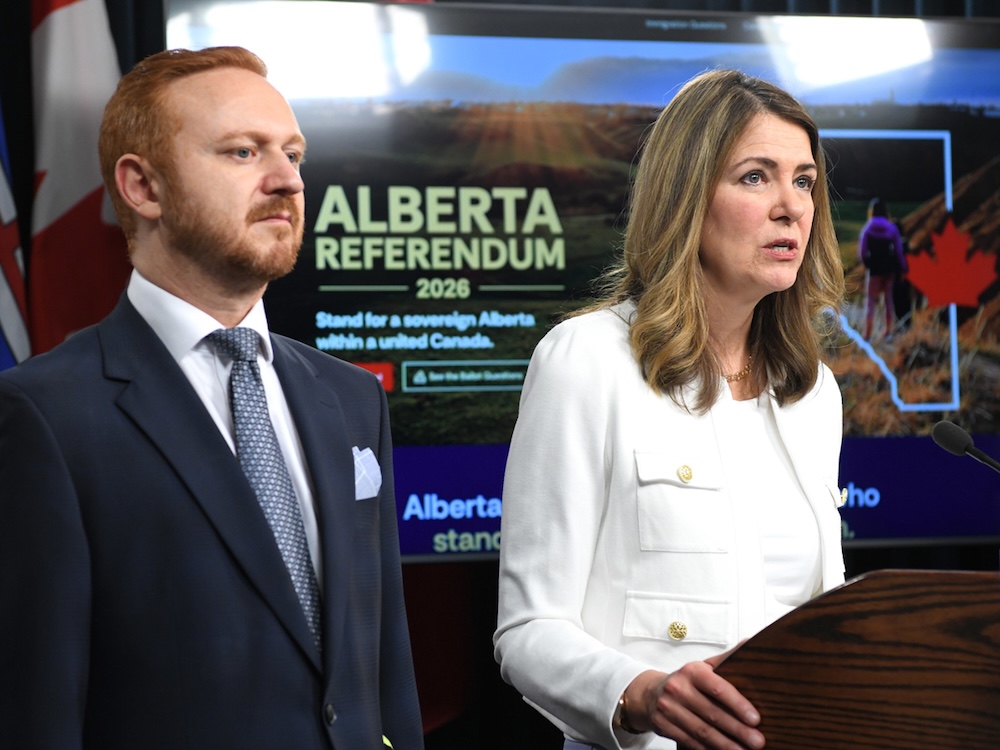
At a news conference Monday, a journalist asked Smith if the government would produce a document that detailed the costs of a potential independent Alberta. It was as if she had been waiting for the question.
Smith said there would be a document produced by August and, unprompted, she reeled off a list of the daunting costs and obligations if the province were to secede from Canada.
“As you can see, it is a pretty extensive list that has probably hundreds of billions of dollars’ worth of startup costs, and people need to understand that about what it would be to set up a fully functional national government from scratch,” she told reporters.
The about-face by Smith is whiplash inducing. While Smith has consistently maintained she supports a sovereign Alberta within Canada, for more than a year her incessant grievance rhetoric, policies and legislative agenda have promoted and normalized the ideology underpinning the province’s separatist movement.
Last July, the UCP lowered the threshold for a citizen-initiated referendum, which directly assisted a petition to force a referendum on independence organized by the pro-separatist Alberta Prosperity Project.
When a judge halted the Alberta Prosperity Project petition by ruling it violated Indigenous treaty rights, Smith circumvented the court by ordering a referendum be held on Oct. 19. A convoluted 37-word question will ask Albertans if they want to stay in Canada or hold another binding referendum on whether to start the legal process to leave.
The Opposition NDP and several columnists have skewered Smith for what they view as her politically self-interested attempt to appease a significant faction of separatists within the UCP, some of whom are threatening to depose her — as they did her predecessor, Jason Kenney.
Mount Royal University political scientist Lori Williams said Smith finally has been forced to take a side.
“Danielle Smith was trying to have it both ways: trying to keep the separatists from challenging her leadership, trying to keep them from splitting off and creating a new party and trying to stay onside with the federalists.”
“But she has finally realized that she has to take a stand,” Williams said.
Or perhaps she has realized, Williams said, that the separatist leaders who have been threatening a coup — Jeff Rath, Mitch Sylvestre, David Parker and others associated with the Alberta Prosperity Project — “are not as influential or as well organized or connected as they have claimed.”
“And so maybe she thinks she can get away with taking a stand now, as many have suggested she would have been forced to eventually,” Williams said.
Smith has also been under “tremendous pressure” from business groups, Williams said, including the powerful Calgary Chamber of Commerce, which represents major oil and gas corporations.
In a recent news release, the chamber said Calgary’s business community had consistently raised concerns about the referendum “because of the profound economic uncertainty and damage it will inflict on the province.”
“While some may dismiss separation as unlikely, the consequences associated with this process are real, immediate and must be treated with the gravity they deserve.”
The UCP is not alone in ignoring the potential consequences. The federal Parliamentary Budget Office told The Tyee it has conducted no analysis. It did not respond to a followup query about whether it intended to. The Bank of Canada said it is under a media lockdown until it releases its next rate decision on June 10.
Kaplan, who is not an economist, conducted his own preliminary analysis based on numbers previously produced by University of Calgary economist Trevor Tombe.
Tombe estimated Alberta’s economy would shrink by about four per cent, which represents about $20 billion of lost revenue or about $3,900 for every citizen.
Stressing that his figures may change as more information becomes available, Kaplan estimates Alberta separation would reduce the province’s economy by $39 billion or 7.2 per cent in the first year of Alberta independence, leading to a $6,304 contraction in Albertans’ disposable income per household.
Business investment would fall by $6.8 billion, or eight per cent lower than if Alberta had not separated, or business as usual. Retail sales would fall by $10 billion, or 8.2 per cent lower than business as usual.
About 45,000 jobs would be lost, which is about 1.7 per cent lower than business as usual.
Both Tombe and Kaplan likened Alberta’s potential situation to Brexit. Kaplan pointed to one post-Brexit analysis that found that by 2025, Brexit had reduced the United Kingdom’s per capita economy by six to eight per cent, investment by 12 to 18 per cent and employment and productivity each by three to four per cent.
In 2019, Kaplan served as executive director of the government’s MacKinnon Report on Alberta’s Finances, which reviewed the province’s finances in 2019 and provided recommendations to balance the budget. He doubts Treasury Board and Finance has the resources or expertise to produce a thorough analysis by August.
The UCP, he said, should select a panel of independent and impartial public policy and economic experts, such as Tombe and former University of Alberta dean of business Mike Percy, to develop the methodology and terms of reference — without government interference — and then hire an outside firm to conduct the analysis.
Finance Minister Jason Nixon provided an emailed response that did not address questions about whether the analysis would be conducted in-house or by an external firm, or when a report would be completed. He said more information would be forthcoming over the next few months.
Williams, the political scientist, said it is “astonishing” that neither the provincial nor the federal government prepared information to counter the misinformation pro-separatists have been circulating for months, nor have they provided information to help people understand the implications of separation.
The Alberta Prosperity Project has posted a 44-page “fully costed fiscal plan” for the “Commonwealth of Alberta” on its website. Kaplan dismissed most of it as “off the wall,” while Tombe labelled some of the claims made by the pro-separatists as “fiscal fantasy.”
A key promise of the separatists is to eliminate all provincial and federal income taxes, corporate taxes and the GST. Tombe estimated that would cut $80 billion from government revenue and create unsustainable deficits, not the surpluses promised by the separatists.
“I think there are a lot of Albertans that are looking for reliable information so they can cast an informed ballot in October,” Williams said. “This is not something that you can cobble together and be seen as credible if it isn’t done properly, and in such a way as to respond effectively to the advocates of separatism.”
Williams said it’s also important to understand that the looming referendum is not just about facts for many Albertans.
“It is essentially a fairness and disenfranchisement argument, so the counter-argument can’t just be numbers, or fearmongering. The case has to be made for the benefits of being part of Canada, and I would hope that there will be a number of people making effective arguments about that as well.”
If you have any information for this story, or information for another story, please contact Charles Rusnell in confidence via email. ![[Tyee]](https://thetyee.ca/design-article.thetyee.ca/ui/img/yellowblob.png)
About the Author