John Carney loves to play his greatest hits. It no longer feels novel to point out that the Irish filmmaker launched his career with a movie called “Once” and then proceeded to tell the exact same story for a second time on his sophomore film “Begin Again.” Now that he’s done the routine a few more times, we can’t even joke that the movie should have been called “Twice.” But charges of unoriginality will always fall on deaf ears when the movies are as enjoyable as what Carney usually puts out. Almost all of his work explores some combination of the same few themes — the transcendent way that music can connect two complete strangers, the joyful alchemy of songwriting, and the hopeful notion that new beginnings are never more than a few notes away — and he continues to demonstrate a knack for bottling that pathos into warm, crowd-pleasing musicals that offer enough substance to cut through the fluff.

Once you deliver something as perfect as “Sing Street,” you irrevocably earn the right to make as many of these musicals as you want.
The first act of his latest effort, “Power Ballad,” appears content to trod a familiar path. Rick Powers (Paul Rudd), hasn’t fully let go of his dreams of rock and roll stardom, even if the responsibilities of middle age have resigned him to singing in an Irish wedding band called The Bride and Groove. (The American fell in love with his wife Rachel, played by Carney regular Marcella Plunkett, on a European tour in his youth, and the fling soon led to them settling down in suburban Dublin to raise a daughter.) But he still can’t resist the urge to occasionally slip one of his originals into their setlist of ’80s classics, even if his bandmates keep reminding him that the job requires him to be nothing more than “a human jukebox.”
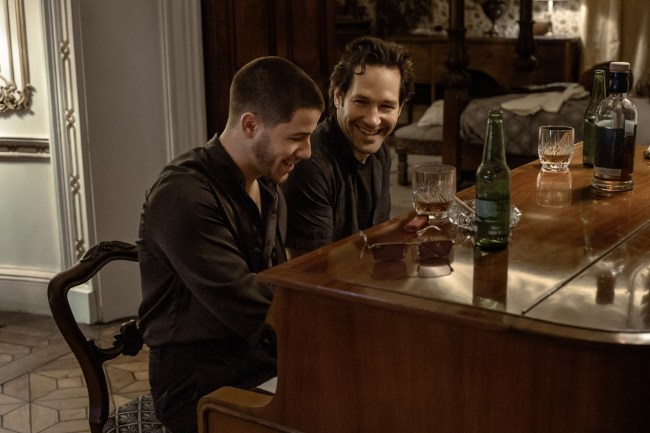
At what appears to be a run-of-the-mill wedding reception, they’re joined for a surprise sit-in by a friend of the groom. Danny (Nick Jonas), is a former boyband superstar who is struggling to launch a solo career that sticks. While Rick is reluctant to give up the spotlight and Danny clearly feels bad about the imposition, they end up duetting on a cover of Stevie Wonder’s “I Wish” that’s straight out of the Carney playbook. They have instant chemistry, with music tearing down walls that no amount of conversation ever could, and Danny admits that it’s the most fun he’s had in years. The two of them hang around after the wedding, which gives way to a late night drinking session in which they each play each other their unfinished songs. When they reluctantly have to part ways in the wee small hours, they embrace and encourage each other to keep pursuing their own artistic visions.

It’s tempting to assume you know what happens next, especially with Carney’s script dangling a potential Madison Square Garden meet-up with all the subtlety of Anton Chekhov setting a play at an NRA convention. But after spending the past two decades exploring how music can cut through the ugliness of human nature, Carney decides to give our demons a fighting chance.
It’s always disappointed me that “Begin Again” was not released under its original planned title, “Can a Song Save Your Life?,” as those six words are a perfect crystallization of Carney’s thematic interests. All of his previous films have started with that question before concluding that the answer is a resounding “yes.” But this time around, Carney asks whether a song can ruin your life. Turns out, that’s firmly within the realm of possibility too!
When Danny goes back to Los Angeles, he’s under immense pressure from his label and manager to deliver a hit. When nobody shows any interest in his originals, he passes off one of Rick’s compositions as his own work. The song quickly becomes a global sensation, giving Danny the kind of solo credibility he craved while Rick is left to watch the entire world sing along to his own lyrics without receiving an iota of credit or a penny of royalties. It’s not immediately clear whether Danny intentionally stole the song or simply misremembered its origins in a drunken haze, but his willingness to ignore Rick’s attempts to contact his manager and keep taking credit speaks volumes.
You have to suspend quite a bit of disbelief to meet the film on its own terms during all of this. Carney’s knack for human emotions is as strong as ever, but the plot has to take some ludicrously soapy turns in order to set up a phenomenally bittersweet third act. (Why wouldn’t these men so much as exchange phone numbers after their life-changing night of bromance in the recording studio? Why wouldn’t Rick even ask for a direct way of contacting his new celebrity friend?) Rick’s life starts to collapse as his obsession with the stolen song gives way to insanity, including a drunk driving incident that briefly gets him kicked out of his own family. And it must be said that Paul Rudd is a national treasure, but his charisma leaves him ill-suited to such an arc.
But even if the actual events connecting Rick and Danny are tough sells, the emotions powering both of their actions are as elegantly complex as anything Carney has written. Rather than take the easy way out, the film builds towards the mature realization that sometimes it’s OK to miss out on our material dreams if we replace them with something better along the way.

On the surface, Carney’s message has not changed a bit: he still very much believes that a song can save your life. But “Power Ballad” is filled with meta nods, like a street busker performing songs from “Once,” that suggest the filmmaker knows we’re getting used to his brand of storytelling. And as the music industry evolves and record labels now function more as vehicles for monetizing existing fanbases than true starmakers, his signature fantasy of producers and executives stumbling upon undiscovered geniuses in bars had to evolve.
“Power Ballad” ultimately manages to do just that. The film isn’t so bold as to suggest that it’s never too late to find fortune and fame in the entertainment industry. But it replaces those fantasies of overnight success with something richer, and its conviction in the power of songwriting as something that doesn’t have to be connected to record sales and stadium shows makes it a charming entry in a filmography that has never tried to be anything it’s not.
Grade: B
Lionsgate will release “Power Ballad” in limited theaters on Friday, May 29 and in wide release on Friday, June 5.
Want to stay up to date on IndieWire’s film reviews and critical thoughts? Subscribe here to our newsletter, In Review by David Ehrlich, in which our Chief Film Critic and Head Reviews Editor rounds up the best new reviews and streaming picks along with some exclusive musings — all only available to subscribers.
About the Author