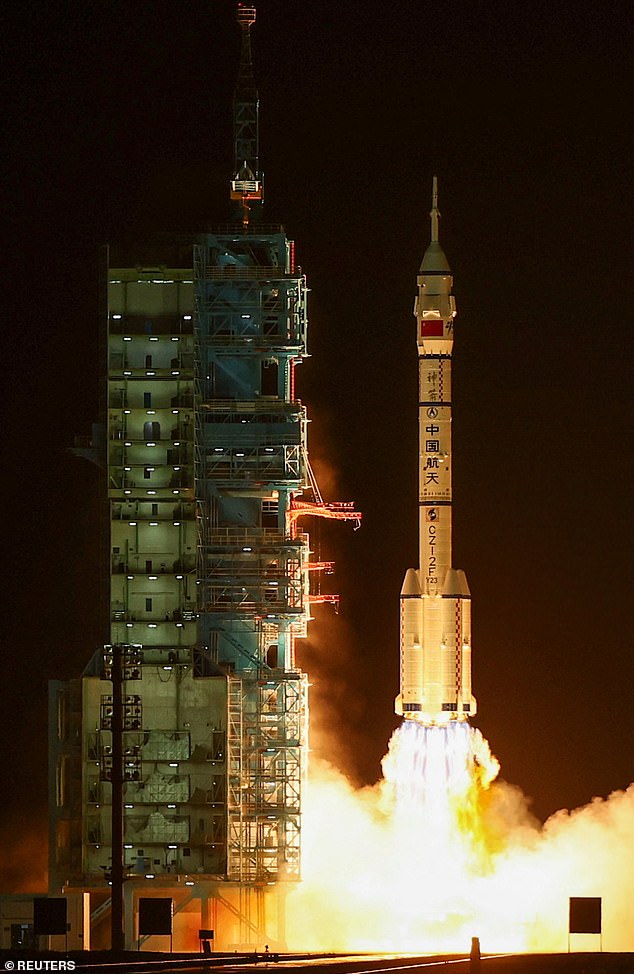
China launched a three-crew space flight on Sunday as part of a mission which hopes to see Beijing to the Moon by 2030.
A Long March 2-F rocket was scheduled to lift off at around 3pm GMT from the Jiuquan launch centre in China’s northwestern Gobi Desert, carrying three astronauts to the Tiangong space station.
The mission marked the first spaceflight ever undertaken by an astronaut from Hong Kong – 43-year-old Li Jiaying, who previously worked for the city’s police.
Other crew members include 39-year-old space engineer Zhu Yangzhu and 39-year-old Zhang Zhiyuan, a former air force pilot, who will be travelling into space for the first time.
The Shenzhou-23 crew will be joining the Shenzhou-21 crew which has stayed in the orbiting Tiangong space station for more than 200 days and is in good physical and mental condition.
The crew is set to carry out numerous scientific projects in life sciences, materials science, fluid physics and medicine. One of the crew members will stay for a year, a record length for the country.
A key experiment of Shenzhou-23 will be the full-year stay in orbit by one of the crew in order to study the effects of a long stay in microgravity.
The experiment is part of China’s preparations for future lunar missions, as well as missions to Mars.
A Long March 2F rocket carrying the Shenzhou-23 spacecraft with astronauts Zhu Yangzhu, Zhang Zhiyuan, and Lai Ka-ying, who is the first astronaut from Hong Kong, blasts off

Astronaut for the Shenzhou 23 manned mission from left Hong Kong’s Lai Ka-ying and China’s Zhu Yangzhu and Zhang Zhiyua

Astronaut Zhang Zhiyuan is reflected on a glass as astronaut Zhu Yangzhu enters a vehicle, on the day of a see-off ceremony
The astronaut selected for this one year mission will be named at a later date, depending on the progress of the Shenzhou-23 mission, a spokesperson for the Chinese space agency said on Saturday.
The main challenges will be long-term effects on humans, including bone density loss, muscle wasting, radiation exposure, sleep disturbances, behavioural and psychological fatigue, said Richard de Grijs, an astrophysicist and professor at Macquarie University in Australia.
He also underlined the importance of reliable water and air recycling systems, as well as the ability to manage potential medical emergencies far from Earth.
China is ‘steadily’ building operational experience for ‘sustained occupation’ of its Tiangong space station, and year-long missions are an important step towards future lunar and potentially deep-space ambitions, de Grijs said.
‘A year in orbit pushes both hardware and humans into a different operational regime compared with the shorter Shenzhou missions of the programme’s earlier phases,’ he said.
Crews aboard Tiangong have until now largely remained in orbit for six months before being replaced.
The Shenzhou-23 mission is part of China’s goal to land astronauts on the Moon before 2030, a race in which the United States is also competing with its Artemis programme.
China is testing the equipment required for its goal, with an orbital test flight of its new Mengzhou spacecraft set for 2026.
The Mengzhou craft will replace the ageing Shenzhou line, and will carry China’s astronauts to the Moon.
Beijing hopes to have built the first phase of a manned scientific base by 2035, known as the International Lunar Research Station (ILRS).
China also plans to welcome its first foreign astronaut, from Pakistan, aboard the Tiangong station by the end of this year.
The Asian giant has significantly expanded its space programmes over the last 30 years, injecting billions of dollars into the sector in order to catch up with the United States, Russia and Europe.
In 2019, China landed a spacecraft the Chang’e-4 probe on the far side of the Moon — a world first.

The crew is set to carry out numerous scientific projects in life sciences, materials science, fluid physics and medicine

People gathered ahead of the Shenzhou-23 spaceflight mission to China’s Tiangong space station

A Long March 2F rocket carrying the Shenzhou-23 spacecraft
Then in 2021, it landed a small rover on Mars.
China has been formally excluded from the International Space Station (ISS) since 2011, when the United States banned NASA from collaborating with Beijing, prompting the Asian giant to develop its own space station project.
It comes just a month after four NASA astronauts made their way into space as a part of the historic Artemis II moon mission.
Astronauts Reid Wiseman, Victor Glover, Christina Koch, and Canadian Space Agency (CSA) astronaut Jeremy Hansen revealed incredible details about their lives on Orion.
The team discussed how they sleep in space, the shocking twist on launch day, and the spectacular moment that made them pause amid their race to the moon.
Speaking to ABC at the time, Wiseman explained the crew had been surviving on just two short naps, joking that ‘sleeping in space is a comical thing.’
‘Christina has been sleeping heads down in the middle of the vehicle, kind of like a bat suspended from our docking tunnel,’ Wiseman said.
‘Victor has a nice little nook wedged in there. And then Jeremy has been stretched out on seat one, and I’ve been sleeping under the displays, just in case anything goes wrong,’ he added.
The team revealed that they were absolutely stunned by how smoothly launch day went. As the countdown neared to its final seconds before takeoff, the SLS rocket was fired on the first attempt.
‘We like to say that we’re prepared without having an expectation — but, in the back of your mind, you kind of hope you launch,’ Glover told Fox News.
‘And then when we got really close, it was like, “Wait, we’re getting ready to go to space?”‘
The team set off on April 1, marking humanity’s first mission to reach the moon since 1972.
This monumental journey travelled a maximum distance from Earth of 252,799 miles, crushing the Apollo 13 record by 4,144 miles.
‘We are not necessarily a crew that lives on superlatives, but this is a milestone that’s important,’ Koch said when asked how the team felt about becoming the first humans to travel this far into space.
‘We’re here to build a legacy for the future,’ she added, praising not only her crew but the entire NASA team that helped make their journey possible.
About the Author