


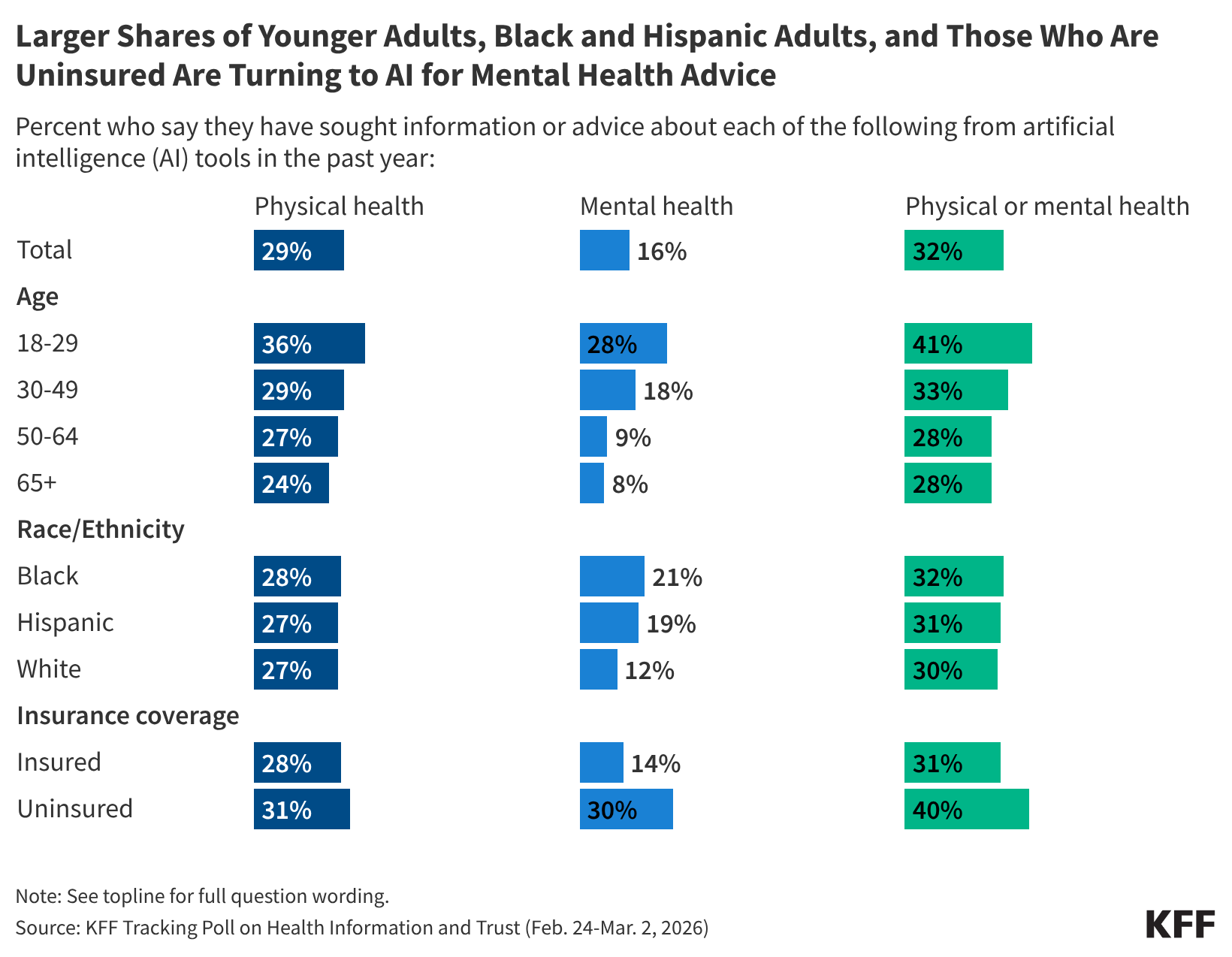
About a third (32%) of adults nationally say they have turned to artificial intelligence (AI) chatbots in the past year for health information, a new KFF Tracking Poll on Health Information and Trust finds. Most who turned to AI for health information say they were in search of quick and immediate advice, though challenges affording and accessing health care also play a role, particularly for younger adults.
The share using AI for health advice includes about 3 in 10 (29%) who have sought information related to their physical health and about 1 in 6 (16%) who have sought information related to their mental health. People are about as likely to use AI as social media to find health information.
As with AI use generally, younger adults are more likely than older adults to rely on AI for health information, particularly for mental health.
For example, adults under age 30 are about three times as likely as adults ages 50 and older to use AI for mental health information (28% vs. 8%). Uninsured adults are also more likely than those with insurance to do so (30% vs. 14%), as are Black and Hispanic adults compared to White adults.
When asked why they consulted AI for health information, about two-thirds (65%) of users say that a major reason was to get quick or immediate information or support. Substantial shares also cite wanting to look up information before deciding whether to see a provider (41%) or feeling more comfortable looking up information privately (36%).
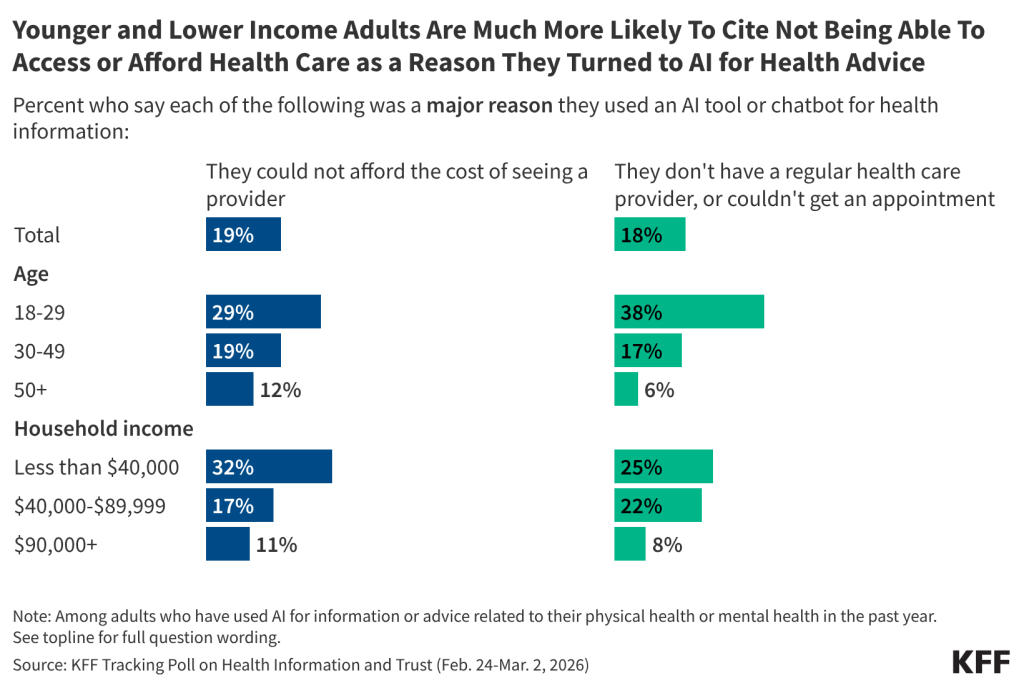
Challenges affording and accessing health care are also driving some to rely on AI, particularly for younger adults and those with lower incomes. About 1 in 5 say that not being able to afford the cost of seeing a health professional (19%) or not having a regular doctor or not being able to get an appointment (18%) was a major reason for turning to AI.
Larger shares of young users (under age 30) cite barriers to affording (29%) or accessing (38%) health care as a major reason they relied on AI for health advice. Similarly, users with low incomes (less than $40,000 annually) are more likely to cite both health care costs (32%) and access (25%) as major factors for using AI.
Many people who consult AI for health information say they did not follow up with a doctor or other health professional afterward, including most (58%) who asked about mental health, and 42% who asked about physical health. Younger adults are more likely than older adults to have used AI for health advice and then not followed up with a doctor.
Many AI Users Upload Personal Health Information Despite Privacy Concerns
Among those who use AI for health information, 41% say that they have uploaded personal medical information like test results or doctors’ notes into an AI tool or chatbot to get personalized explanations or advice related to their health. This means 13% of the public has uploaded personal medical information to an AI chatbot for this purpose.
Among the public at large, about three-quarters (77%) say that they are concerned about the privacy of personal medical information provided to AI tools, including most (65%) of those who have shared personal medical information with AI.
Designed and analyzed by public opinion researchers at KFF, this survey was conducted February 24-March 2, 2026, online and by telephone among a nationally representative sample of 1,343 U.S. adults in English and in Spanish. The margin of sampling error is plus or minus 3 percentage points for the full sample. For results based on other subgroups, the margin of sampling error may be higher.
