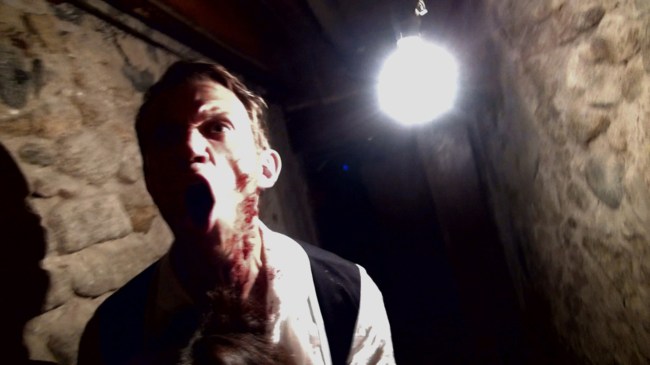
In the gold rush to find the next “Backrooms,” producers are looking anywhere and everywhere online for unconventional IP. The latest example is a new iteration of the “V/H/S” horror franchise that is inspired by yet another internet universe of writing called the SCP Foundation. The film project is set at A24 and being produced by “Undertone” teams Spooky Pictures and Image Nation.
Like “Backrooms,” SCP Foundation has a rich lore, all of it generated online, that dates back years and includes a plethora of creators who have shaped stories in countless directions. Sounds like a no-brainer way to find the next Kane Parsons, except it seems that not all online IP is created equal.

Last week, SCP Foundation’s Wiki posted a statement explaining that A24, Spooky Pictures, and Image Nation “does not and cannot have any exclusive rights to anything related to the SCP Foundation.” The writing on SCP Foundation’s Wiki is protected under a Creative Commons Attribution-ShareAlike license, which allows for derivative works, but only with permission and with the stipulation that the content be freely shared and duplicated, i.e. not exactly a commercial film that hopes to make $400 million the way “Backrooms” did.
The people behind the Wiki said they also have not heard from anyone at A24 or the two production companies, though they still hope to start a dialogue.
The producers feel this is all something of a misunderstanding. While the July 2026 Variety article announcing A24’s involvement mentioned that they have the worldwide rights, sources explained to IndieWire that’s in reference to “V/H/S,” an existing horror franchise, and they’re not claiming they own the rights to the SCP Foundation work. A “V/H/S” film would merely be inspired by the ideas and concepts of the SCP Foundation and not a direct adaptation of someone else’s work.
What’s more, no writer or director (or directors, considering it’s an omnibus “V/H/S” film) are attached as of yet, so it’s all a bit too early to say what this will look like. What’s more, adapting online IP, be it internet writing, fanfics, or open sourced things that don’t have a particular owner, is all new territory for Hollywood, so the line of what’s acceptable or not isn’t clear.
But the admins for SCP Foundation argue their writing and license doesn’t share that same level of ambiguity. Creative Commons doesn’t mean “public domain” or “free use,” and the wording of both Spooky Pictures and Image Nation announcing the project and the news of it landing at A24 suggested to them that the filmmakers had an “incomplete” understanding of their license.
“Because the original announcement and the subsequent announcement each say ‘V/H/S: SCP Foundation,’ I feel a reasonable presumption that this is not an inspired by work, this is a derivative work,” Josie Rollins, one of the site’s admins who uses the tag AriadnesThread, told IndieWire. “We also have 20 years of enforcing the license in situations that have come up, some I have actually learned about quite recently, ensuring that the works that are posted on our website are compliant with the license as well as other places on the internet that have tried to use the likeness.”
The SCP Foundation admins spend a lot of time ensuring their writers and the larger community understand why the rules of the license need to be “respected and upheld” as a means of continuing to keep the site free and protected. Understandably, they’ve been getting a lot of concerned emails from their writers about how their work will be used.

“We are all volunteers. We all have full-time jobs that have nothing to do with this. Nobody’s getting paid to do this,” Rollins said. “This is a labor of love, and so there is a degree of fish out of water as well. So opening a dialogue [with A24] is our number one priority.”
SCP Foundation imagines a world in which everyday objects are imbued with magical, paranormal properties that can cause anomalies or don’t operate the way nature intends, and if their secrets got out to the public, could cause danger or harm to society. SCP Foundation, which stands for “Secure, Contain, Protect,” is an organization that combats these anomalies and works to contain them, some of which are classified as “Keter” and are considered difficult and dangerous to contain.
There are tens of thousands of articles written on the wiki by hundreds of authors, so the canon and continuity went out the window a long time ago, but the concepts of an organization fighting to contain anomalies are consistent across all the articles.
SCP Foundation has similar creepypasta roots as the lore of Backrooms, with tons of different writers taking things in their own directions. But unlike Backrooms, SCP Foundation has always been more centralized to this one website, and every subsequent SCP Foundation work has always fallen under the guise of the Creative Commons license, something the Backrooms creepypasta never did.
In the case of the “Backrooms” film, A24’s movie was derived from the copyright of Parsons’ own YouTube channel. This film would purport to be inspired by the lore set up by SCP Foundation, potentially branding with that very name, logo, and likeness which, to the admins, makes it a derivative work.
“Just like ‘V/H/S’ couldn’t arbitrarily make, to choose some famous horror examples, ‘V/H/S: Scream’ or ‘V/H/S: Friday the 13th,’ or other popular horror properties without permission, they can’t make a ‘V/H/S: SCP’ based on our website and our works without following the requirements of our license,” said one of the site’s licensing admins who goes by Kufat.
It’s important to clarify the SCP Foundation admins aren’t the owners of the copyright; the individual writers are to their specific articles and stories. But the admins are the stewards of the license, and in terms of enforcing the Creative Commons license, they have faced instances of being able to issue DMCA takedowns of things like YouTube videos if anything violates their terms.
The misunderstanding of what the Creative Commons license is and how it operates has come up for the admins before. Over the years, they’ve had a handful of Hollywood producers approach them looking to adapt their work, only to see things fizzle once they realize what the license demands.
“We do not have the authority to set aside the license or say, OK, this studio gets an exception. We’ve been asked about that a lot in the past,” Kufat said. “The calls usually go something like this: They say, ‘Hey, we’re interested in making a movie.’ We say, ‘Have you read our license?’ They say yes. So we have the call, and then we talk a little, and then they ask, ‘Can you set aside the license?’ And we say no, and then they say, ‘OK, we’ll get back to you,’ and then we never hear from them again.”
The admins actually love the idea of an SCP Foundation movie and the chance to showcase some of the talented writers in their community. But, as mentioned in their statement, they want it to be compliant with the Creative Commons license. Per their statement, that would mean releasing the film without traditional DRM technology that would prevent it from being copied and even making it available on YouTube simultaneously alongside its theatrical release. That would be a non-starter for most film distributors.
That said, there are instances in which something like this could work. A 2019 video game called “Control” is technically inspired by the world of SCP Foundation, as it’s an action game about paranormal phenomena with a protagonist who works for the Federal Bureau of Control, or FBC. It doesn’t have the same name, terminology, or SCP Foundation logo, but the concepts are similar. The admins called this effectively an SCP story with “the serial numbers filed off,” but not one that necessarily violates any rules. If the “V/H/S” movie ended up going down this road, the admins at the wiki might not have much legal standing.

There’s also the example of “The Amazing Digital Circus: The Last Act” movie from this summer. That’s not a Creative Commons-licensed property, but it’s an internet-based story, and the film was released theatrically by Fathom Entertainment as a way of getting fans all together for a special event cinema moment before it was later released online. The film made $23.4 million domestic in just a single week.
Would fans turn out in theaters for a special event that still adhered to the Creative Commons license? Would A24 allow that? Doubtful, but it’s good food for thought.
The SCP Foundation admins have their reasons for being protective of the site’s material and the license. There aren’t many things left that can operate the way the SCP Foundation Wiki does as a free site for creative expression, and they want to keep it that way.
“It’s an exciting moment, and I think it’s a good thing for young, rising artists to be recognized, and this new avenue of art to be seen for what it is, which is art,” said an admin who goes by pr0m37h3um. “At the same time, we don’t want that to become a thing of corporations thinking they have the access to anything they want, because these things do matter. The creators do matter. And it’s important that it can’t just be swallowed up.”
About the Author