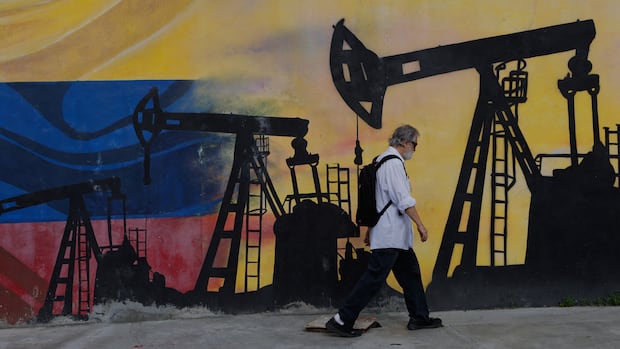
Besides a social media post from U.S. President Donald Trump, the White House has said little about what he is calling “THE BIGGEST OIL DEAL IN WORLD HISTORY” in Venezuela.
Trump said the agreement announced Friday night would give the United States a stake in Venezuela’s vast oil reserves, a step toward his goal of extracting energy from the country after American forces captured then-president Nicolás Maduro in a middle-of-the-night raid in January and brought him to New York to face federal drug-trafficking charges.
Venezuela’s acting president, Delcy Rodríguez, described the deal as a step toward economic recovery that will modernize the country’s oil industry.
But the answers to questions such as how soon the reserves could be drilled and who will pay to make it happen were not immediately clear. No text of any agreement has been released.
Here’s a look at what we know and don’t know — and how the agreement could affect Canada’s oil industry, too.
In a post on his Truth Social platform, U.S. President Donald Trump announced a deal that would allow the United States to control more than 65 billion barrels of Venezuelan oil.
What are the terms?
The U.S. government and an unnamed private operator in Venezuela formed a new private company that was given the rights to vast, untapped oil fields for 100 years.
A statement from Rodríguez said the deal involves the development of 17 fields with a proven potential of 65 billion barrels. It said the agreement could draw $100 billion US in investment into Venezuela’s oil industry and yield over $209 billion US in taxes for Caracas.
Trump said the agreement was negotiated by U.S. Secretary of State Marco Rubio, Defence Secretary Pete Hegseth and Rodríguez.
The deal gives the United States 55 per cent effective output of the new private company, including an ownership stake and rights to buy oil at cost. American purchases of the oil will go toward the U.S. strategic oil reserves along with the military, according to a U.S. official who was not authorized to discuss the matter publicly and spoke on the condition of anonymity.
The company would be the second-largest corporate holder of proven reserves after Saudi Aramco, according to the official.

Will gas prices go down?
Probably not any time soon.
Trump says the deal will help lower gas prices for Americans — an important objective for the Republican president as the Iran war slows the shipping of Persian Gulf oil and keeps prices elevated months before U.S. midterm elections in November.
But experts have repeatedly warned that Venezuela’s dilapidated oil infrastructure will take years and billions of dollars to repair. A substantial boost in production is not expected to happen quickly.
The deal could be “helpful in the long run, but it’s not going to do anything to change the price of gasoline at the retail station for Labour Day weekend,” said Amy Myers Jaffe, director of the Energy, Climate Justice and Sustainability Lab at New York University.
Neither side made clear who would pay for infrastructure investments and at what cost.
Kevin Book, managing director at ClearView Energy Partners, said Venezuela has room to build on its oil production — in the past it produced more than 2.5 million barrels a day above current levels — but this kind of investment does not come quickly.
“It doesn’t happen all at once. It’s going to take time — many years — to deploy that much capital and produce the kind of incremental results that history suggests possible,” Book said.

U.S. President Donald Trump is urging top oil executives to move quickly on developing Venezuela’s vast oil reserves. But few seem eager to jump in with both feet in the days after U.S. forces seized Venezuelan President Nicolás Maduro.
What could the deal mean for Canada’s oil industry?
While many details of the agreement remain unclear, experts said earlier this year that a revival of Venezuelan oil production would impact the Canadian oil industry.
Canada and Venezuela produce similar heavy crude, and over the past decades, Canadian oil filled a gap in the U.S. market amid shrinking Venezuelan exports.
U.S. imports of Venezuelan supplies “would compete directly with Canadian crude in the U.S. Gulf Coast market,” Marc Ercolao, an economist at TD Economics, said in January after the U.S. said Venezuela would turn over as many as 50 million barrels of oil.
The Gulf Coast accounts for about 10 per cent of Canadian oil exports to the U.S., Ercolao said.
Observers say a rapid and large-scale increase in Venezuelan oil production isn’t likely after years of under-investment, sanctions and political uncertainty.
But even a gradual recovery “would reintroduce meaningful competition into the North American heavy crude market,” said Christopher Hernandez-Roy, acting director of the Americas program at the Center for Strategic and International Studies in Washington, D.C.
Canadian heavy crude trades at a discount, or differential, relative to benchmark U.S. crude prices, Hernandez-Roy said in May. So a “meaningful increase in Venezuelan crude” could widen that differential and reduce the value Canadian producers get for every exported barrel, he said.
Over the long term, a significant scale-up of Venezuelan oil production also could strengthen Canada’s push to diversify its trading partners and become less reliant on the U.S. market, the experts said.
“China, the number one buyer of Venezuelan crude, may need to strategically reorient their import sources, further buoying the case for Canada to diversify its energy trade,” Ercolao at TD Economics said in January.

What questions remain?
The identity of the private operator, who will cover necessary investments and how America’s stake in the company breaks down all remains unclear.
The U.S. will get 55 per cent of the company’s effective output, but it was not clear what portion of that comes from the ownership stake and how much comes from the right to buy oil at cost.
It’s also unclear how the industry will react. Persuading big American oil companies to return to the region could prove a challenge given the political uncertainty and damaged infrastructure.
Chevron, the only U.S. oil company actively producing in Venezuela, declined to comment. Separately from Trump’s announcement, Chevron already had been in talks to expand investment in the country. Exxon Mobil also declined to comment.
David Oxley, chief climate and commodities economist at Capital Economics, said that on its face the deal could double U.S. oil reserves and reduce dependence on crude oil from Canada and Mexico.
But Oxley, writing in a commentary, cautioned that there are logistical hurdles and he said the value of Venezuela’s reserves may have been exaggerated under former president Hugo Chávez.
Even with legal and security guarantees, it is not clear that U.S. oil companies “would be eager to invest,” he wrote, noting that “there simply might be more enticing commercial opportunities on offer elsewhere.”
About the Author